

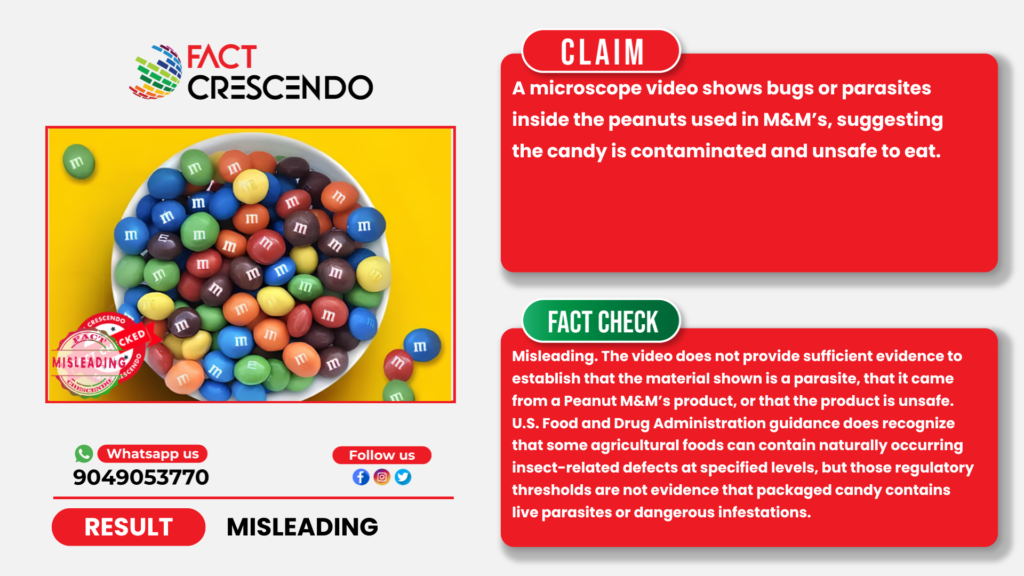
A video circulating on social media claims to show what is allegedly hidden inside peanuts used in M&M’s when viewed under a microscope. The footage is accompanied by alarming descriptions suggesting that viewers can see “bugs” or “parasites” inside the candy, with some versions implying that parents should stop giving M&M’s to children.
The claim may appear convincing because microscopic images can make ordinary food structures look unfamiliar, while the movement of an unidentified object can easily be interpreted as evidence of a living organism. The post also appears to draw on a genuine but frequently misunderstood fact about food regulation: agricultural products can contain small amounts of unavoidable insect-related material.
However, the available evidence does not establish that the video shows a parasite inside Peanut M&M’s or that the product is contaminated in the manner claimed. The claim is therefore misleading.
Social Media Posts
The viral material reviewed for this fact-check consists of microscope footage presented alongside claims that worms or parasites are present inside peanuts in M&M’s.
Fact Check
Why Live Worms or Parasites Are Unlikely in Finished M&M’s
Although peanuts can be affected by insects during cultivation, harvesting and storage, peanut processors use inspection and processing controls to remove defective or infested kernels before they enter finished products. The FDA’s guidance for peanut processing specifically notes controls against insect infestation during harvesting, shelling and storage, including inspection and other preventive measures.
Peanut M&M’s also contain roasted peanuts, meaning the raw agricultural ingredient undergoes a heat-processing step before becoming part of the finished candy. FDA food-safety guidance identifies roasting as the key processing step used to reduce pathogens such as Salmonella in peanut products.
The FDA also has specific procedures for examining finished candy for contamination. Inspectors examine packaging and the candy itself for signs such as insect damage, cast skins, webbing, excrement and live insects, and may cut the product open or conduct laboratory analysis when necessary.
This does not mean contamination is impossible. Insects can occasionally infest food before or after processing, which is why regulators have specific inspection methods and defect thresholds. However, these controls make the claim that ordinary, commercially packaged M&M’s contain visible live worms or parasites highly unsupported without product-specific laboratory evidence.
FDA Does Recognize Insect-Related Defects in Some Foods
The viral claim appears to draw on a real aspect of food regulation, but it presents that information without the necessary context. The U.S. Food and Drug Administration maintains a Food Defect Levels Handbook covering “natural or unavoidable defects” in foods. The FDA explains that these action levels are based on defects that, at the specified levels, do not present an inherent health hazard. The agency also explicitly warns that these figures are not targets or averages representing what food normally contains. In fact, FDA states that actual defect levels are generally much lower and that products harmful to consumers remain subject to regulatory action regardless of whether they exceed a listed defect level.
The FDA says these thresholds exist partly because it is economically impractical to produce agricultural commodities that are completely free of every naturally occurring and unavoidable defect. The agency also states that poor manufacturing practices can result in enforcement action independently of the action level.
Therefore, the existence of an FDA defect level does not mean manufacturers are permitted to deliberately add insects to food, nor does it mean consumers should expect to find insects in every package.
Similar Microscope Videos Have Been Found Misleading
Previous Fact Crescendo investigations into similar videos claiming to show mites on Pringles and Cheetos found that the footage did not establish that the organisms originated from the food. The videos lacked controlled sampling and independent identification, leaving open the possibility that organisms were introduced during handling or filming.
These cases do not prove that the M&M’s video was manipulated. However, they illustrate why microscopic footage alone cannot establish food contamination. Without evidence linking the sample to the original product and independently confirming the identity and origin of the organisms, the footage cannot prove that Peanut M&M’s contain live worms or parasites.
A separate TikTok video by @oneminmicro tested the claim by opening Peanut M&M’s and examining the peanuts, reporting no visible maggots or insects. The creator also demonstrated how an insect could be manually inserted into an M&M, showing how similar footage could be staged. This demonstration does not prove that the original viral video was fabricated, but it further illustrates why the provenance and handling of the sample matter.
Conclusion
The claim that a viral microscope video proves Peanut M&M’s contain parasites is Misleading. While agricultural products like peanuts can naturally contain minor insect-related defects, the FDA’s defect action levels do not imply that consumer candy is infested with parasites. The existence of these regulatory thresholds for raw commodities is not evidence that finished, processed candy contains live organisms.
The viral video lacks any verifiable laboratory identification or product provenance to prove the imagery originated from Peanut M&M’s. Without documented evidence of contamination or controlled sampling, the unidentified microscopic material cannot be classified as a parasite or a safety hazard. Consumers should rely on confirmed food safety reports rather than unverified social media footage.
Title: No Evidence Viral Microscope Video Shows Parasites Inside Peanut M&M’s
Fact Check By: Cielito Wang
Result: Misleading
