

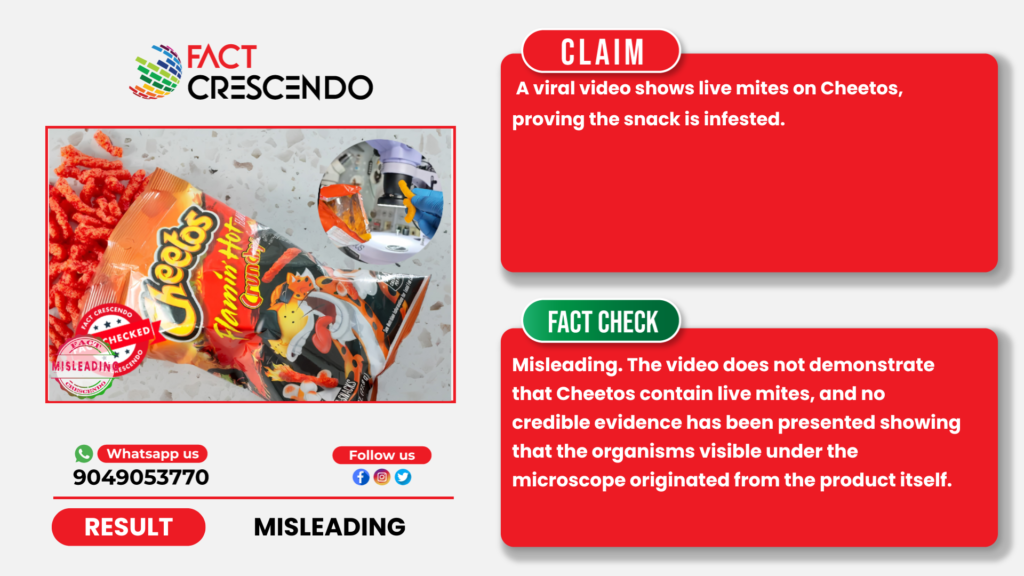
A viral video circulating on social media platforms claims to show a Cheetos snack examined under a microscope, revealing what appear to be tiny mites crawling across the surface of the product. The footage has been widely shared as evidence that Cheetos and other processed snack foods contain live insects or mites invisible to the naked eye.
The claim has attracted significant attention because it appears to expose a hidden food-safety issue. However, a review of the available evidence, previous fact-checks of similar microscope-food videos, food manufacturing standards, and scientific information about mites suggests that the video does not provide reliable evidence that Cheetos contain live mites. Instead, the claim is misleading.
Social Media Posts
The viral video, originally posted by a microscope-content creator on TikTok, shows a Cheetos cheese puff under magnification. As the camera zooms in, tiny moving specks become visible, leading viewers to conclude that the snack is infested with mites.
Fact Check
Analysis of Methodology
The viral video lacks the scientific rigor and procedural safeguards necessary to substantiate claims of food contamination. Standard investigative protocols, such as documenting the opening of a sealed package, ensuring sterile handling, and verifying the cleanliness of the microscope equipment, are not evident in the footage. Without these controls, it is impossible to determine whether the observed organisms originated from the snack or from external factors like environmental exposure or contaminated equipment.
Furthermore, the video fails to provide a verifiable chain of custody or any form of independent authentication from microbiologists, entomologists, or food safety authorities. Consequently, the footage does not serve as credible evidence of a live infestation within the product, as the organisms could have been introduced through handling or deliberate placement during the filming process.
The account that posted the video is part of a broader trend of microscope-content channels that regularly publish highly magnified footage of foods and other everyday objects. Similar videos from comparable channels have repeatedly been investigated by fact-checkers and found to lack evidence that the organisms shown originated from the products themselves.
Similar Microscope Food Videos Have Been Repeatedly Debunked
The Cheetos video closely resembles numerous viral microscope-food videos that have previously been investigated by independent fact-checkers.
Fact Crescendo also fact-checked the video allegedly showing bugs or mites inside Pringles chips. And we found that the videos failed to demonstrate that the organisms came from the food products being shown.
Several analyses also noted signs of staging, contamination after opening, or deliberate manipulation. In some cases, creators of comparable microscope-content videos later acknowledged that their videos were created for entertainment rather than scientific demonstration.
The recurring pattern is significant. The same style of content repeatedly appears online, generates strong emotional reactions, and is later shown to lack evidence that the organisms originated from the food being examined.
The video also does not include any species identification, laboratory analysis, or expert assessment confirming that the moving particles are mites. Without controlled examination of the original sample, it is not possible to determine whether the organisms shown are mites, other microscopic organisms, environmental contaminants, or artifacts introduced during handling or filming. As a result, the footage cannot establish either the identity or origin of the organisms observed.
Food Mites Thrive in Specific Storage Conditions
Food mites are real pests, but they typically occur under specific environmental conditions rather than inside newly manufactured snack foods.
According to Colonial Pest Control, food mites commonly infest foods stored for long periods in humid, mold-prone environments. They are frequently found in grains, flour, pet food, bird seed, and other products exposed to moisture or poor storage conditions.
Research published in the journal Veterinary Sciences found that storage mites such as Tyrophagus putrescentiae thrive in protein- and fat-rich foods under favorable environmental conditions, particularly where humidity is high and storage conditions allow populations to grow. The study found that mite populations can grow under favorable storage conditions, particularly when humidity and food composition support their development.
These findings are relevant because the viral video provides no information about the history of the sample. Viewers are not shown whether the Cheetos were freshly opened, exposed to humid conditions, left out for extended periods, or otherwise handled before filming. Therefore, even if the organisms shown were mites, the video would not establish that they originated from the product during manufacturing.
Food Safety Controls Make Such a Scenario Highly Unlikely
The claim is also inconsistent with the food-safety controls required in modern food manufacturing.
Cheetos are manufactured by PepsiCo, which states that its products are produced under a global food-safety and quality-management system that includes risk assessments, supplier verification, sanitation programs, traceability systems, and quality-assurance monitoring throughout production and distribution. PepsiCo states that food safety and product quality are integrated across its supply chain and manufacturing operations.
In addition, food manufacturers operating in the United States must comply with FDA Current Good Manufacturing Practice regulations. Under 21 CFR §117.35, facilities are required to take effective measures to exclude pests from manufacturing, processing, packing, and storage areas, and pests must not be allowed in food plants.
The FDA’s Food Safety Modernization Act (FSMA) also requires manufacturers to identify foreseeable hazards and implement preventive controls designed to minimize contamination risks before products reach consumers.
While no food-manufacturing system can guarantee absolute zero contamination, a visible population of live mites inside a factory-sealed retail packet would be highly inconsistent with the food-safety controls expected in modern snack-food manufacturing. The viral video provides no evidence that such a situation occurred.
Why Cheetos Are Not an Ideal Environment for Mites
The nature of the product itself also makes the claim less plausible. Cheetos are manufactured through high-temperature cooking and extrusion processes before being coated with seasoning and sealed in moisture-resistant packaging. Food and storage mites generally require favorable environmental conditions, including sufficient humidity and suitable food sources, to survive and reproduce. Research on storage mites such as Tyrophagus putrescentiae indicates that mite populations grow under specific storage conditions, particularly when environmental factors support their development.
Pest-management experts likewise note that food mites are most commonly associated with long-stored products exposed to moisture, mold, or poor storage conditions. Consequently, a freshly manufactured, low-moisture snack product inside an intact retail package would not typically represent the type of environment where active mite populations are expected to thrive. (Sources: MDPI, Colonial Pest, University of Minnesota)
Processed Foods May Contain Trace Defects, But That Is Different From Live Infestations
The video also blurs an important distinction between unavoidable microscopic defects and live infestations.
The U.S. Food and Drug Administration’s Food Defect Levels Handbook explains that small amounts of natural and unavoidable defects, including insect fragments, may occur in foods during harvesting and processing. These limits exist because complete elimination of all microscopic defects is not technically possible at industrial scale, and the permitted levels are considered safe for consumers.
However, trace insect fragments are not the same as living mites actively crawling across a product. The existence of FDA defect levels does not support claims that sealed snack foods routinely contain live infestations.
Conclusion
The claim that a viral microscope video proves Cheetos contain live mites is misleading. The footage does not establish that the organisms shown originated from the snack itself, and it lacks the controls necessary to verify contamination. Similar microscope-food videos involving instant noodles, hot dogs, Oreos, and Pringles have repeatedly been debunked or found to be misleading.The video does not establish the origin of the organisms shown. Without controlled sampling, independent verification, and evidence that the sample came directly from a sealed package, the footage cannot demonstrate that Cheetos contain live mites.
Although trace insect fragments can occur naturally in processed foods under regulatory limits, there is no credible evidence that the viral video demonstrates live mites inside commercially packaged Cheetos. Current food-safety regulations, manufacturing standards, and the biology of food mites make such a claim highly unlikely without independent verification.

Title: Fact Check: Does a Viral Video Prove Cheetos Contain Live Mites?
Fact Check By: Cielito Wang
Result: Misleading
