

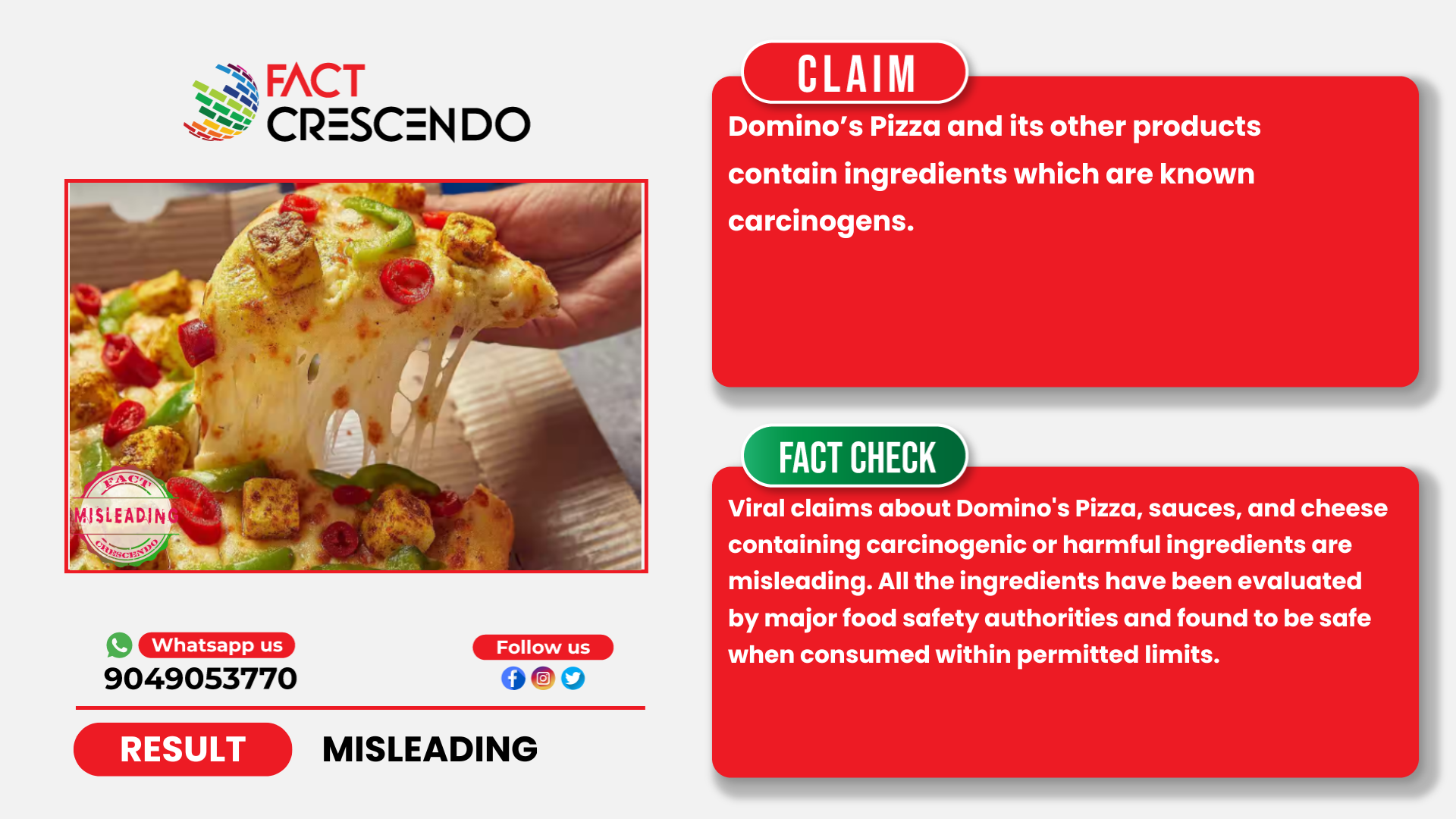
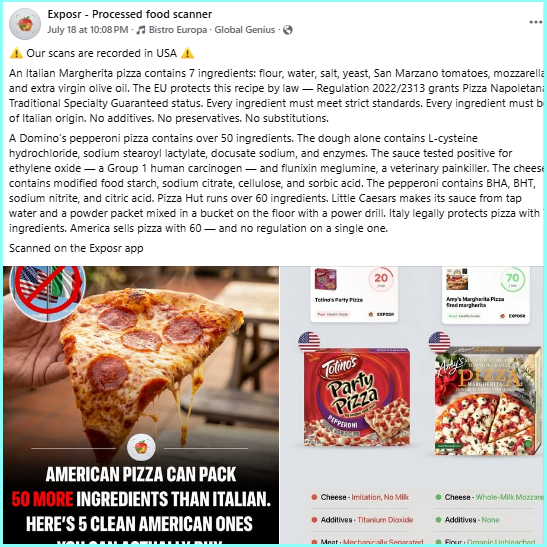
Social media posts have claimed that Domino’s Pizza and some of its ingredients, including its sauces and cheese, contain carcinogenic or harmful substances that make the products unsafe for consumption. The claim suggests that the products contain ingredients like L-cysteine hydrochloride, Sodium Stearoyl Lactylate, Ethylene Oxide, Sodium Citrate, Sorbic Acid, etc, which have been found to cause serious health issues.
However, Fact Crescendo found the claim to be misleading. All the ingredients in Domino’s pizza base, sauce, and cheese are approved and safe.
Fact Check—
Let’s check the facts of the ingredients mentioned in the post.
L-cysteine hydrochloride: According to a report, L-cysteine hydrochloride (L-CH) is used in bread and other products to improve the quality and preserve them by stopping the growth of fungus, especially Aspergillus flavus, which can contaminate foods by creating Aflatoxin B1 (AFB1), a highly toxic and cancer-causing substance.
The FDA had approved the use of this additive as a dough strengthener, flavor enhancer, flavoring agent or adjuvant, flour-treating agent, and nutrient supplement.
Sodium Stearoyl Lactylate: The European Food Safety Authority (EFSA) reviewed the safety of sodium stearoyl lactylate, which is commonly used as emulsifiers and stabilizers in products like bread, baked goods, and some dairy foods. EFSA found that these additives have low toxicity, do not damage DNA, and are broken down into stearic acid and lactic acid, which are naturally found in foods and are easily processed by the body. EFSA established an Acceptable Daily Intake (ADI) of 22 mg per kilogram of body weight per day.
Ethylene Oxide: Domino’s does not contain ethylene oxide as an ingredient. This rumor started a few years back when a batch of Domino’s pizza sauce was intercepted by Taiwan Food and Drug Administration. The sauce was being imported from the US. A residue of 1.3mg/kg of ethylene oxide was found in that batch only.
After this incident, Dominos suspended the use of the affected sauce and replaced it with locally produced sauce. The incident was limited to that shipment and does not mean all Domino’s sauces worldwide contain ethylene oxide.
Sodium Citrate: Sodium citrate is commonly used as an acidity regulator, buffer, emulsifier, and preservative in foods and beverages. The National Institute of Health stated that this additive has been evaluated by the food safety authorities and is considered safe. After consumption, sodium citrate breaks down into citrate, which is well metabolised and does not accumulate in the body as a toxic substance. However, very large amounts of sodium citrate can cause temporary gastrointestinal discomfort or affect electrolyte balance in people with severe kidney disorder. But the amount of this additive in food and beverages is quite low and falls under the safe zone.
Sorbic Acid: The European Food Safety Authority (EFSA) reviewed the safety of sorbic acid and its salts like potassium sorbate and calcium sorbate, which are commonly used as food preservatives in the EU. These additives were already approved under EU law, and an acceptable daily intake (ADI) of 25 mg per kg of body weight per day was set. Studies showed that potassium sorbate is easily absorbed by the body and mostly broken down into carbon dioxide after digestion. Animal studies did not show harmful effects even at very high doses. No evidence suggesting that potassium sorbate damages DNA was found.
Pepperoni contains-
BHT: As per FDA report, BHT (butylated hydroxytoluene) is approved for use as a food preservative to prevent oxidation and extend shelf life, provided it meets a purity level of at least 99%. It can be used alone or combined with BHA. For the safety of the consumers, its concentration has been limited to specific levels in different food products, such as 50 ppm in dry breakfast cereals and potato flakes, 10 ppm in potato granules, and up to 200 ppm in emulsion stabilizers for shortenings. FDA has ordered strict guidelines such as labels for products containing BHT must clearly state its presence, and if mixed with a carrier, the percentage must also be disclosed to ensure safety and transparency.
BHT has been extensively studied for its metabolism and toxicology. It is recognized as an effective antioxidant. According to reports, it may have vitamin E-like effects in fatty tissues and reduce certain tumour incidences in animal studies. At low dietary levels no toxic effects are observed. However, higher doses can lead to increased liver weight and elevated microsomal enzyme activity, which is generally reversible and not considered toxic at standard usage levels. But the possibility of BHT affecting other tissues (like the lungs or gastrointestinal lining) requires further investigation. No immediate public health hazards have been identified so far.
Sodium Nitrite: Various researches have also found that sodium nitrite can be highly lethal if consumed in large amounts. It converts normal hemoglobin in the blood into methemoglobin, which cannot carry oxygen. This causes severe oxygen shortage in the body (hypoxia), leading to symptoms such as dizziness, blue skin, breathing difficulty, low blood pressure, organ failure, and possibly death.
According to the study, the estimated lethal dose for humans is around 2.6 grams, although deaths have occurred even with 1 gram.
Food-grade sodium nitrite is used to cure meat, as it helps in preventing the growth of dangerous bacteria, Clostridium botulinum and keeps meat pink in color. However, the amount allowed in food is extremely small and closely regulated. The European regulations approved a maximum of 150 mg per kilogram of meat products, which is considered safe for normal consumption. The Acceptable Daily Intake (ADI) value established for sodium nitrite is around 0.4 mg per kilogram of body weight, which is considered as low level.
According to EFSA, the Panel on Food Additives and Nutrient Sources (ANS) reviewed the safety of potassium nitrite (E 249) and sodium nitrite (E 250), which are used as food additives. They found that these nitrites are not likely to cause genetic damage or cancer based on animal studies. The main health concern was an increase in methaemoglobin levels (which affects how blood carries oxygen), so they set a safe intake level (ADI) at 0.07 mg per kilogram of body weight per day. This additive has been reviewed by food safety authorities like EFSA, JECFA, and SCF.
The FDA had also approved the use of sodium nitrite as an antimicrobial agent, antioxidant, color or coloring adjunct, flavor enhancer, etc.
Citric Acid: Citric acid is a naturally occurring compound found in plants and animals. It appears as a colorless crystal or white powder. It can be obtained from natural sources like lemon or pineapple juice or produced through fermentation using specific fungi such as Candida or Aspergillus niger. The citric acid used in food must meet the quality and purity standards set by the Food Chemicals Codex. It is approved for use in food without any restrictions if prepared under good manufacturing practices guidelines.
Citric acid (E330) is also listed under approved additives by Food Safety Standards in the UK.
Conclusion:
Fact Crescendo found that the viral claims about Domino’s Pizza, sauces, and cheese containing carcinogenic or harmful ingredients are misleading. All the ingredients have been evaluated by major food safety authorities and found to be safe when consumed within permitted limits.
Title: Are Domino’s Pizza, Sauces, and Cheese Harmful and Contains Carcinogenic Ingredients?
Fact Check By: Siddharth Sahu
Result: Misleading
