

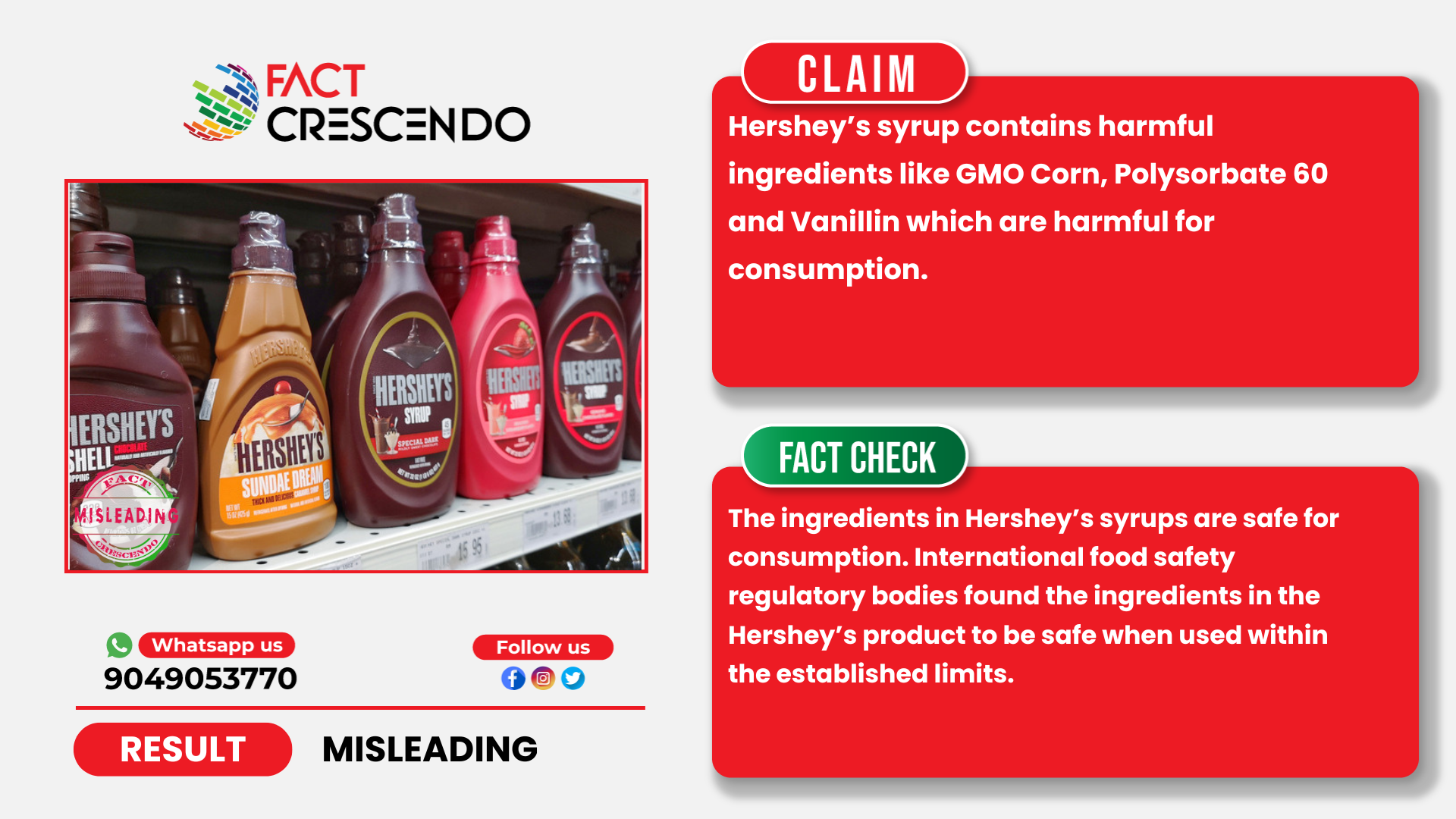
Social media posts have recently raised a concern that Hershey’s syrup contains harmful ingredients such as GMO corn, vanillin, and polysorbate 60. The claim suggests that these substances pose health risks and should be avoided.
However, Fact Crescendo found the claim to be misleading. The ingredients mentioned in the viral video are used in many food products for various purposes. All these ingredients have been evaluated and approved for use in food.
Fact Check-
Genetically Modified Corn: The European Food Safety Authority (EFSA) reviewed a request from Bayer CropScience to allow the import and use of genetically modified (GM) corn MON 95275 in food and animal feed in the European Union. EFSA’s scientists examined how the corn was modified, the proteins it produces to protect against insects, and its overall safety. They found that the genetic changes are stable, the insect-resistant traits work as intended, and the proteins are not toxic or likely to cause allergies. Field tests showed that MON 95275 grows and performs like regular corn, with no significant differences in nutrition or composition. The experts also concluded that it would not harm the environment if accidentally released and that no extra monitoring is needed after approval. Overall, EFSA found that MON 95275 is as safe as traditional corn for people, animals, and the environment.
According to the FDA, most of the corn grown in the USA is GMO. GMO corn is created to resist insect pests or tolerate herbicides. Bacillus thuringiensis (Bt) corn is a GMO corn that produces proteins that are toxic to certain insect pests but not to humans, pets, livestock, or other animals. These are the same types of proteins that organic farmers use to control insect pests, and they do not harm beneficial insects, such as ladybugs. GMO Bt corn reduces the need for spraying insecticides while still preventing insect damage. While a lot of GMO corn goes into processed foods and drinks, most of it is used to feed livestock, like cows, and poultry, like chickens.
Polysorbate 60: According to the Code of Federal Regulation’s report, Polysorbate 60 is made by combining stearic and palmitic acids with sorbitol and polyoxyethylene. It helps mix ingredients like oil and water and is used in various food products. It is approved for safe use in certain foods. The regulatory body has set limits on the use of Polysorbate 60 in different foods. For example, in cakes and cake mixes, it cannot be more than 0.46% of the dry weight. In icings and fillings, the total amount should not exceed 1% when mixed with similar emulsifiers. These rules ensure Polysorbate 60 is used safely in food.
The FDA has also approved the use of Polysorbate 60 as a food additive and categorised it as Generally Recognized as Safe (GRAS).
Vanillin: Vanillin is the main chemical responsible for the characteristic vanilla flavor and aroma. It is widely used as a flavoring in foods such as chocolates, cakes, ice cream, and beverages. It is found in vanilla beans, but the ones used in food products are mostly produced industrially.
According to an article, vanillin is obtained naturally from vanilla plants or can be manufactured synthetically. Extracting vanillin from vanilla plants has its limitations because the plant grows in specific geographical locations and the process of pollinating vanilla flowers requires manual effort and a lot of labor. Hence, it is manufactured synthetically using materials such as industrial pulp waste liquid or petrochemicals.
During animal studies, it was found that high doses of vanillin can be harmful and may cause eye irritation, muscle weakness, breathing difficulty, and circulatory failure. Extremely high doses also showed a risk of cancer when vanillin is injected in the body.
But, the Joint FAO/WHO Expert Committee on Food Additives (JECFA) recommended an acceptable daily intake of vanillin up to 10 mg per kilogram of body weight. It was also found that inhaling small amounts of this substance for a short time did not cause harm.
According to the National Institute of Health, during animal studies it was found that the lethal dose of vanillin in mice and rats are 4333 mg/kg and 4730 mg/kg, respectively. This means that a very high dose of vanillin is needed to cause serious toxicity. Studies in rats showed that even a dose of 300 mg/kg of the substance did not produce harmful effects on the kidneys, liver, or blood cells. Because of lack of toxicity in animal studies, researchers consider it to be a non-toxic compound which can be used in foods and for pharmaceutical purposes.
According to the U.S. Food and Drug Administration, Vanillin is used in foods mainly as a flavoring agent to give a vanilla taste and aroma. It is listed in the FDA inventory of substances added to food. This means it is recognized and permitted for use in food products when used according to the regulations.
Conclusion:
Fact Crescendo found the claim to be misleading. The ingredients in Hershey’s syrups are safe for consumption. International food safety regulatory bodies found the ingredients in the Hershey’s product to be safe when used within the established limits.
Title: Hershey’s Syrup’s Ingredients Are Approved and Safe for Consumption
Fact Check By: Siddharth Sahu
Result: Misleading
