

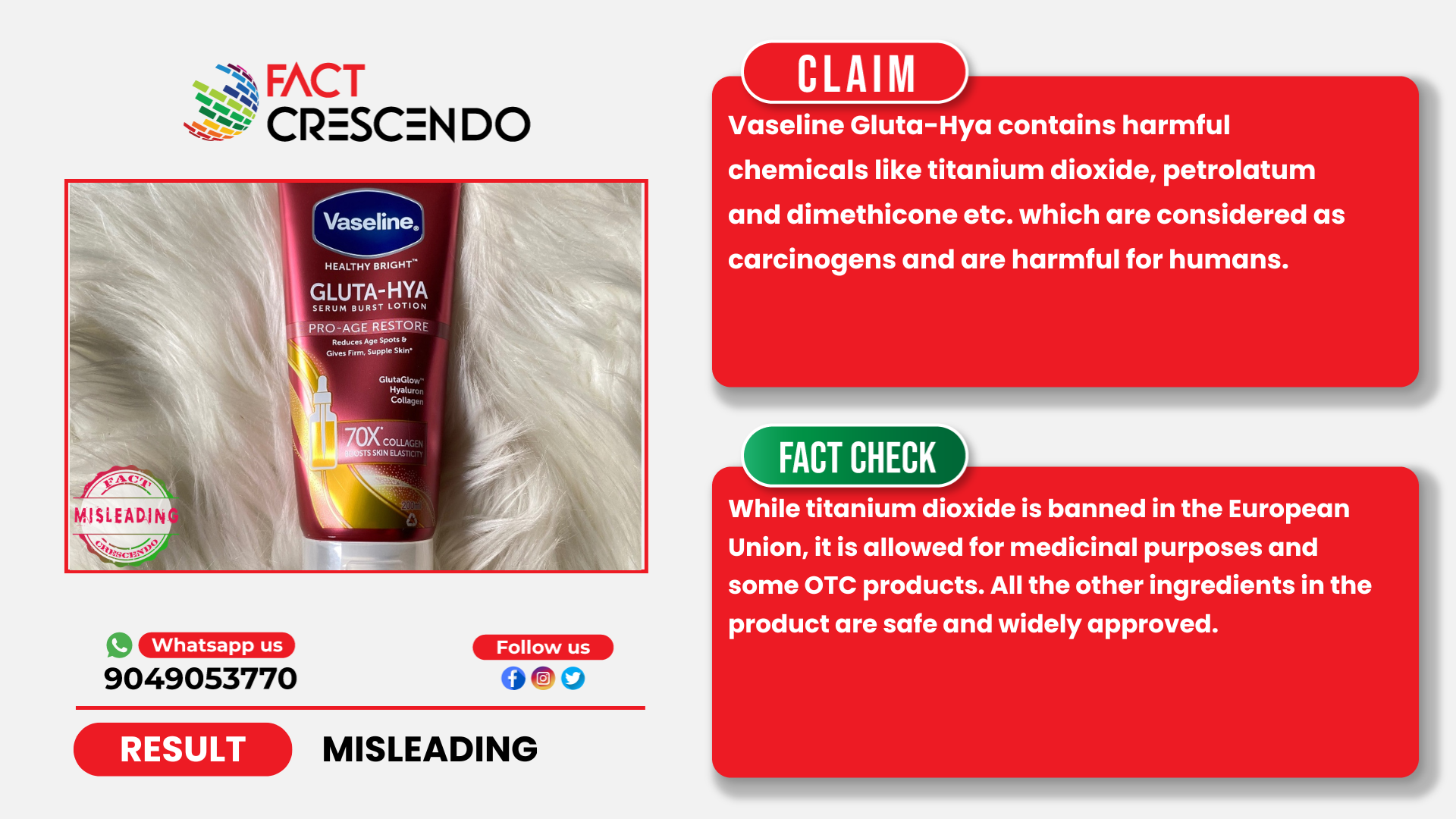
Social media posts were found to claim that Vaseline Gluta-Hya contains harmful and carcinogenic chemicals, specifically citing ingredients such as titanium dioxide, petrolatum, dimethicone, etc., and therefore poses a health risk to consumers. In the video, when the product was scanned using an app, it received a poor score.
However, Fact Crescendo found the claim to be misleading. All the ingredients of Vaseline Gluta-Hya, mentioned in the viral video, are approved and considered safe.
Fact Check—
Let’s check the safety of the ingredients mentioned in the post.
Petrolatum: As per an article, there is misinformation circulating on the internet about the petrolatum used in cosmetic and personal care products. The claims state that there is a risk of contamination from polycyclic aromatic hydrocarbons (PAHs), a cancer-causing chemical found in crude oil and its byproducts. The petrolatum used in cosmetics and personal care products is highly refined and meets very strict safety standards.
The FDA allows petrolatum to be used in certain foods and food-contact materials. It also approves petrolatum as an active ingredient in some over-the-counter medicines, including skin protectants, eye products, and anorectal products. In the European Union, petrolatum used in cosmetics must be properly refined, and its refining history must show that it does not come from a carcinogenic source. Health Canada also considers highly refined, pharmaceutical- or cosmetic-grade petrolatum suitable for cosmetics and medicines. It also reported that no unacceptable contamination, including PAHs, has been reported in petrolatum used in Canadian products.
According to another article, Petrolatum (petroleum jelly) is a widely used skincare product, especially for moisturizing and protecting the skin. It helps moisturize the skin by forming a protective barrier that reduces water loss. It was found that there is no evidence available to support the claim that petrolatum causes acne or is unsafe around oxygen. When properly manufactured, petrolatum is found to be a safe ingredient in skincare and dermatology.
Titanium Dioxide: Titanium dioxide is currently approved for use in medicines in many countries, including the United States and the European Union, primarily as a colorant and opacifying agent in tablets, capsules, etc. The FDA allows for the safe use of it as a color additive in foods according to the specifications and conditions, including that the quantity of titanium does not exceed 1% by weight of the food, as stated in FDA regulations. The FDA has reviewed scientific data and found no safety concerns when titanium dioxide is used within the approved limits.
According to the National Institute of Health, the nano form of Titanium Dioxide is used in sunscreen and other products. It protects the skin from UV rays and works against sunburn and skin cancer.
There were concerns that these nanoparticles of titanium dioxide might enter the body through the skin, but the studies had shown that these particles stay on the outer skin layer and don’t reach the bloodstream. The SCCS found that it doesn’t cause allergies, serious irritation, cancer, or reproductive harm when used on the skin at levels up to 25%. However, it should not be used in sprays or powders that can be inhaled.
The European Food Safety Authority (EFSA) reviewed scientific evidence and found that titanium dioxide (TiO₂) particles may cause genotoxicity (damage to DNA). Due to this concern, EFSA no longer considers titanium dioxide (E171) safe as a food additive and cannot establish a safe daily intake. However, this evaluation applies only to its use in food and not to other applications.
On 24 November 2023, World Health Organization (WHO) and the Food and Agriculture Organization (FAO) Joint Expert Committee on Food Additives (JECFA) released an assessment of the health impacts of titanium dioxide. According to the report, TiO₂ is poorly absorbed in the gastrointestinal tract. JECFA found no evidence of carcinogenic, reproductive, or developmental toxicity effects from long-term exposure to TiO₂.
Dimethicone: It is used in many products like cosmetics, moisturizers and creams, shampoo, hairstyling products, etc. Some people believe that dimethicone is not safe, as it is not natural. However, the amount of dimethicone in face and hair products is generally considered safe. In a 2019 review, the Cosmetic Ingredient Review Expert Panel found that most over-the-counter products contain less than 15 percent dimethicone.
According to the National Institute of Health, dimethicone is a stable substance and does not break down to other chemicals under various circumstances. It does not interfere with the skin’s ability to breath and does not appear to affect the immune system. Overall, the evidence indicated that dimethicone is safe for use in dermatological and cosmetic products.
Conclusion:
Fact Crescendo found the claim to be misleading. While titanium dioxide is banned in the European Union, it is allowed for medicinal purposes and some OTC products. All the other ingredients in the product are safe and widely approved.
Title: Vaseline Gluta-Hya is a safe product. The viral claim is based on misleading reports.
Fact Check By: Siddharth Sahu
Result: Misleading
