

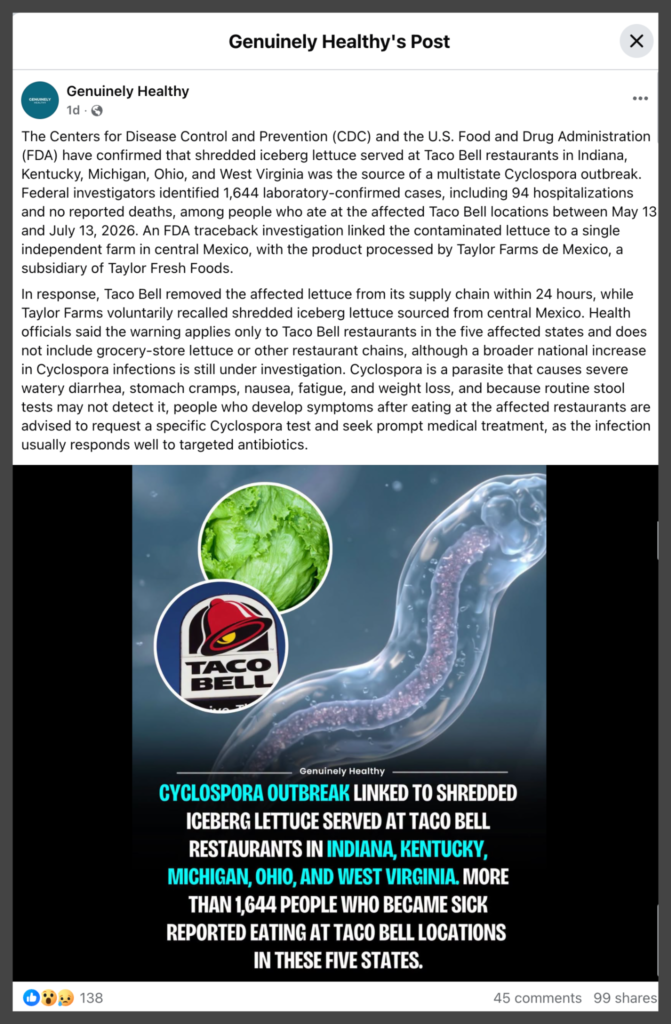
A claim circulating across social media states that the U.S. Centers for Disease Control and Prevention (CDC) and the U.S. Food and Drug Administration (FDA) have confirmed that shredded iceberg lettuce served at Taco Bell restaurants in Indiana, Kentucky, Michigan, Ohio, and West Virginia was the source of a multistate Cyclospora outbreak. While CDC and FDA have publicly linked the outbreak to shredded iceberg lettuce served at Taco Bell restaurants in the affected states, the agencies continue to describe the investigation as ongoing. Therefore, the claim is Missing Context.
Social Media Posts
The viral claim states that the CDC and FDA have “confirmed” shredded iceberg lettuce served at Taco Bell restaurants in Indiana, Kentucky, Michigan, Ohio, and West Virginia as the source of the Cyclospora outbreak.
Fact Check
What CDC and FDA Actually Announced
The CDC’s outbreak advisory states that the outbreak is linked to shredded iceberg lettuce served at Taco Bell locations in Indiana, Kentucky, Michigan, Ohio, and West Virginia. The agency advises consumers not to eat shredded iceberg lettuce served at those Taco Bell restaurants and notes that illnesses included in this investigation are a subset of nationwide Cyclospora cases.
Similarly, the FDA announced that, working with CDC and state partners, it was investigating a multistate outbreak linked to shredded iceberg lettuce served at Taco Bell locations in the five affected states.
The FDA reported that traceback investigations identified convergence on a single supplier, Taylor Farms de Mexico, which supplied shredded iceberg lettuce to Taco Bell restaurants where infected people had eaten before becoming ill.
Together, the CDC’s epidemiological findings and the FDA’s traceback investigation identified shredded iceberg lettuce served at Taco Bell restaurants in the five affected states as the likely vehicle associated with the outbreak.
According to the CDC investigation update of July 16, 2026, epidemiologic and traceback data show that shredded iceberg lettuce served at some Taco Bell locations is contaminated with Cyclospora and is making people sick. CDC reported 1,644 laboratory-confirmed illnesses among people who reported eating at Taco Bell in the five states, with 94 hospitalizations and no deaths, and illness onset dates ranging from May 13 to July 13, 2026. Not all Taco Bell locations in those states received lettuce from the implicated supplier.
Why Saying the Source Was “Confirmed” Can Be Misleading
Although the agencies identified a strong association between the outbreak and shredded iceberg lettuce, they did not characterize the investigation as complete.
The FDA repeatedly states throughout its outbreak page that: “FDA’s investigation is ongoing.” The agency also notes that: “Additional implicated brands, restaurants, retailers, or distribution channels may be identified as the investigation continues.”
This wording reflects standard foodborne outbreak investigations, where agencies may identify the most likely source before every scientific question has been resolved.
Although the FDA’s traceback investigation identified a single supplier of shredded iceberg lettuce served at Taco Bell restaurants, the agency continued to state that the investigation was ongoing and that additional brands, retailers, restaurants, or distribution channels could still be identified. Consequently, describing the source as permanently or conclusively “confirmed” overstates the certainty reflected in the agencies’ own language.
FDA Later Determined One Positive Lettuce Sample Was a False Positive
The investigation became more complicated after the FDA issued an update on July 19.
On July 18, the FDA announced that a sample of shredded iceberg lettuce supplied by Taylor Farms de Mexico had tested positive for Cyclospora during targeted surveillance conducted as part of the outbreak investigation. The agency said it was working with Taylor Farms to determine whether any of the implicated product remained in commerce or consumers’ homes. (Source)
However, on July 19, the FDA said its laboratory experts had re-reviewed the sample results and concluded that the earlier finding “does not represent true amplification and should be considered a false positive.” The agency removed the positive sample information from its previous update and stated that as of July 19, 2026, “there are no confirmed positive sample results for product testing for Cyclospora.”
Importantly, the FDA did not say the outbreak had been ruled out or that the epidemiological link to shredded iceberg lettuce had been disproven. Instead, the agency said it continues working with Taylor Farms to ensure product implicated in this outbreak has been removed from the market, while FDA and state partners continue collecting and analyzing product samples as the investigation remains ongoing. (Source)
The retracted result was a product sample, not a patient sample. The illnesses in this outbreak were confirmed by laboratory testing of patients, not of lettuce, so withdrawing the product-sample result does not reduce the number of confirmed infections.
What Does “False Positive” Mean?
A false positive does not mean the outbreak itself never occurred. Rather, it means that a laboratory result initially appeared to detect Cyclospora but, after expert review, did not meet the scientific standard required to be considered a true positive finding.
FDA guidance generally defines a false positive as a test result indicating the presence of an analyte or organism when it is not actually confirmed to be present.
In outbreak investigations, laboratory testing represents only one component of the overall investigation. Investigators also evaluate: epidemiological evidence, patient interviews, food exposure histories, traceback investigations, distribution records, environmental assessments.
Therefore, rejecting one laboratory result does not automatically invalidate epidemiological evidence pointing toward a likely source.
FDA explains that outbreak investigations frequently rely on multiple lines of evidence and may continue even when laboratory confirmation is unavailable or inconclusive.
Why the Agencies Still Linked the Outbreak to Taco Bell Lettuce
Although laboratory confirmation became less certain, epidemiological evidence remained strong. According to the FDA, investigators interviewed affected individuals and found that ingredient-level analysis identified shredded iceberg lettuce as the common exposure.
Among 190 of the cases who reported eating at Taco Bell whose meal ingredients were analyzed, 90% reported consuming iceberg lettuce before becoming ill.
Michigan’s own reported burden was far higher: the state reported 5,002 patients and 102 hospitalizations on July 17, against a typical baseline of roughly 40 to 50 confirmed cases for an entire year (Food Safety News).
FDA traceback investigators also found that multiple Taco Bell restaurants associated with illnesses received shredded iceberg lettuce from the same supplier. This combination of epidemiological analysis and traceback evidence formed the basis for the public health advisory even though laboratory confirmation remained incomplete.
Taco Bell’s Response
Taco Bell said it acted voluntarily after discussions with public health officials. The company stated that it removed “potentially impacted lettuce” supplied to restaurants in the affected states and later removed the ingredient from its supply chain nationwide “out of an abundance of caution.” The company said the action was intended to protect customers while federal investigators continued examining the outbreak. (Source)
Taylor Farms’ Response
Following its identification by FDA traceback investigators as the common supplier, Taylor Farms de Mexico voluntarily withdrew all iceberg lettuce sourced from central Mexico from the U.S. market. Taylor Farms said no Taylor Farms branded salad kits contain iceberg lettuce and described the affected production as less than one percent of the U.S. iceberg lettuce supply (a company estimate). However, that statement addresses only the company’s own consumer brand: the recall notice FDA posted on July 18 also covers retail bagged product sold under the Marketside label at Walmart, including 12 oz and 24 oz Iceberg Salad and 8 oz and 16 oz Shredded Lettuce, with best-if-used-by dates through August 3, 2026.
Although the illness cluster under investigation is confined to Taco Bell customers in five states, the recall itself is considerably broader. According to the company announcement posted by FDA on July 18, 2026, shredded iceberg product was distributed between June 29 and July 16 to food-service customers in 27 states, including Sysco, and at retail under the Marketside brand sold at Walmart. Because the product carries best-if-used-by dates as late as August 3, 2026, some of it may still be in consumers’ homes.
After the FDA later announced that the initial positive laboratory result was a false positive, Taylor Farms issued a statement noting that the agency confirmed no positive product tests for Cyclospora existed at that time. Consequently, the company clarified that its recall had been conducted out of an abundance of caution while the federal investigation remained ongoing.
Why Foodborne Outbreak Investigations Can Continue Without a Positive Food Sample
Foodborne outbreak investigations do not rely on a single positive food sample. Instead, investigators evaluate multiple lines of evidence, including epidemiological data, traceback investigations, laboratory testing, and environmental assessments.
As the FDA explains, outbreak investigations often continue as new evidence becomes available, and public health recommendations may be updated throughout the investigation. Therefore, a false-positive laboratory result does not necessarily invalidate the broader epidemiological and traceback evidence linking a food item to an outbreak.
Although the FDA withdrew the laboratory finding, it did not withdraw its traceback conclusions. The agency continued to advise consumers to avoid shredded iceberg lettuce served at Taco Bell locations in the five affected states and said it was continuing to work with Taylor Farms to remove product implicated in the outbreak while the investigation remained active.
Conclusion
The claim is Missing Context. CDC and FDA have publicly linked the multistate Cyclospora outbreak to shredded iceberg lettuce served at Taco Bell restaurants in Indiana, Kentucky, Michigan, Ohio, and West Virginia using epidemiological investigations and traceback analysis. However, both agencies continue to describe the investigation as ongoing rather than fully concluded.
Moreover, the FDA later announced that an initially reported positive lettuce sample should be considered a false positive and stated that, as of its latest update, there were no confirmed positive product tests for Cyclospora. This does not negate the epidemiological and traceback evidence linking the outbreak to shredded iceberg lettuce served at Taco Bell restaurants.
Readers who may have recalled product should check the lot codes and best-if-used-by dates in FDA’s recall notice and discard or return it rather than washing it, since washing does not reliably remove Cyclospora. Anyone with watery diarrhea lasting more than a few days after eating iceberg lettuce in the previous two weeks should contact a healthcare provider and mention Cyclospora specifically. This fact check reflects information available as of July 20, 2026.

Title: CDC and FDA Linked Taco Bell Lettuce to Cyclospora Outbreak, but “Confirmed” Source Claim Lacks Important Context
Fact Check By: Cielito Wang
Result: Missing Context
