

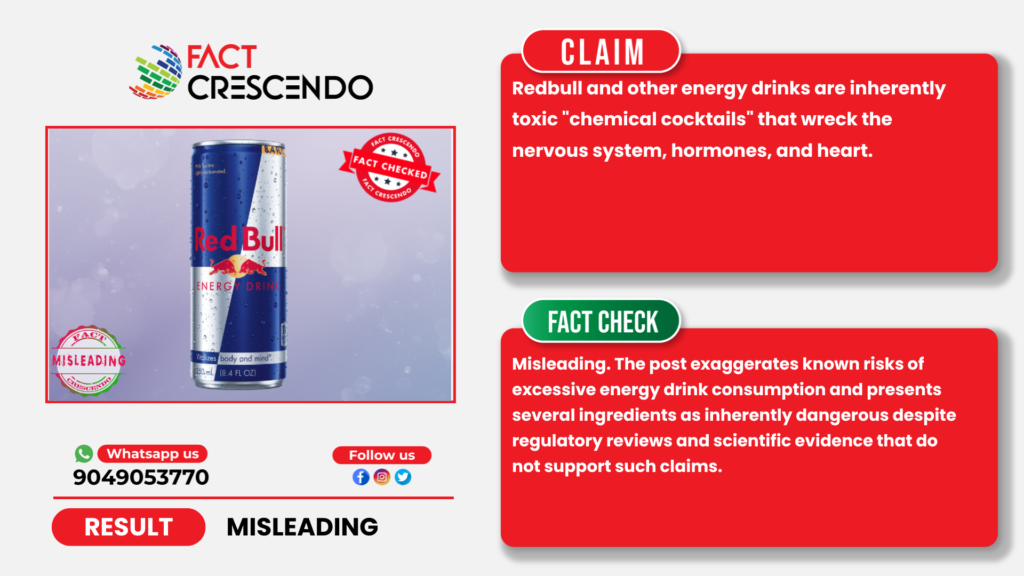
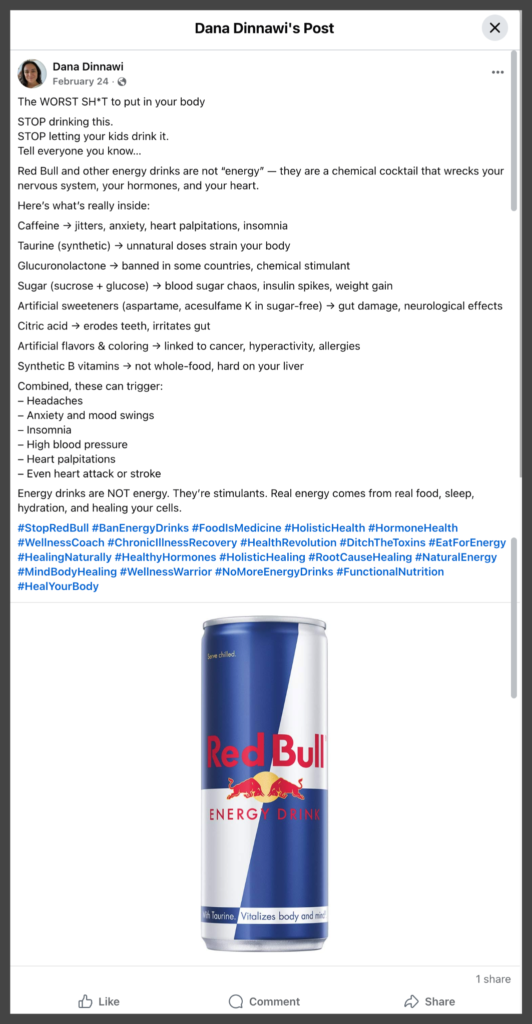
Claims portraying energy drinks as inherently toxic and harmful to the body frequently appear in online health discussions and social media content. The post lists ingredients such as caffeine, taurine, glucuronolactone, sugar, artificial sweeteners, citric acid, food colorings, and B vitamins, claiming they collectively lead to anxiety, insomnia, heart attacks, strokes, and long-term bodily damage.
However, while there are legitimate concerns regarding excessive consumption, the viral claim presents a much more extreme picture than current scientific evidence supports. Our investigation found the claim to be misleading.
Social Media Posts
The post states that energy drinks are “not energy” but stimulants that “wreck your nervous system, hormones, and heart.” It attributes a range of health problems to individual ingredients commonly found in products such as Red Bull, Monster, and other energy beverages. The post further claims that taurine is dangerous because it is synthetic, glucuronolactone is banned in some countries, artificial sweeteners cause neurological damage, and synthetic vitamins place stress on the liver.
Fact Check
Energy Drinks Are Not Risk-Free, But Neither Are They Universally Harmful
The claim begins with a genuine public health concern: excessive caffeine intake can produce unpleasant and sometimes dangerous side effects. According to the U.S. National Center for Complementary and Integrative Health (NCCIH), consuming large amounts of caffeine may cause anxiety, insomnia, jitteriness, digestive problems, increased blood pressure, and heart rhythm disturbances, particularly among people who are caffeine-sensitive or who consume very high doses.
The NCCIH also notes that energy drinks may pose particular concerns for children, adolescents, individuals with cardiovascular disease, and people who combine energy drinks with alcohol or intense physical activity.
However, this is not equivalent to saying that energy drinks automatically “wreck” the nervous system, hormones, or heart in everyone who consumes them. The health risks associated with caffeine are highly dependent on dosage, individual sensitivity, age, medical history, and frequency of consumption rather than the mere presence of caffeine itself.
Taurine Is Not a Dangerous Synthetic Chemical
The viral post characterizes taurine as an unnatural additive that may strain the body at high doses. This claim is not supported by current scientific consensus or regulatory safety assessments.
Taurine is a naturally occurring amino acid-like compound found in meat, fish, dairy products, and in the human body itself, where it plays roles in energy metabolism, bile salt formation, and regulation of fluids and minerals. The fact that taurine in beverages is produced synthetically does not make it biologically different from naturally occurring taurine.
Regulatory authorities have repeatedly reviewed taurine safety in energy drinks. The European Food Safety Authority concluded that exposure to taurine through normal energy drink consumption does not pose a safety concern. Similarly, the U.S. Food and Drug Administration has reviewed taurine as a Generally Recognized As Safe (GRAS) ingredient under approved uses.
Some researchers continue to study potential interactions between taurine and caffeine at very high intake levels, but current evidence does not support claims that taurine itself is inherently harmful or toxic at levels commonly found in commercial energy drinks.
Claims That Glucuronolactone Is “Banned” Lack Evidence
The post characterizes glucuronolactone as a “chemical stimulant” and claims it has been banned in certain countries.
However, glucuronolactone is a naturally occurring compound produced in small amounts by human metabolism and found in connective tissue. It is commonly included in energy drinks alongside caffeine and taurine. (Source)
The European Food Safety Authority specifically evaluated glucuronolactone in energy drinks and concluded that intake levels from normal consumption were not considered a safety concern. We found no evidence that glucuronolactone is broadly banned in any major jurisdiction, despite this claim frequently appearing in viral posts and online discussions. The claim appears to stem from long-running internet rumors that have circulated for years without citation to any specific regulatory ban.
Sugar and Artificial Sweeteners Present Different Health Questions
The claim that sugar-containing energy drinks can contribute to blood sugar spikes, excess calorie intake, and weight gain is largely accurate. Frequent consumption of sugar-sweetened beverages has been linked to obesity, insulin resistance, and metabolic disease.
However, the post then implies that sugar-free versions are equally harmful because they contain artificial sweeteners such as aspartame and acesulfame potassium.
The evidence here is considerably more nuanced. Some observational studies have found associations between high artificial sweetener intake and cardiovascular disease. For example, a large French cohort study published in The BMJ found correlations between certain sweeteners and cardiovascular outcomes.
However, observational studies cannot prove causation. Researchers themselves caution that these findings should not be interpreted as evidence that artificial sweeteners directly cause heart disease or neurological damage. The science remains actively debated, and current regulatory agencies continue to consider approved sweeteners safe within established intake limits. (Source)
In 2023, the International Agency for Research on Cancer (IARC) classified aspartame as “possibly carcinogenic to humans” (Group 2B), but the WHO and food safety regulators maintained that current acceptable daily intake levels remain unchanged.
In other words, the evidence may justify moderation and further study, but not the certainty implied by the viral claim.
Citric Acid, Food Coloring, and B Vitamins Are Not Automatically Dangerous
The viral post also frames citric acid, food colorings, flavorings, and synthetic B vitamins as evidence that energy drinks are toxic.
Citric acid is widely used in beverages to improve flavor and shelf stability. While acidic drinks can contribute to dental enamel erosion over time, this is not unique to energy drinks and applies to many soft drinks, juices, and sports beverages.
Similarly, food additives and approved colorings undergo safety evaluations by food regulators before entering the market. Claims that these ingredients are generally “linked to cancer” or routinely cause allergies and hyperactivity are unsupported without specifying the compound, dose, exposure level, and underlying evidence.
The same applies to B vitamins. The body uses vitamins regardless of whether they originate from food sources or industrial production. Toxicity depends on dose rather than whether the vitamin is “natural” or “synthetic.”
Toxicologists frequently warn that presenting long lists of scientific-sounding ingredients without context is a common fear-based communication tactic because it encourages readers to assume danger simply because the names sound unfamiliar. (Source: Red Bull, PMC)
The Language of the Post Relies More on Fear Than Science
Expressions such as “chemical cocktail,” “wreck your nervous system,” and “heal your cells” sound alarming but have little scientific meaning.
Everything we consume, including water, fruits, and vegetables, is composed of chemicals. Describing a product as a “chemical cocktail” is therefore a rhetorical device rather than a scientific assessment.
Likewise, while it is technically correct that energy drinks are stimulant beverages because caffeine is their primary active ingredient, saying they are “not energy” is more of a slogan than a scientific correction.
The post also blurs the distinction between short-term stimulant effects and permanent organ damage. A temporary increase in heart rate after consuming caffeine is not equivalent to long-term cardiovascular disease, and an occasional episode of insomnia does not mean the nervous system has been damaged.
Researchers reviewing energy drinks consistently conclude that the greatest risks occur with excessive consumption, particularly among young people, individuals with underlying health conditions, and those combining energy drinks with alcohol or strenuous exercise.
See more detail here, here, and here.
Conclusion
The claim that Red Bull and other energy drinks are merely a “chemical cocktail” that automatically destroys the nervous system, hormones, and heart is misleading.
Scientific evidence supports concerns about excessive caffeine intake and high consumption of energy drinks, particularly among children, adolescents, people with cardiovascular conditions, and those consuming multiple drinks in a short period. However, many of the viral post’s ingredient-specific warnings are exaggerated, unsupported, or stripped of important context about dosage and risk.
The post combines legitimate concerns about caffeine overconsumption with unsupported ingredient alarms and emotionally charged language to create a one-size-fits-all warning that goes beyond what current evidence supports.
Energy drinks are not health foods, but current evidence does not support portraying them as universally toxic substances either.

Title: Does Red Bull “Wreck” Your Body? Experts Say the Evidence Is More Nuanced
Fact Check By: Cielito Wang
Result: Misleading
