
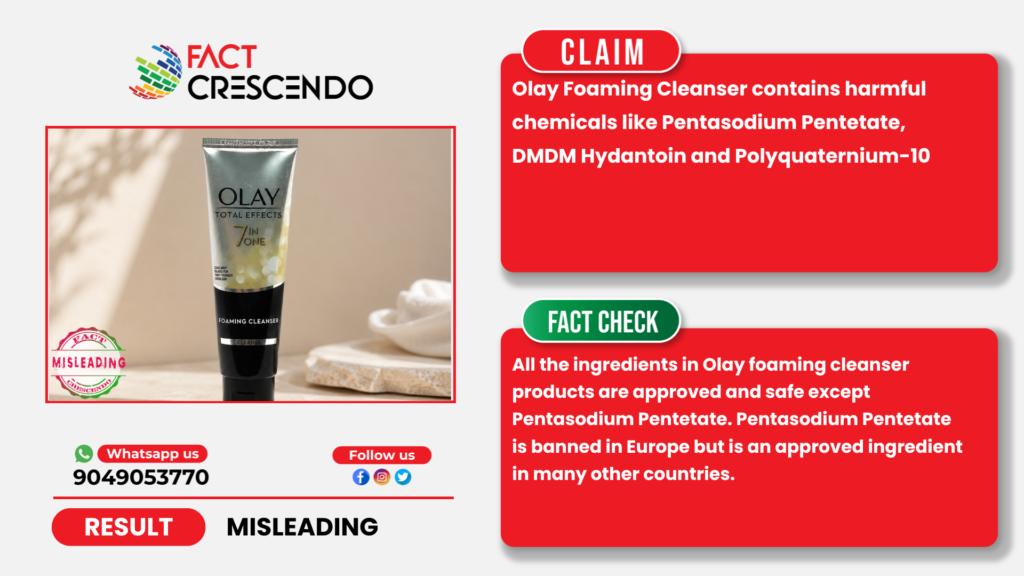
Social media posts have claimed that Olay Foaming Cleanser contains harmful chemicals like Pentasodium Pentetate, DMDM Hydantoin and Polyquaternium-10. These chemicals make the product unsafe for use.
However, Fact Crescendo found the claim to be misleading. Except Pentasodium Pentetate all the other ingredients are safe and approved. Pentasodium Pentetate is also an approved ingredient but has been banned by the European Union since December 2023.
Fact Check-
Let’s check the safety of the three major ingredients mentioned in the viral video.
Pentasodium Pentetate:
Pentasodium Pentetate is used in cosmetics and personal care products as chelating agents. This means it is used to remove calcium and magnesium cations, which reduces the foaming and cleansing performance of the product. It is usually found at concentrations between 0.1% to 1% in various products.
According to the National Institute of Health, the safety studies showed that Pentasodium Pentetate has low toxicity. No significant harmful effects were observed when it is used in normal levels during the animal studies. It does not irritate the skin, but slight irritation can happen when it is used repeatedly on damaged skin. It does not cause allergies or damage genes. Studies also suggested that it is unlikely to penetrate skin.
However, Pentasodium Pentetate has been banned by the European Union from 1 December 2023. The union had classified it as CMR, meaning it was classified as carcinogenic, mutagenic or toxic for reproduction. The regulation does not state that cosmetics containing Pentasodium Pentetate have been proven to harm consumers under normal conditions of use. Instead, the ingredient was prohibited because it falls under the EU’s rules for substances classified as CMR and no exception was granted.
DMDM Hydantoin:
DMDM Hydantoin is a white, odorless preservative, commonly appearing in shampoos, conditioners, styling products, moisturizers, and foundation makeup. It prevents the growth of mold and other fungi, yeast and harmful bacterias.
It has been a matter of concern because it releases small amounts of formaldehyde. This chemical helps prevent your products from going bad, but at high doses, it may have the potential to cause cancer in humans.
According to another article, DMDM Hydantoin releases small amounts of formaldehyde throughout the shelf-life of a personal care product or cosmetic product. According to the Personal Care Products Council, preservatives such as DMDM hydantoin that “slowly release small, safe amounts of formaldehyde over time” help prevent harmful mold and bacteria. A recent safety assessment published in the International Journal of Toxicology reaffirmed that formaldehyde can be used safely in cosmetics if established safety limits are not exceeded.
The Cosmetic Ingredient Review (CIR) also has evaluated the scientific data and concluded that DMDM hydantoin is safe as a cosmetic ingredient at current levels of use – 0.074 percent, or less. In 2005, the CIR Expert Panel considered available new data on DMDM hydantoin and reaffirmed its safety conclusion.
Polyquaternium-10:
Polyquaternium-10 is a conditioning ingredient commonly used in personal care and cosmetic products such as shampoos, conditioners, body washes, facial cleansers, and hair styling products. It is a modified form of cellulose (a natural substance found in plants) that carries a positive charge. This allows it to stick to hair and skin.
According to the Cosmetic Ingredient Review (CIR) report, Polyquaternium-10 is a safe ingredient for use in cosmetics and personal care products. It was reviewed by the CIR panel which concluded that it is safe for use in cosmetics at the concentrations and under the conditions currently used. The ingredient was used in 139 cosmetic products in 1981, and by 2005, its use had increased to 396 products. It is used at concentrations ranging from 0.004% to 5% depending on the type of product. Because Polyquaternium 10 absorbs in the hair, but not skin, the Expert Panel considered that these new product categories did not raise any issues of safety.
Conclusion:
Fact Crescendo found the claim to be misleading. All the ingredients in Olay foaming cleanse products are approved and safe except Pentasodium Pentetate. Pentasodium Pentetate is banned in Europe but is an approved ingredient in many other countries.
Title: Are the Ingredients in Olay Foaming Cleanser Safe to Use?
Fact Check By: Siddharth Sahu
Result: Misleading