

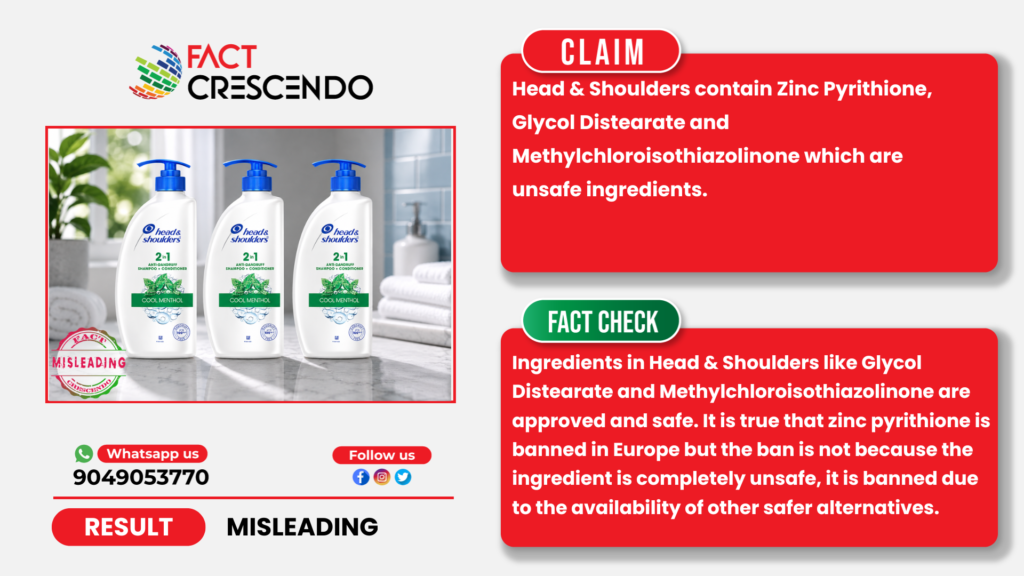
Social media posts have claimed that Head & Shoulders shampoos contain harmful chemicals, including glycol distearate, zinc pyrithione and methylchloroisothiazolinone suggesting that the product is unsafe for human use and should be avoided.
However, Fact Crescendo found the claim to be misleading. All the ingredients mentioned in the video are safe and approved except zinc pyrithione which is banned by the European Union. The ban is not because the ingredient is completely unsafe but due to the availability of other alternatives.
Fact Check-
Let’s find the facts about the safety of a few ingredients mentioned in the post.
Zinc Pyrithione: Zinc pyrithione is an antimicrobial and antifungal agent commonly formulated in scalp treatments. It is primarily used to reduce dandruff and its symptoms, such as itchiness and crusting. In dandruff-prone scalps, the Malassezia yeast tends to overpopulate and alter the scalp’s environment. Zinc pyrithione works by targeting this imbalance while also regulating the overproduction of skin cells on the scalp.
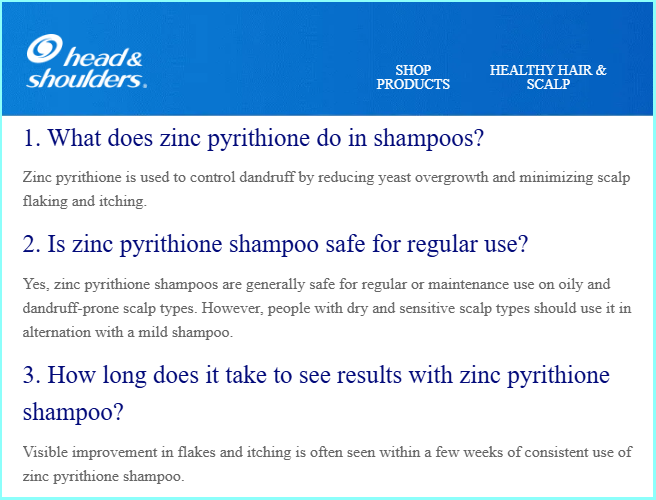
The Head & Shoulders mentioned that zinc pyrithione shampoos are generally safe for regular or maintenance use on oily and dandruff-prone scalp types. But, people with dry and sensitive scalp can use it in alternation with a mild shampoo.
According to the National Eczema Association, for scalp seborrheic dermatitis, over-the-counter dandruff shampoos containing ingredients such as zinc pyrithione, selenium sulfide, ketoconazole 1%, coal tar, tea tree oil, or salicylic acid can be effective. A shampoo with zinc pyrithione may also be recommended by the dermatologist. However, dandruff shampoo is not recommended for treating an infant for cradle cap.
Previously, the Europe,an Union considered zinc pyrithione as safe when used as an anti-dandruff in rinse-off hair products up to a maximum concentration of 1%. However, on 29 October 2021, The European Commission updated its cosmetics law to ban zinc pyrithione which is classified as carcinogenic, mutagenic, or toxic for reproduction (CMR).
The Scientific Committee on Consumer Safety (SCCS) reviewed the ingredient and concluded that it is safe when used in rinse-off anti-dandruff shampoos at concentrations up to 1%. Under EU cosmetic law, a CMR ingredient can only remain in cosmetics if no other suitable alternative ingredients are available. As suitable alternatives for anti-dandruff shampoos were available, zinc pyrithione was removed from the list of permitted cosmetic ingredients and added to the list of prohibited substances.
So, saying that zinc pyrithione is banned in Europe because it is unsafe will not be a complete truth. The ingredient was banned because it did not meet the legal requirements for an exemption after being classified as a Category 1B reproductive toxicant, and suitable alternatives were considered available. It is also worth noticing that the scientific safety committee considered it safe at up to 1% in rinse-off shampoos.
Glycol Distearate: Glycol distearate is an opacifier and pearling agent used in cleansing products, making them white and glossy. It can give liquids and gels a pearlescent appearance, such as in shower gel, to increase the visual appeal of the products. It is used in shampoos as a pearling agent, viscosity modifier, and surfactant.
Based on the available information, Cosmetic Ingredient Review (CIR) expert panel concluded that Glycol Distearate is safe as a cosmetic ingredient in the present practices of use and concentration. During animal and human studies, it was found that it has low acute oral toxicity, and no evidence of skin irritation and or allergic sensitization was noticed.
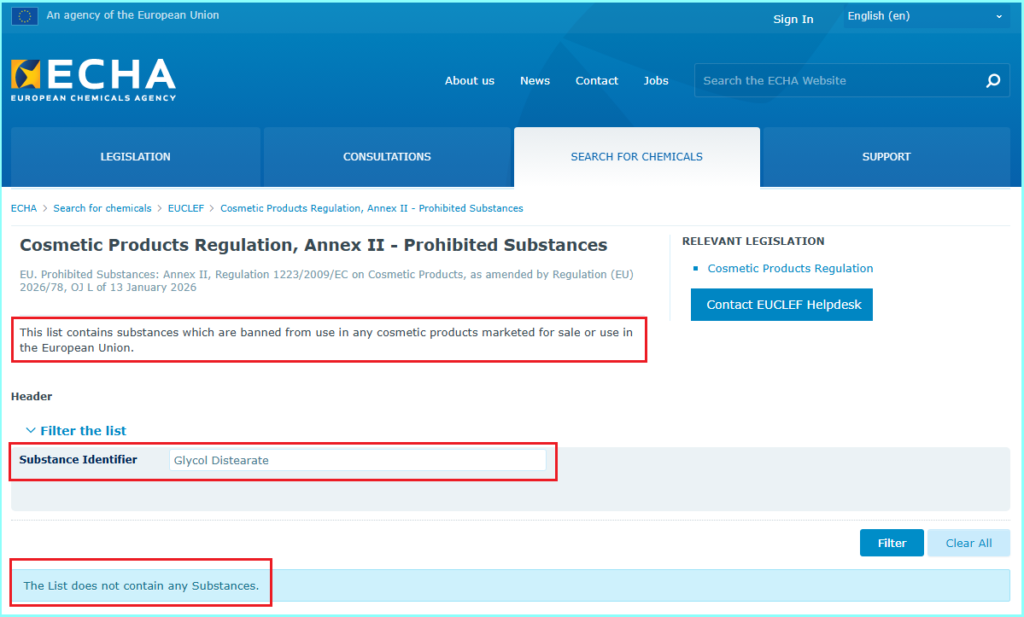
Further, Glycol Distearate is not prohibited or restricted in the European Union. This means it is legally permitted for use in cosmetic products.
Methylchloroisothiazolinone: According to a report, Methylchloroisothiazolinone (MCI) is often combined with methylisothiazolinone (MI) under the brand name Kathon CG. In the United States, it’s currently used in concentrations of up to 15 parts per million (ppm) in rinse-off products and 8 ppm in other cosmetics.
In 2014, the European Commission’s science group recommended a ban on using MCI/MI in leave-on products like body creams. This was to help reduce skin allergies. However, they said it’s still okay to use in rinse-off products like shampoos and shower gels, but only in very tiny amounts (0.0015%).
According to Cosmetic Ingredient Review (CIR), the European Cosmetics Regulation allows the use of a mixture of Methylchloroisothiazolinone (MCI) and Methylisothiazolinone (MI) in cosmetic products up to 0.0015%. In 2004, the European Safety Committee reviewed MI and found it safe for use in both leave-on and rinse-off products up to 0.01%. However, over time, dermatologists noticed a rise in allergic skin reactions, especially in Europe, linked to MI in leave-on cosmetics like lotions and wet wipes. After reviewing new evidence in 2013, the committee concluded that there is no safe amount of MI for leave-on products. They did, however, confirm that rinse-off products, such as shampoos and shower gels, can still safely contain MI at a concentration of up to 0.0015%.
Conclusion:
Fact Crescendo found the claim to be misleading. Ingredients in Head & Shoulders like Glycol Distearate and Methylchloroisothiazolinone are approved and safe. It is true that zinc pyrithione is banned in Europe but the ban is not because the ingredient is completely unsafe, it is banned due to the availability of other safer alternatives.
Title: The Truth Behind Claims That Head & Shoulders Contains Toxic Ingredients
Fact Check By: Siddharth Sahu
Result: Misleading
