

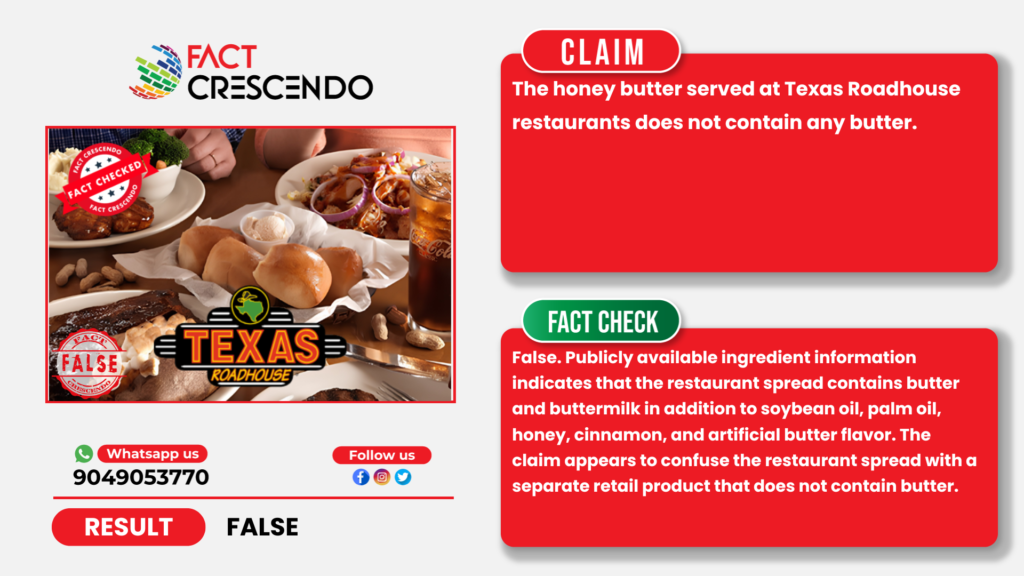
A viral social media video has sparked debate over one of Texas Roadhouse’s best-known menu items: the honey cinnamon butter served alongside its signature dinner rolls. In the video, a physician and influencer claims the spread “doesn’t actually contain any butter” and is instead made from “whipped soybean oil and honey.” However, our investigation found that the evidence does not support that conclusion. Publicly available nutrition and ingredient information identifies the restaurant’s Honey Cinnamon Butter as a butter blend containing both butter and buttermilk. While it is not made entirely from dairy butter, the claim that it contains no butter at all is inaccurate.
Social Media Posts
The viral claim asserted that the restaurant’s honey butter “doesn’t actually contain any butter.” According to the video, the spread consists primarily of whipped soybean oil and honey.
Fact Check
Texas Roadhouse’s Restaurant Spread Is Listed as a Butter Blend
Publicly available ingredient information from Nutritionix, cited by the Houston Chronicle, identifies the restaurant’s spread as a butter blend containing butter and buttermilk, along with vegetable oils, honey and cinnamon.
The restaurant menu identifies the product as Honey Cinnamon Butter, listing approximately 90 calories, 9 grams of total fat, and 3 grams of saturated fat per serving. While nutrition information alone cannot determine whether a product contains butter, the accompanying ingredient information describes the spread as a butter blend rather than pure butter.
According to the published ingredient listing, the restaurant spread contains:
- Artificial butter flavor
- Butter
- Buttermilk
- Soybean oil
- Palm oil
- Honey
- Cinnamon
This formulation indicates that the spread contains both dairy ingredients and vegetable oils. In other words, it is not pure butter, but it is equally inaccurate to describe it as butter-free. (Source)
This distinction is important because food products frequently combine dairy fats with vegetable oils to improve texture, consistency, stability, or shelf life. Such formulations are commonly marketed as butter blends or buttery spreads, depending on the product and applicable labeling regulations.
The Viral Claim Confuses Two Different Products
Much of the online confusion appears to stem from the existence of a separate retail product sold in supermarkets under the Texas Roadhouse brand.
Unlike the spread served in restaurants, the grocery-store version is marketed as Texas Roadhouse Honey Cinnamon Whipped Buttery Spread. Retail listings from H-E-B, and other supermarkets show an ingredient list beginning with soybean oil and water, followed by honey, palm oil, palm kernel oil, salt, cinnamon, soy lecithin, pea protein, preservatives, natural flavors, vitamin A palmitate, and beta-carotene. Butter is not listed among the ingredients.
Retailers also describe the product as being inspired by the restaurant’s famous honey cinnamon butter rather than explicitly stating that it is the identical formulation served in Texas Roadhouse restaurants. This distinction is significant because restaurants and packaged retail products often use different recipes, ingredients, suppliers, and manufacturing processes.
As a result, evidence about the grocery-store spread cannot automatically be used to describe the formulation of the restaurant spread. (Source)
Nutrition Facts Cannot Prove Whether Butter Is Present
However, nutrition labels are not designed to identify every ingredient in a food product. Under U.S. Food and Drug Administration (FDA) nutrition-labeling regulations, certain nutrient values may be rounded according to specified rules. Consequently, a nutrition panel alone cannot determine whether a product contains a particular ingredient.
For ingredient verification, the ingredient list is the appropriate source of evidence. In this case, the available restaurant ingredient information identifies both butter and buttermilk as ingredients in the spread. (Source)
Limitations of the Available Evidence
Although the available evidence contradicts the viral claim, there are limitations.
Texas Roadhouse does not publicly publish a complete ingredient specification for every restaurant menu item on its primary website. Much of the publicly available ingredient information comes through the restaurant’s Nutritionix-powered nutrition guide, which is widely cited by media outlets but may be updated over time.
Additionally, restaurant formulations can change because of supplier updates, regional sourcing, or recipe revisions. Retail products sold under the Texas Roadhouse brand may also be manufactured by different companies using different formulations.
For these reasons, the most accurate description based on the current publicly available evidence is: The restaurant Honey Cinnamon Butter is a butter blend containing both dairy ingredients and vegetable oils, while the separately sold retail Honey Cinnamon Whipped Buttery Spread appears to be an oil-based product that does not contain butter.
Conclusion
The claim that Texas Roadhouse’s restaurant honey butter contains no butter is false. Available ingredient information indicates that the restaurant’s Honey Cinnamon Butter contains butter and buttermilk, along with soybean oil, palm oil, honey, cinnamon, and artificial butter flavor. Although the spread is not made entirely from dairy butter, the evidence does not support the assertion that it is completely butter-free.
The misunderstanding appears to arise from confusion between the restaurant spread and a separate grocery-store product marketed as Honey Cinnamon Whipped Buttery Spread. Unlike the restaurant version described in the available Nutritionix ingredient information, the retail product’s published ingredient list does not include butter.

Title: Texas Roadhouse’s Restaurant Honey Butter Does Contain Butter
Written By: Pranpreeya
Result: False
