

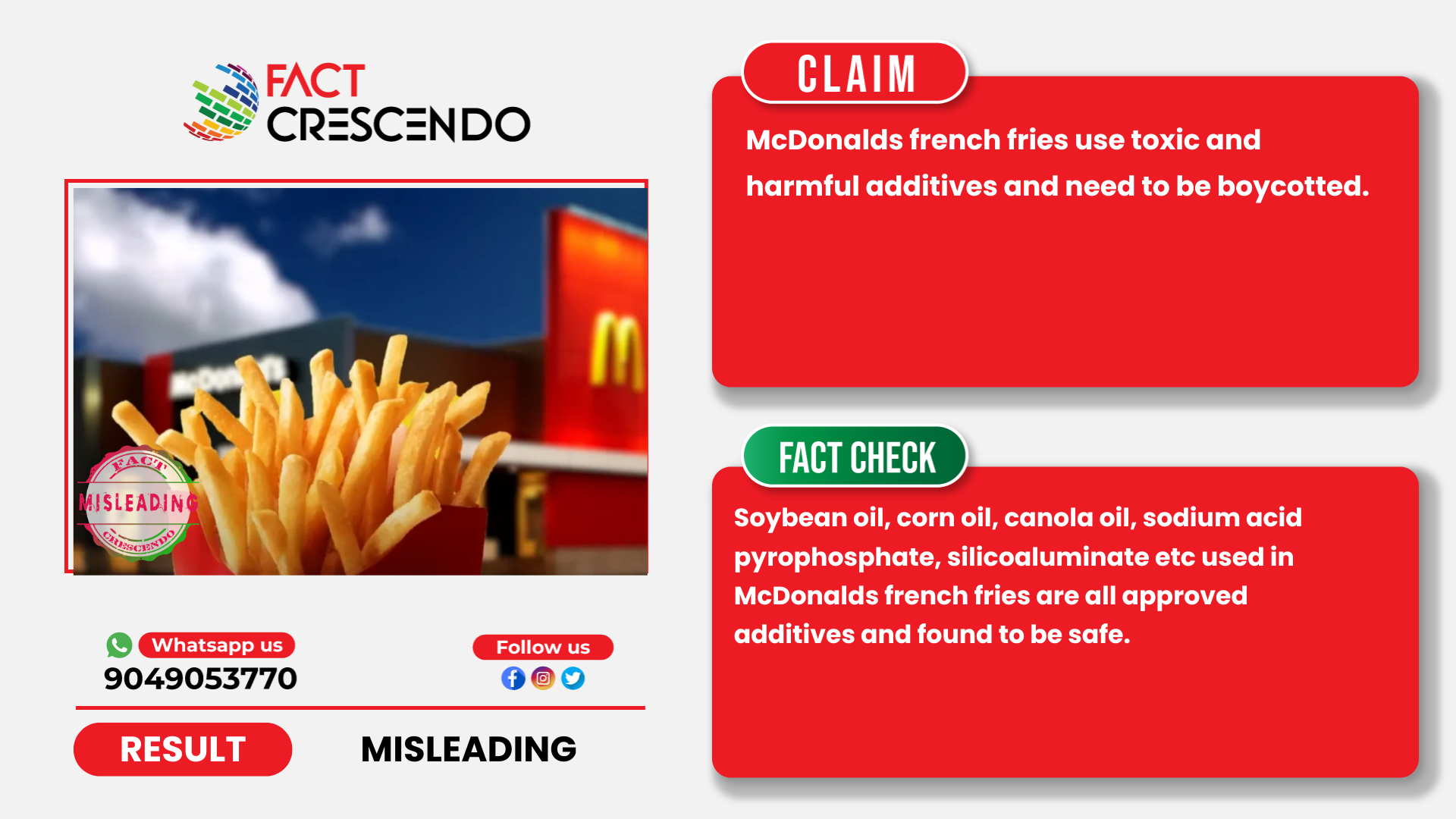
McDonald’s French fries have once again come to the limelight after many social media users warned consumers that the popular brand contains harmful chemicals such as soybean oil, hydrogenated soybean oil, corn oil, canola oil, silicon-based additives, and sodium acid pyrophosphate.
The claim suggests that these additives are harmful upon consumption and lead to various diseases.
Fact Check-
Let’s check the safety of the ingredients used in McDonalds french fries.
High Oleic Low Linoleic Canola Oil: According to the Canola Council, Canola oil has been declared Generally Recognized as Safe (GRAS) by the U.S. Food and Drugs Administration. The FDA also allowed canola oil to carry a health claim, saying it might help lower the risk of heart disease when used instead of saturated fats. However, this is not conclusive. FDA had also approved carrying a claim for high oleic canola oil because it has a lot of healthy monounsaturated fats. In Canada, canola oil is approved to carry a health claim that replacing saturated fats with unsaturated fats can help lower blood cholesterol.
The Environmental Protection Agency (EPA) also considers canola oil safe because it has very low toxicity and is already approved as an edible oil for human food. Studies have shown its safety and nutritional properties are similar to other vegetable oils. The EPA has granted it for use on many food crops, ornamental plants, and houseplants to control pests like aphids, beetles, mites, and caterpillars. Since it breaks down quickly in the environment and poses little risk to people, animals, and wildlife.
Corn Oil: The Corn Refiners Association (CRA) stated that corn oil is a refined corn product which is produced under very strict safety and quality standards. Producers follow the U.S. FDA’s Food Safety Modernization Act (FSMA) and current Good Manufacturing Practices. Their facilities are regularly audited by both the FDA and their customers. Refined corn oil is considered very safe, with almost no cases of recalls by the FDA. During the process of the production of corn oil, harmful things like heavy metals, toxins, pesticides, and germs are removed making the oil safe for consumers to use.
FDA considers Corn Oil safe for people to consume. It has been studied, tested and shown not to be toxic, harmful or carcinogenic. Studies on animals and past research confirm that corn oil does not cause health problems when eaten in normal amounts. The oil is made from corn germ, a part of the corn kernel that naturally contains oil, and its production process removes harmful substances. Because of this evidence, experts concluded that corn oil is “Generally Recognized As Safe” (GRAS) for use in food.
Soybean Oil: High Oleic Soyabean Oils (HOSBO or HOSO) has been evaluated for its effect on human health and overall safety. A clinical trial involving 60 participants was conducted and found that HOBSO diets help in reducing cholesterol. However, when compared to regular soybean oil, HOSBO resulted in slightly higher LDL cholesterol and apoB levels.
Health Canada’s assessment confirmed that high-oleic soybeans, produced through gene-editing, are safe and nutritious as conventional soybeans, with no increased toxicity. Overall, HOSBO is considered safe for consumption and may be a healthier alternative to oils high in saturated fats.
Health Canada’s assessment confirmed that high-oleic soybeans, produced through gene-editing, are safe and nutritious as conventional soybeans, with no increased toxicity. Overall, HOSBO is considered safe for consumption and may be a healthier alternative to oils high in saturated fats.
According to the US Soyabean Export Council (USSEC), the panel established a Codex standard after collaborating with various domestic and international partners to facilitate a Codex standard for HOSO. The standard aims to facilitate trade by establishing a universally recognized benchmark for the product.
Sodium Acid Pyrophosphate: Food grade Sodium Acid Pyrophosphate (SAPP) is commonly used with sodium bicarbonate as a leavening agent in bakery products. It is also used to maintain the color of the processed potatoes and also prevents struvite crystal in canned seafood.
According to the U.S. Food and Drug Administration’s food regulations, sodium acid pyrophosphate is officially listed as generally recognized as safe (GRAS) when used in accordance with good manufacturing practice. The FDA has approved SAPP as a color protector, emulsifier, leavening agent, and oxidizing or reducing agent in processed foods. In products such as McDonald’s French fries, this ingredient is commonly added in small quantities to help maintain the fries’ natural color and quality during storage and frying.
Dimethylpolysiloxane: The EFSA Panel reviewed the safety of dimethyl polysiloxane (E 900), a food additive approved in the EU. Earlier limits set the acceptable daily intake (ADI) at 1.5 mg/kg body weight, but new studies showed very low absorption in the body as almost all of the additive gets excreted. It has low toxicity and no genotoxic effects. Eye issues were found in animals due to the direct contact of the additive and not ingestion. A long-term rat study found no harmful effects at up to 1,742 mg/kg/day, leading the Panel to raise the ADI to 17 mg/kg/day and withdraw the old limit. Estimated exposure from food is far below this new ADI, so there is no safety concern.
Silicoaluminate: Silicoaluminate is a generic term which generally refers to Sodium Aluminium Silicate (E554) or Potassium Aluminium Silicate (E555).
The European Food Safety Authority reviewed sodium aluminium silicate and similar silicate-based food additives to evaluate potential safety implications and health risks associated with their use in food products. The panel found that silicoaluminate additives are poorly absorbed by the human body. No evidence of genotoxicity or cancer risk was found when the additive is used within permitted limits. This additive does not raise safety concerns for consumers.
The FDA had listed Sodium Aluminium Silicate as a legally permitted food ingredient. This substance is generally recognized as safe for use at a level not exceeding 2 percent in accordance with good manufacturing practice.
Conclusion:
Fact Crescendo found the claim to be misleading. Soybean oil, corn oil, canola oil, sodium acid pyrophosphate, silicoaluminate, etc. used in McDonalds french fries are all approved additives and found to be safe.
Title: Are McDonald’s French Fries Filled With Harmful Chemicals? Know The Facts
Fact Check By: Siddharth Sahu
Result: Misleading
