

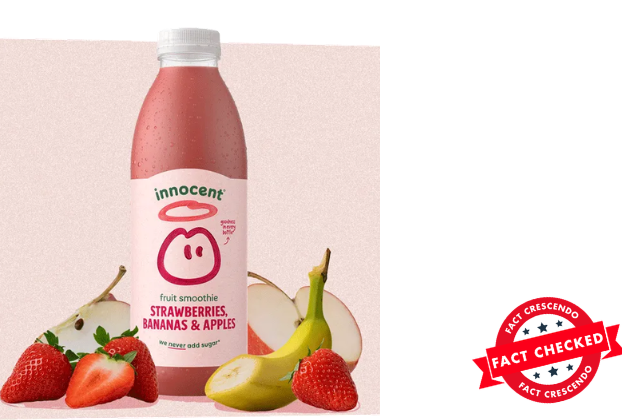
Innocent Smoothies is one of the major food and drink brands in the world. Due to its popularity, the brand has been the subject of several viral claims, such as that “the brand is misleading the public by saying it has no added sugar”. This raises questions about how much sugar it contains and how it impacts health.
In this fact-check, we will take each claim and analyze it clearly. This will help us distinguish what is supported by nutrition science, labelling regulations, and available evidence.
Social Media Posts
According to a viral social media video, “Innocent Smoothie” is misleading customers by stating that it has “no added sugar” on products that actually contain a lot of sugar. The video also suggests this is a marketing trick to hide unhealthy content. This fact-check examines whether those claims are accurate.
Fact Check
Claim 1: Does “no added sugar” mislead consumers?
The term “no added sugar” is defined and regulated in some jurisdictions. Food labelling regulations in the UK and Australia generally use “no added sugar” to indicate that sugars such as syrups and honey have not been added during processing. Read here and here. However, products can still contain naturally occurring sugars from fruits and vegetables.
As a result, this type of labelling can be technically compliant while still being easy to misunderstand. It also does not necessarily mean the product is “low sugar” or “sugar-free”.
Claim 2: Do Innocent Smoothies contain high sugar levels?
Innocent Smoothies contain naturally occurring sugars and, in some products, the sugar content exceeds 11 grams per 100 ml. While the products may be labelled as having no added sugar, a 750 ml bottle can contain more than 82 grammes of sugar, and a 150 ml serving can contain about 16.5 grammes. Read here. These sugars primarily come from fruit.
As a result, the products are sometimes discussed as being high in sugar, even though the sugars are naturally occurring rather than added during processing.
Claim 3: Are natural sugars and added sugars the same?
Sugar is typically made from glucose, fructose, or sucrose. However, the body reacts differently to natural and added sugars when it comes to biology. Added sugars like syrups or white sugar lack nutrition and cause quick blood sugar rises and health problems. In contrast, natural sugars like fructose and lactose are mixed with fibre and nutrients that delay absorption into the bloodstream. For this reason, the FDA states that added sugars be labelled and limited separately. Read here
However, NHS guidelines state that sugars found in smoothies, vegetable juices, and fruit juices without added sugar are free sugars. Read here
Claim 4: Does this illustrate the “health halo effect”?
The “health halo effect” is a cognitive bias that can lead people to perceive a product as healthier than it is when they notice positive claims. Examples include “no added sugar”, “sugar free”, “organic”, “low-fat”, or “natural”. These terms can sometimes draw attention away from other nutritional factors, such as the overall amounts of sugar, salt, or fat, and may influence portion choices.
This effect reflects how some consumers interpret marketing claims. It does not necessarily indicate wrongdoing by a company. In the case of Innocent Smoothies, the labels display nutritional information, and the product may still be discussed in terms of a potential health halo effect without concluding that the brand is misleading the public.
Conclusion
In conclusion, “no added sugar” is generally a truthful but often misunderstood label. While Innocent Smoothie contains naturally occurring sugars, its overall sugar content may still be high, so it may not be a healthy choice for everyone, depending on portion size and dietary needs.
Title: Does “No Added Sugar” Mean Healthy? Innocent Smoothie Case Study
Fact Check By: Rashmitha Diwyanjalee
Result: Misleading
