
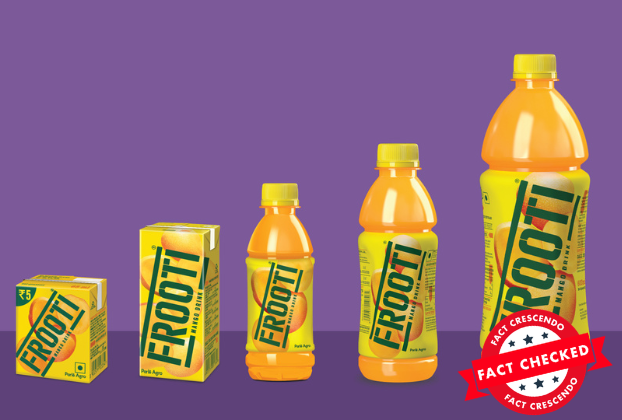
Frooti is a popular fruit drink brand in India. It is widely consumed in homes, schools, and at public events. It is known for its strong association with mango flavor and convenience. Its popularity makes it a frequent target of viral claims about its ingredients and health impact.
In this fact-check, we will analyze each claim. We will distinguish what is supported by nutritional data and food safety standards, and what is based on misleading information.
Social Media Posts
According to a widely shared social media video, “Frooti” contains around 21 teaspoons of sugar and several additives. The post accuses the company of hiding this information from consumers. The post further suggests that people are unknowingly consuming excessive sugar. This fact-check investigates whether those claims are accurate or misleading.
Fact Check
Claim 1: Does one bottle of Frooti actually contain 21 teaspoons of sugar?
Nutrition data shows Frooti contains about 15.8 g of sugar per 100 ml (both natural and added sugar). This is equivalent to 3.78 teaspoons. Convert here.
Frooti is available in 65 ml, 125 ml, and 200 ml (7.56 teaspoons), and also in PET bottles of 125 ml, 250 ml, 300 ml (11.34 teaspoons), 600 ml (19.18 teaspoons), 1.2 L (38.36 teaspoons), and 1.8 L (58.54 teaspoons). However, the video doesn’t indicate the volume. Therefore, there is no direct evidence from product labels or nutrition data that a standard bottle of Frooti contains 21 teaspoons of sugar.
Thus, there is no standard Frooti bottle with 21 teaspoons (~88 g) of sugar. So, we can conclude that the viral claim is not supported by standard nutritional data.
Claim 2: Is the sugar content unusually high?
Frooti is a sugar-sweetened beverage. It contains high sugar levels that are typically similar to other soft drinks. Sugary drinks commonly contain 5–10 teaspoons per serving. Read here and here. Frooti also falls within the normal range. The amount of consumption depends on serving size.
Further, these drinks (including juice and smoothies) are classified as “free sugar sources.” Health authorities recommend limiting them. Read here.
Thus, in Frooti, sugar levels are high but comparable to other sweetened drinks.
Claim 3: Are the listed ingredients harmful or unusual?
Frooti ingredients typically include sugar, mango pulp, citric acid, stabilizers, preservatives, and flavoring agents. These may sound alarming when highlighted separately in social media posts. But these additives are commonly used in beverages. They are well-regulated and approved for consumption within recommended limits.
Thus, Frooti’s ingredients are typical of packaged drinks and are not inherently dangerous.
Claim 4: Does the video accurately represent ingredients?
The viral video shows ingredients, including sugar and other additives, separately. However, the visual representation is exaggerated, converting sugar values into surprising teaspoon equivalents.
It is noteworthy that Frooti’s bottle labels already disclose ingredients and quantities. However, the terrifying visual representations in social media posts can distort viewers’ minds.
Thus, the video is visually impactful but ethically questionable in its representation.
Conclusion
In conclusion, the claim that Frooti contains “21 teaspoons of sugar” is not supported by standard nutrition information and appears to overstate the sugar content without specifying the bottle size. While Frooti is a sugar-sweetened beverage, its sugar levels are broadly comparable to other similar drinks and vary by serving size.
As with other sugary drinks, it is generally best consumed in moderation. The video presents the information in a highly dramatized way, which may lead to confusion or concern that is not proportionate to the evidence.

Title: Does Frooti Really Contain 21 Teaspoons of Sugar?
Fact Check By: Rashmitha Diwyanjalee
Result: Misleading