

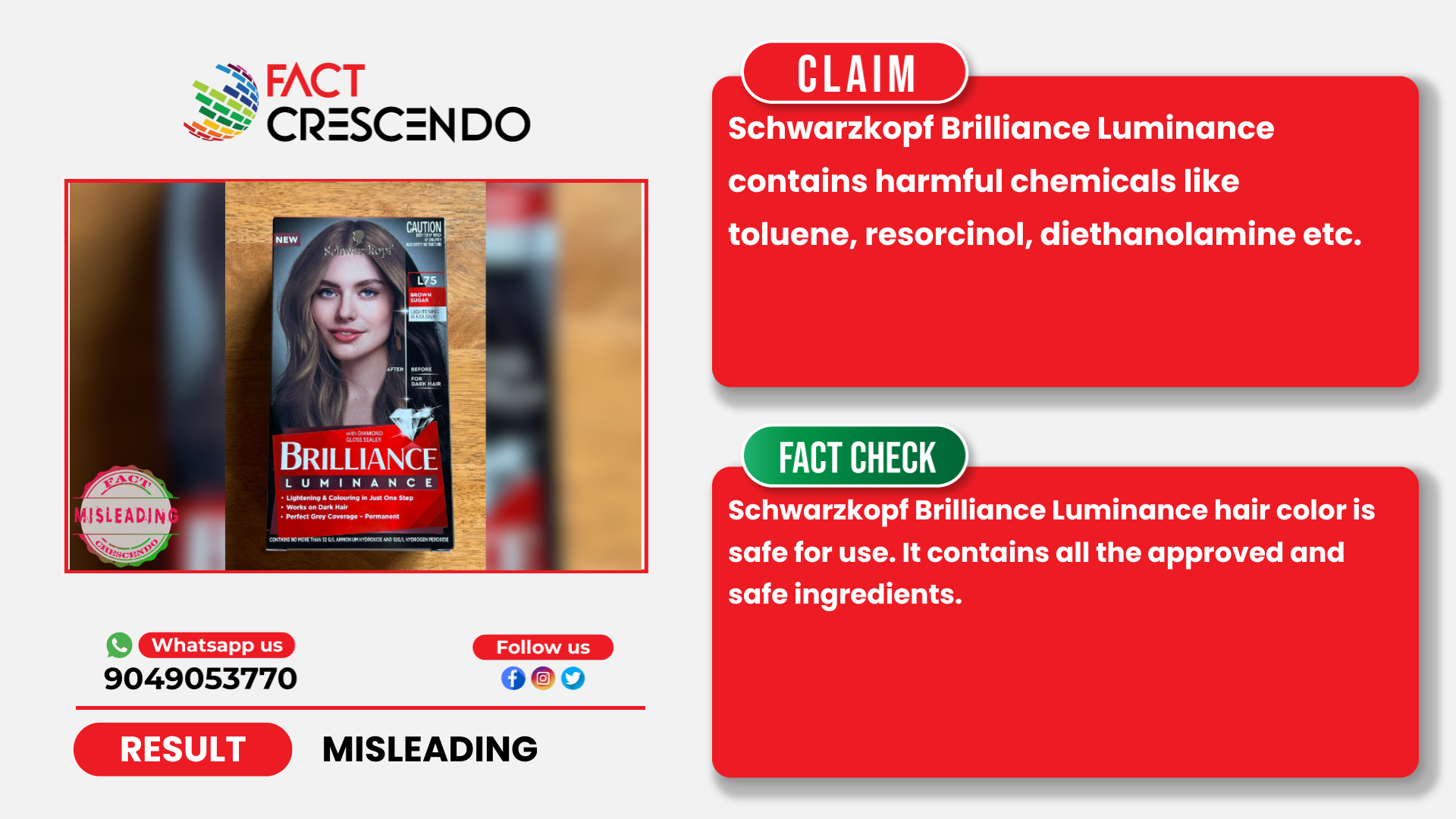
Social media posts claim that Schwarzkopf Brilliance Luminance hair color contains harmful chemicals like toluene, resorcinol, diethanolamine etc. and should therefore be avoided.
However, Fact Crescendo found the claim to be misleading as all the ingredients mentioned in the video are considered safe and have been approved for use in various products.
Fact Check-
We checked the list of ingredients in Schwarzkopf Brilliance Luminance L 75 hair color and found that it contains resorcinol, sodium laureth sulfate, diethanolamine, dimethicone and other ingredients. Toluene is not mentioned in the ingredient list. However, Toluene-2,5-Diamine Sulfate is one of the ingredients of the product.
Toluene-2,5-Diamine Sulfate: According to the National Institute of Health, Toluene-2,5-diamine and toluene-2,5-diamine sulfate are used as coloring agents in permanent hair dyes. Toluene-2,5-diamine is used in some hair dye products at concentrations of up to 3%, while its sulfate form is used in products at concentrations of up to 4%.
The Cosmetic Ingredient Review (CIR) Expert Panel previously considered toluene-2,5-diamine, toluene-2,5-diamine sulfate, and toluene-3,4-diamine as safe for use in hair dyes. However, newer research indicates that these may be toxic and carcinogenic. After reviewing the available evidence, the Panel concluded that toluene-2,5-diamine and toluene-2,5-diamine sulfate are safe when used in hair dyes at the concentrations and under the conditions currently used.
Resorcinol: Resorcinol (CAS 108-46-3) is a regulated and permitted ingredient for use in oxidative/permanent hair dyes in the European Union. The European Commission’s Scientific Committee on Consumer Safety (SCCS) concluded in 2021 that resorcinol is safe for use as an oxidative hair dye at up to 1.25% on the hair. It is also permitted at up to 0.5% in hair lotions and shampoos under certain conditions.
According to the assessment done by the World Health Organization (WHO), only a small portion of resorcinol is absorbed during normal hair dye or hair color use. Various studies indicated that around 0.076% of the applied dose gets excreted, which makes dermal absorption during hair coloring relatively low.
However, resorcinol is not considered completely harmless. Higher or repeated exposure can produce toxic effects, particularly involving the thyroid and nervous system. Therefore, resorcinol was permitted in oxidative hair dyes limited to around 1.25%, even though the older regulatory limit was higher.
Diethanolamine (DEA): According to the FDA, National Toxicology Program (NTP) studied the effect of Cocamide and other DEA and found it to be carcinogenic in laboratory animals. But, the NTP study did not establish a link between DEA and the risk of cancer in humans. However, based on information filed with FDA’s Voluntary Cosmetic Registration Program, it was found that DEA-related ingredients are used much less frequently in cosmetic products than they were when the NTP completed its study.
FDA also stated that there is no reason for consumers to be alarmed for the use of DEA substances in cosmetics. It has also labelled DEA as one of the most commonly used ingredients. The FDA is still monitoring the health hazard of the substance.
According to the National Institute of Health, the Cosmetic Ingredient Review (CIR) Expert Panel studied the diethanolamide chemicals, including how they break down in the skin to form DEA and fatty acids. The panel concluded that these ingredients are safe to use if they are formulated in a way that doesn’t irritate the skin and if the amount of free DEA stays within safe limits. However, the panel advised against using these ingredients in products where harmful N-nitroso compounds could form.
Dimethicone: It is used in many products like cosmetics, moisturizers and creams, shampoo, hairstyling products, etc. Some people believe that dimethicone is not safe, as it is not natural. However, the amount of dimethicone in face and hair products is generally considered safe. In a 2019 review, the Cosmetic Ingredient Review Expert Panel found that most over-the-counter products contain less than 15 percent dimethicone.
According to the National Institute of Health, dimethicone is a stable substance and does not break down to other chemicals under various circumstances. It does not interfere with the skin’s ability to breath and does not appear to affect the immune system. Overall, the evidence indicated that dimethicone is safe for use in dermatological and cosmetic products.
Conclusion:
Fact Crescendo found the claim to be misleading. Schwarzkopf Brilliance Luminance hair color is safe for use. It contains all the approved and safe ingredients.
Title: Claims That Schwarzkopf Brilliance Luminance Contains Harmful Chemicals Are Misleading
Fact Check By: Siddharth Sahu
Result: Misleading
