

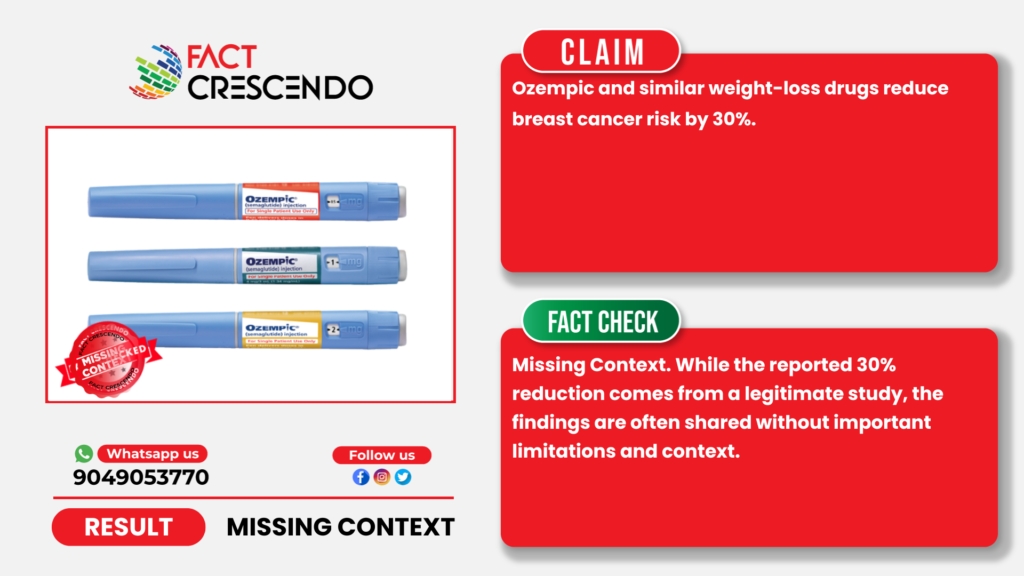
A growing number of social media posts have been sharing claims that Ozempic and similar weight-loss medications may significantly reduce the risk of breast cancer. Many posts cite a recent study suggesting that women who used GLP-1 receptor agonist medications experienced approximately a 30% lower incidence of breast cancer than non-users.
The claim is based on a real scientific study, but the way it has been presented online often lacks important context. While the reported 30% reduction comes from a legitimate study, the findings are often shared without important limitations and context. We therefore rate the claim as Missing Context.
Social Media Posts
Numerous posts circulating claim that Ozempic and similar drugs can lower breast cancer risk by about 30%. Some posts go further, implying that the medications may function as a form of cancer prevention.
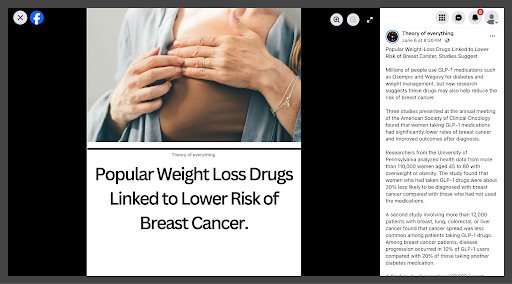
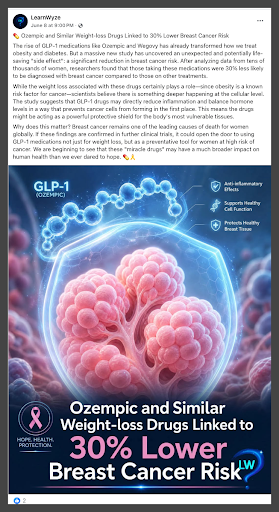
Source | Archive Source | Archive
Fact Check
What the Study Actually Found
The claim comes from a study by researchers at the University of Pennsylvania’s Perelman School of Medicine. It looked at over 111,000 women between the ages of 45 and 80 who were overweight or obese and had received breast imaging.
The researchers found that women taking GLP-1 receptor agonist medications had about a 30% lower rate of breast cancer compared to similar women who were not taking these drugs. These findings were published in the journal JCO Oncology Practice and covered by outlets like Penn Medicine and other media outlets.
Importantly, the researchers themselves emphasized that the findings do not prove that GLP-1 drugs directly reduce breast cancer risk. Lead investigator Dr. Elizabeth McDonald stated that the research was observational and therefore could not definitively establish a cause-and-effect relationship. The study was designed to identify associations, not to prove prevention.
According to Penn Today, the authors specifically noted that further prospective clinical studies are required before any conclusions about cancer prevention can be made. The study also did not account for the type of GLP-1 medication used, duration of treatment, genetic risk factors, or cancer stage and subtype at diagnosis. Researchers noted that further analyses are planned to examine some of these variables.
Observational Studies Cannot Prove Causation
This research was an observational study, which analyzes existing health records for patterns, rather than a randomized controlled trial, which is the standard for proving cause-and-effect. While observational studies are useful for identifying potential links, they cannot definitively prove that one factor causes another.
Women who take GLP-1 medications might differ from those who do not in ways beyond just the medication itself. They may have better access to healthcare, more frequent medical check-ups, or healthier lifestyles, factors that were not fully captured in the data. Even when researchers attempt to account for these differences, other ‘hidden’ factors can still influence the final results.
Randomized controlled trials are often preferred in clinical research for establishing cause-and-effect relationships compared to observational studies.
Major Confounding Factors Remain
The Pennsylvania researchers adjusted for variables such as age, body mass index, race, ethnicity, breast density, and diabetes status. Other potentially influential variables, however, were outside the scope of the analysis.
The study did not track factors like diet, physical activity, smoking status, alcohol consumption, healthcare utilization patterns, or socioeconomic status, which are known to influence breast cancer risk.
Additionally, the study population was restricted to women who had undergone breast imaging. This group may differ from those who do not receive regular screenings, for instance, in their access to healthcare, engagement with preventive services, or adherence to medical guidance.
These variations suggest that the observed reduction in breast cancer incidence might relate to these underlying factors rather than solely the biological impact of GLP-1 medications. The study also defined GLP-1 exposure based on prescription records and did not fully account for treatment duration, adherence, or the amount of weight loss achieved.
Two additional methodological biases are notably absent from the analysis. First, detection bias: women on GLP-1 drugs are typically under closer metabolic monitoring, meaning they are more likely to receive breast imaging, and thus have cancers detected at higher rates, which can paradoxically inflate the apparent “lower incidence” figure. Second, immortal time bias: patients who survive long enough to be prescribed a GLP-1 drug are longer-term survivors, artificially inflating the drug’s apparent protective effect in retrospective record-based studies.
Study Population Was Limited
The findings also cannot automatically be generalized to the broader population.
The study focused on women aged 45 to 80 who had overweight or obesity and who had undergone breast imaging within the University of Pennsylvania health system and affiliated institutions. Women who were younger, of normal weight, outside the healthcare network, or not receiving regular breast screening were not represented.
Because of these limitations, researchers cannot assume that the findings would apply equally to all women or to the general population. Details about the study population are available through Penn Medicine here.
Why Might GLP-1 Drugs Affect Cancer Risk? (Biological Mechanism)
Scientists have proposed several biological pathways. First, GLP-1 drugs cause substantial weight loss, which lowers circulating estrogen levels, a known driver of postmenopausal breast cancer. Second, they reduce chronic inflammation and improve insulin sensitivity, disrupting the insulin/IGF-1 signaling pathway that many tumor cells exploit for growth. Third, preclinical studies show GLP-1 receptors may have direct antitumor activity via inhibition of oncogenic PI3K/Akt/mTOR pathways. See NIH review on GLP-1 and cancer mechanisms and JNCI emerging evidence overview. Understanding these mechanisms is essential for evaluating biological plausibility, a key criterion in evidence-based medicine (Bradford Hill criteria).
Higher-Quality Evidence Does Not Yet Show a Protective Effect
While the new study received considerable attention, it is not the only body of evidence available.
A 2021 meta-analysis of randomized controlled trials involving approximately 48,000 participants found no statistically significant difference in breast cancer incidence between GLP-1 users and control groups. However, these trials were primarily designed to evaluate diabetes and metabolic outcomes rather than cancer prevention, meaning they may not have been adequately powered to detect differences in breast cancer risk.
These results do not negate the Pennsylvania study; rather, they indicate that the overall evidence remains inconclusive. While the observational findings suggest a potential association, they await confirmation from randomized controlled trials.
Additionally, findings presented at ASCO 2026 (May 2026), published just weeks before this article, showed that GLP-1 medications were associated with reduced cancer risk across six out of seven cancer types studied in a large multi-institutional cohort. This broader convergence of evidence strengthens the case that an association exists, though it does not resolve the causation question. See NPR coverage of ASCO 2026 GLP-1 cancer findings and Business Standard: Ozempic-style drugs and cancer spread. Omitting this context makes the evidence landscape appear more isolated than it is.
Researchers Are Still Planning Clinical Trials
The current findings have generated sufficient interest that researchers are now planning prospective clinical trials to determine whether GLP-1 medications might genuinely reduce breast cancer risk.
According to Penn Medicine and ScienceDaily, investigators are working to establish larger multisite studies that could evaluate the hypothesis more rigorously.
Until those trials are completed, scientists cannot conclude that Ozempic, Wegovy, Mounjaro, or related medications prevent breast cancer.
Ozempic and Wegovy contain semaglutide (a GLP-1 receptor agonist), while Mounjaro and Zepbound contain tirzepatide (a dual GIP/GLP-1 receptor agonist with a distinct mechanism of action). The Penn study specifically examined GLP-1 receptor agonists, and results may not apply equally to dual agonists. This distinction should be clarified for scientific accuracy. See ASCO 2026: GLP-1 and cancer spread across drug types.
Expert Perspective from the Study Authors
The researchers behind the study have cautioned against interpreting the findings as proof that GLP-1 medications prevent breast cancer.
In comments accompanying the publication, lead investigator Dr. Elizabeth McDonald, a breast radiologist and professor at the University of Pennsylvania Perelman School of Medicine, emphasized that the study was observational and therefore unable to establish a direct cause-and-effect relationship.
“While our study was observational and does not definitively confirm an association between GLP-1 medications and reduced breast cancer incidence, it does add to the growing body of evidence suggesting that it’s worth investigating these weight-loss drugs as potential cancer prevention tools,” McDonald said. According to the researchers, the findings should be viewed as a basis for further investigation rather than evidence that GLP-1 medications can currently be used to prevent breast cancer. Researchers are now working to establish a multisite clinical trial to determine whether the observed association can be confirmed in prospective studies.
Moreover, cancer specialists generally view the findings as promising but preliminary.
According to medical professionals at the Memorial Sloan Kettering Cancer Center, obesity represents a documented risk factor for various malignancies, notably postmenopausal breast cancer. Due to the significant weight reduction associated with GLP-1 therapy, a biological basis exists for the hypothesis that these drugs might lower cancer incidence. Nonetheless, experts emphasize that investigations into this relationship are still in progress, and the FDA has not authorized any GLP-1 medication for the purpose of cancer prophylaxis.
Furthermore, specialists highlight that existing data fails to confirm a direct causal link between the pharmacological agents and the decreased cancer rates observed in studies.
Regulatory Status
Neither the U.S. Food and Drug Administration (FDA) nor any major medical organization currently recommends Ozempic, Wegovy, Mounjaro, Zepbound, or other GLP-1 receptor agonists for breast cancer prevention.
These medications are currently approved by the U.S. Food and Drug Administration (FDA) primarily for the treatment of type 2 diabetes (Ozempic) and chronic weight management or obesity (Wegovy), with certain additional cardiovascular and metabolic indications. They are not approved for cancer prevention.
Using them specifically to prevent cancer would be considered unapproved use unsupported by current clinical guidelines.
FDA Boxed Warning: Thyroid Cancer Risk
In animal studies, semaglutide caused dose-dependent thyroid tumours, and the drug is therefore contraindicated in patients with a personal or family history of MTC or Multiple Endocrine Neoplasia syndrome type 2 (MEN 2). A balanced health fact-check that discusses GLP-1 drugs and cancer risk must acknowledge this dual reality, the same drug class claimed to reduce one cancer risk carries a regulatory cancer-risk warning for another. See FDA Boxed Warning: Ozempic and thyroid cancer and Roswell Park: Ozempic and thyroid cancer overview.
Furthermore, a 2025 retrospective cohort study found a nuanced cancer risk profile for GLP-1 drugs: while associated with reduced risks of endometrial, ovarian, and meningioma cancers, GLP-1 receptor agonists were associated with an increased risk of kidney cancer. This mixed picture reinforces the need for caution in interpreting GLP-1 drugs as broadly cancer-protective. See PubMed: GLP-1 Receptor Agonists and Cancer Risk in Adults with Obesity (2025).
Conclusion
The claim that Ozempic and similar weight-loss drugs are linked to a 30% lower risk of breast cancer is based on a real study, but the claim is missing context.
Researchers did observe approximately 30% lower breast cancer incidence among women using GLP-1 medications. However, the study was observational and cannot prove that the drugs caused the reduction. Major confounding factors remain, the findings have not been confirmed by randomized clinical trials, and no medical authority currently recommends GLP-1 drugs for cancer prevention.
The reported 30% reduction comes from a legitimate observational study, but there is currently no proof that Ozempic or similar medications directly prevent breast cancer. More rigorous clinical trials are needed before such claims can be considered established scientific facts.

Title: Does Ozempic Reduce the Risk of Breast Cancer by 30%?
Fact Check By: Cielito Wang
Result: Missing Context
