

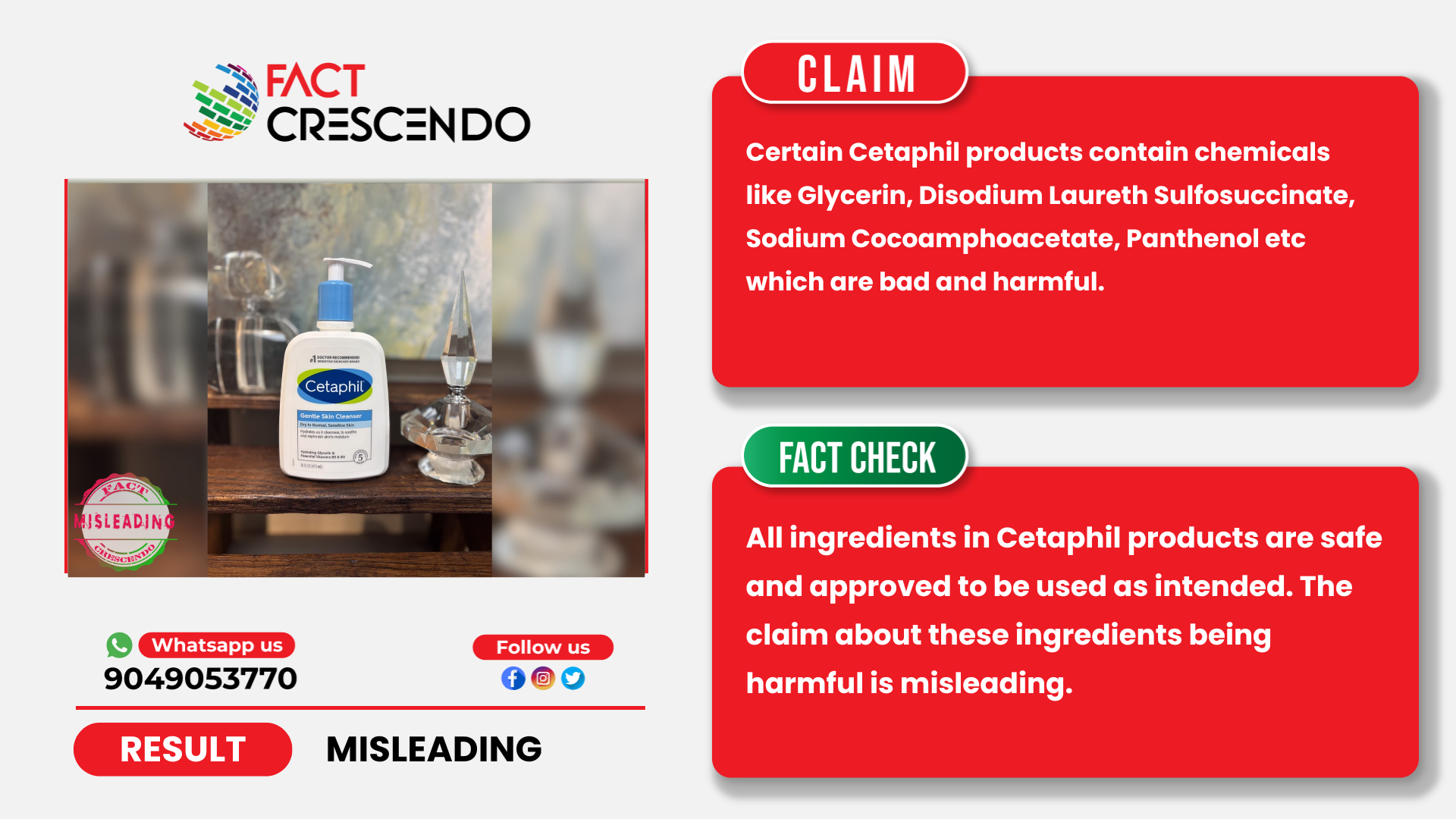
Social media users have raised concerns about the use of certain ingredients used in a few Cetaphil products, which make those unsafe for use. The claim suggests that ingredients like Glycerin, Disodium Laureth Sulfosuccinate, Sodium Cocoamphoacetate, Panthenol, etc. are unsafe and need to be replaced.
However, Fact Crescendo found the claim to be misleading. All the mentioned ingredients are safe when used within the established limits. All these ingredients are found to be safe when used as intended.
Fact Check-
Let’s check the facts of each of the ingredients.
Glycerin:
Glycerin, also known as glycerol, is a natural compound derived from vegetable oils or animal fats. It’s a clear, colorless, odorless, and syrupy liquid with a sweet taste. It is commonly used in skincare products to trap the moisture.
According to the Cosmetic Ingredient Review (CIR), studies in animals and humans show that glycerin has very low toxicity. It is considered safe when used in normal levels. At very high levels and when taken orally, a person can experience mild side effects such as headache, dizziness, nausea, thirst, vomiting, or diarrhea. Long-term studies in animals found no major health problems or increased cancer risk. No evidence of reproductive or birth defects were found during the studies. However, direct injection of glycerin into the testes of animals affected sperm production which is not relevant to normal dietary or cosmetic use.
Disodium Laureth Sulfosuccinate:
Disodium Laureth Sulfosuccinate is a surfactant and cleansing agent commonly used in shampoos, body washes, facial cleansers, and other rinse-off products. It helps remove dirt and oil while producing foam.
According to the Cosmetic Ingredient Review (CIR) safety assessment, Disodium Laureth Sulfosuccinate (DLS) is considered a safe cosmetic ingredient when used in the concentrations currently found in the market. It has low toxicity, which means large amounts of this ingredient will be needed to cause serious harm. A repeated high-dose study in rats did not show significant harmful effects. However, some cases of increase in liver weight were found at very high doses.
This ingredient has been classified as non genotoxic, non carcinogenic and does not affect reproductivity or development. Skin testing in humans showed that Disodium Laureth Sulfosuccinate is generally mild and well tolerated. Solutions containing 5–10% of this did not cause significant irritation, and no evidence was found that it causes allergic reactions.
There are chances that it may contain trace impurities such as 1,4-dioxane, ethylene oxide, and formaldehyde from the manufacturing process. However, these impurities are present only at very low levels and are controlled during manufacturing.
Sodium Cocoamphoacetate:
Sodium Cocoamphoacetate is a clear, yellowish liquid which is used as a cleansing agent. It has good foaming properties and is majorly used in baby products.
The Cosmetic Ingredient Review (CIR) panel reviewed various animal studies, human studies, and other safety data and found it to be of low toxicity in nature and are safe for use in cosmetic products. Studies showed no evidence of genotoxicity, cancer, reproductive toxicity, or developmental toxicity. However, in concentrated form, it may cause mild skin and eye and skin irritation.
In a case study, a 45-year-old woman who had a history of eczema and allergies affecting the eyes and nose developed a skin rash on her face after using an eye makeup remover that contained Sodium Cocoamphoacetate. Doctors performed patch tests using the makeup remover and Sodium Cocoamphoacetate solutions at concentrations of 1% and 2%. The woman had positive reactions to both the ingredient and the makeup remover.
The same tests were also performed on 33 other people without similar underlying conditions. None of their skins reacted to 1% Sodium Cocoamphoacetate solution. A few showed mild irritation when exposed to the 2% solution, but those reactions were weak.
Overall, the findings suggested that this ingredient can cause mild skin and eye irritation in some sensitive individuals, but it did not cause any serious health issues.
Panthenol:
Panthenol, also known as Vitamin B-5, is a chemical substance made from pantothenic acid. It can also be produced from both plant and animal sources. It’s used as an additive in various cosmetic and personal care products. It is majorly used as a moisturizer. But it’s also included in many cosmetics as a softening, soothing, and anti-irritant agent. It also helps the skin build up a barrier against irritation and water loss.
Both the U.S. Food and Drug Administration (FDA) and the European Commission on Cosmetic Ingredients have approved panthenol for use in cosmetics. The National Institutes of Health (NIH) classifies panthenol as “possibly safe” for general topical applications and nasal sprays. And it’s listed as “likely safe” for topical use by children.
Pantolactone:
Pantolactone, also known as Pantoyl Lactone is a synthetic humectant that plays a role in maintaining skin’s moisture balance. It is required for the creation of skin-beneficial B vitamins panthenol and pantothenic acid. It is considered safe for use in cosmetics and personal care products when the amount is less than 1%.
As discussed above, Panthenol made from Pantolactone is a safe ingredient.
Cocamidopropyl Betaine:
Cocamidopropyl Betaine (CAPB) is a cleansing ingredient derived from coconut oil that is commonly used in shampoos, body washes, facial cleansers, and other personal care products. The researchers examined data on acute toxicity, skin and eye irritation, allergic reactions, repeated-dose toxicity, genotoxicity, carcinogenicity, and phototoxicity of this ingredient. It was found that CAPB has low overall toxicity and does not appear to cause genetic damage, cancer, or phototoxic effects.
However, CAPB can cause mild skin and eye irritation and in rare cases allergic reactions in people with sensitive skin. But, the exposure level of this ingredient by using cosmetics is much lower than the levels that cause adverse effects. It was concluded that Cocamidopropyl Betaine is safe for use in cosmetic products under current conditions of use with concentrations up to 6% in leave-on products and 30% in rinse-off products.
Sodium Benzoate:
According to a report, Sodium benzoate is a preservative which is found in food, beverages, personal care products and cosmetics. It is effective against bacteria, yeast and fungi etc and helps in increasing the shelf life of the products. It has been declared Generally Recognized as Safe (GRAS) by the FDA and other global authorities.
According to an article, it acts as a preservative which helps in preventing fungal and bacterial growth and helps in increasing the shelf life of the product. The FDA had allowed the use of sodium benzoate for food and cosmetic applications. On the other hand, the European Union approved up to 2.5% sodium benzoate in rinse-off products. The CIR panel considers the usage of levels between 0.5 to 1% as safe in cosmetics.
Generally, it is recognized as safe in many skin care products. But under certain conditions it can be harmful. It causes skin irritation if the concentration is too high. When combined with Ascorbic acid (Vitamin C), it can form benzene under certain conditions, which is a known carcinogen.
Initially, in 1991, the Joint FAO/WHO Expert Committee on Food Additives (JECFA) reviewed the safety of sodium benzoate and related compounds and established an Acceptable Daily Intake (ADI) value of 0-5 mg per kilogram of body weight. But in 2021, after examining updated scientific evidence, JECFA increased the ADI value to 0-20 mg per kilogram of body weight.
Fragrance:
Fragrance is not just one simple ingredient. It is made using various ingredients to give a pleasant and sweet smell to the products or food. It is used to make the products smell better.
According to Cancer Council Australia, there is no scientific evidence that fragranced products such as perfumes, scented toilet paper, personal care products or baby wipes cause cancer in humans. Although some fragrance ingredients have been shown to cause cancer in laboratory animals, but only at concentrations many times higher than those used in consumer products. Thousands of different chemicals are used to make fragrances, and each fragrance is a mix of many of these chemicals. Experts and safety groups check and test these chemicals to make sure they are safe to use.
Fragrance ingredients, including diethyl phthalate (DEP), are regularly tested for safety. In 2002, the Cosmetic Ingredient Review (CIR) panel confirmed that DEP is safe in the amounts used in cosmetics. The safety of fragrance chemicals is evaluated by the Research Institute for Fragrance Materials (RIFM), which follows a four-step process to assess risks, exposure levels, and safe limits. Based on this research, the International Fragrance Association (IFRA) sets guidelines that ban or limit certain ingredients if needed. A recent study found that people who use a lot of scented products are exposed to these chemicals at levels far below what is considered harmful.
Conclusion:
Fact Crescendo found the claim to be misleading. All the mentioned ingredients are safe when used within the established limits. All these ingredients are found to be safe when used as intended.
Title: Are Synthetic Chemicals in Cetaphil Products Really Harmful? Know The Facts
Fact Check By: Siddharth Sahu
Result: Misleading
