

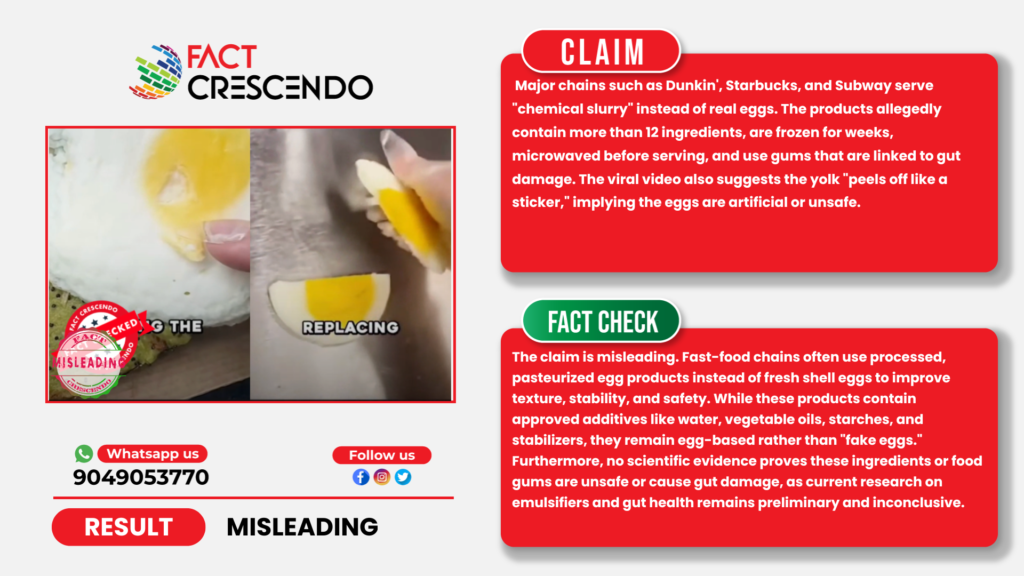
A viral video circulating claims to expose the “dark truth” behind breakfast sandwiches sold by major chains including Dunkin’, Starbucks, and Subway. The narrator alleges that the eggs are not real eggs but a “chemical slurry” made with more than a dozen ingredients, frozen for weeks, reheated before serving, and held together by gums supposedly linked to gut damage.
Our review of ingredient lists, food regulations, scientific literature, and manufacturer information found that the viral claim presents a misleading picture.
Social Media Posts
The claim has been widely shared in short-form videos across multiple social media platforms. In the footage, a person peels apart a frozen-looking egg patty while asserting that major restaurant chains are serving customers a manufactured mixture instead of genuine eggs with the claim that:
“What if I told you the “freshly cracked egg” in your favorite breakfast wrap has more in common with latex paint than a farm? This viral footage is exposing the dark truth behind industrial eggs at major chains like Dunkin’, Starbucks, and Subway. We’re talking about a chemical “slurry” made of :
“12+ Ingredients (not just egg!)
Soybean oil and industrial thickeners.
Freezing for weeks before being nuked in a microwave.
The most shocking part? That yellow yolk isn’t naturally staying there—it’s held together by gums linked to gut damage. If it peels off like a sticker, is it even food? 🤯
We deserve to know what’s fueling our bodies. It’s time to stop settling for “ultra-processed” and start demanding real food. 🥗💪”
Fact Check
What Are These Fast-Food Egg Products?
One of the central claims in the viral video is that breakfast sandwiches at Dunkin’, Starbucks, and Subway are made from a “chemical slurry” rather than real eggs. That characterization is inaccurate.
In the United States and many other countries, restaurants commonly use processed egg products, which are legally defined as eggs that have been removed from their shells and processed under government inspection. According to the U.S. Department of Agriculture (USDA), egg products include liquid, frozen, or dried eggs that may be blended with other approved ingredients before being pasteurized to reduce the risk of foodborne illness. These products are widely used throughout the food-service industry because they provide consistency, convenience, and improved food safety.
The USDA explains that processing can involve filtering, mixing, stabilizing, blending, pasteurization, chilling, freezing, or drying before packaging. Additional ingredients may be incorporated depending on the intended product, provided they comply with federal food safety regulations.
Therefore, egg patties with additional ingredients are classified as egg products, rather than imitation or synthetic alternatives.
The Ingredient Lists Are Real, but the Video Misrepresents What They Mean
The viral video correctly notes that some breakfast egg products contain more than just eggs. Publicly available nutrition and ingredient information confirms that several chains use formulated egg products for certain menu items.
For example, Dunkin’s breakfast egg patties contain eggs together with ingredients such as water, soybean oil, modified corn starch, xanthan gum, citric acid, natural flavors, and seasonings to help produce a uniform texture that withstands freezing, transportation, and reheating. Starbucks’ egg products similarly contain additional ingredients depending on the menu item, while Subway’s egg products also vary by market but may include stabilizers, vegetable oils, and other functional ingredients. These ingredient lists are publicly disclosed by the companies rather than hidden from consumers.
A longer ingredient list does not necessarily indicate that a product consists primarily of chemical additives. Food labels are legally required to list every ingredient in descending order by weight. As a result, ingredients appearing near the end of the list are typically present in significantly smaller quantities than those listed first. The FDA also requires that all ingredients be declared, regardless of whether they are naturally or synthetically derived. (Source: New York Post, FDA)
Why Are Water, Oils, Starches, and Gums Added?
The presence of unfamiliar ingredients often raises questions about the composition and authenticity of processed food products. In reality, most of these ingredients perform well-established technological functions. Water helps maintain moisture, vegetable oils contribute to texture, modified starches improve thickening and structural stability, xanthan gum and other hydrocolloids act as stabilizers and texturizers to produce a uniform consistency, while citric acid functions as a pH control agent to help maintain product quality. Natural flavors are added to provide or enhance flavor. These uses are consistent with the functions described by the U.S. Food and Drug Administration and are common across many processed foods, not just commercial egg patties.
The U.S. Food and Drug Administration categorizes these ingredients as common food additives used to stabilize products, improve texture, prevent separation, control moisture, or extend shelf life. Their presence does not indicate that a product is artificial or unsafe. Food ingredients are required to meet the same safety standards regardless of whether they originate from natural or synthetic sources.
The FDA also emphasizes that additives such as xanthan gum, guar gum, carrageenan, gelatin, and pectin are widely used as stabilizers, thickeners, binders, or texturizers across many processed foods, not just breakfast sandwiches.
Do the Additives Make Up Most of the Product?
The viral video suggests that eggs are a minor component and that the product is primarily composed of additives. However, ingredient labeling indicates that eggs constitute the largest portion of the formulation.
Ingredient lists are ordered by weight, meaning eggs appear first because they constitute the largest portion of the formulation. Functional ingredients such as gums, starches, acids, and flavorings generally appear later because they are added in relatively small amounts to achieve specific manufacturing purposes.
Although manufacturers do not publicly disclose the precise percentage of every ingredient in their proprietary formulations, there is no evidence that stabilizers or gums make up a substantial portion of the finished product. Instead, the products remain predominantly egg-based, with smaller amounts of functional ingredients added to improve consistency during commercial production. (Source)
Why Are These Egg Products Frozen and Reheated?
The video presents the freezing and reheating of these products as a critique of their quality. However, freezing is a standard preservation method used throughout the food industry. The USDA states that frozen egg products are routinely produced, distributed, and stored under regulated conditions, and can remain safe for extended periods when kept at appropriate freezer temperatures. Before reaching restaurants, commercially processed egg products are pasteurized to reduce harmful bacteria such as Salmonella, then frozen or refrigerated until use.
Restaurants subsequently reheat these products using ovens, steamers, or microwaves depending on their preparation systems. This standardized process is used to maintain consistency and meet food safety requirements across numerous restaurant locations. The freezing and reheating of egg patties is a standard practice in the production of many commercially prepared foods. (Source)
Are the Gums in These Egg Products “Linked to Gut Damage”?
This is the most scientifically nuanced part of the viral claim. While there is an active and growing body of research examining how some food emulsifiers and stabilizers may affect the gut microbiome and intestinal barrier, the video overstates both the strength and the certainty of the evidence.
First, the claim treats all “gums” as though they have identical biological effects. They do not. Food gums include a diverse group of ingredients such as xanthan gum, guar gum, cellulose gum (carboxymethylcellulose), carrageenan, locust bean gum, and gum arabic. These ingredients differ substantially in their chemical structures, technological functions, and the amount of scientific evidence available regarding their health effects.
Current research has identified carboxymethylcellulose (CMC) and polysorbate 80, two emulsifiers commonly used in processed foods, as among the additives with the strongest experimental evidence for altering gut microbiota and intestinal barrier function. However, this evidence comes largely from laboratory experiments, animal models, and a relatively small number of controlled human feeding studies. The evidence for xanthan gum, one of the gums commonly found in commercial egg patties, is considerably less consistent. (Source: Nature, Wiley)
What Does the Scientific Evidence Actually Show?
Over the past decade, researchers have investigated whether certain food additives may contribute to changes in the gut microbiome, intestinal permeability (“leaky gut”), or inflammation.
A 2024 review published in Nature Reviews Gastroenterology & Hepatology, which evaluated hundreds of studies on ultra-processed foods and food additives, concluded that there is growing evidence that some additives can influence gut health. However, the authors also emphasized that most of this evidence comes from preclinical studies involving animals or cell cultures rather than long-term human research. Human intervention studies remain relatively limited, making it premature to conclude that approved food additives routinely cause gut disease in people consuming normal diets.
Similarly, a 2024 review in Food Research International concluded that food additives may affect gut microbiota, intestinal barrier function, metabolism, and immune responses. However, the review repeatedly notes that further human research is needed before these findings can be translated into public health recommendations because much of the current evidence remains mechanistic or experimental.
In other words, there is a legitimate scientific discussion about whether certain food additives may influence gut biology. That is very different from saying they are proven to cause gut damage in people eating commercially prepared breakfast sandwiches.
Human Studies Do Not Support the Viral Claim
Unlike many viral nutrition claims, this topic has begun to be examined in controlled human studies. One of the most important studies to date was a 2024 randomized controlled feeding trial published in Alimentary Pharmacology & Therapeutics. Researchers assigned healthy adults to consume either a diet high in emulsifiers and thickeners or a comparable diet without them. The study found differences in intestinal permeability responses during acute physiological stress, but did not observe intestinal inflammation or evidence of clinical gut injury over the study period. The authors concluded that the findings warrant additional investigation rather than demonstrating that food emulsifiers cause disease.
What About Xanthan Gum Specifically?
Viral claims suggesting that gums in egg products are dangerous are not supported by the evidence for xanthan gum specifically. Xanthan gum is a widely used, regulator-approved food thickener and stabilizer. While some laboratory studies have explored potential effects on gut bacteria, findings remain mixed and do not demonstrate harm in everyday human diets. (PubMed) Experts caution that findings from specific additives or laboratory experiments cannot be generalized to all gums or real-world dietary exposure. (Frontiers)
Does the “Sticker Yolk” Prove the Egg Is Fake?
The visual of a yolk peeling cleanly from the egg white is often misinterpreted as evidence of an artificial product. In reality, this is a result of intentional food engineering. Processed egg products are formulated with stabilizers and specific cooking methods to ensure they maintain their structural integrity and consistent texture during industrial handling, freezing, and reheating. These characteristics are designed to provide a uniform experience across restaurant locations rather than indicating the product is “fake.” (Nature)
Conclusion
The claim is misleading. While chains like Dunkin’, Starbucks, and Subway use processed egg products containing ingredients like oils, starches, and gums, these additives serve to improve texture, consistency, and shelf life. Their inclusion does not mean the products are ‘fake eggs’ or a ‘chemical slurry.’
The claim overstates gut health science. While researchers are studying if emulsifiers affect the gut microbiome or intestinal barrier, evidence is mostly from laboratory and animal studies, with limited human data. Current studies do not prove that gums in these commercial egg products cause gut damage under normal conditions. Thus, the viral video exaggerates a complex, evolving area of nutrition science by presenting preliminary research as established fact.

Title: Viral Video Misrepresents Processed Egg Products at Dunkin’, Starbucks and Subway as a “Chemical Slurry”
Fact Check By: Cielito Wang
Result: Misleading
