

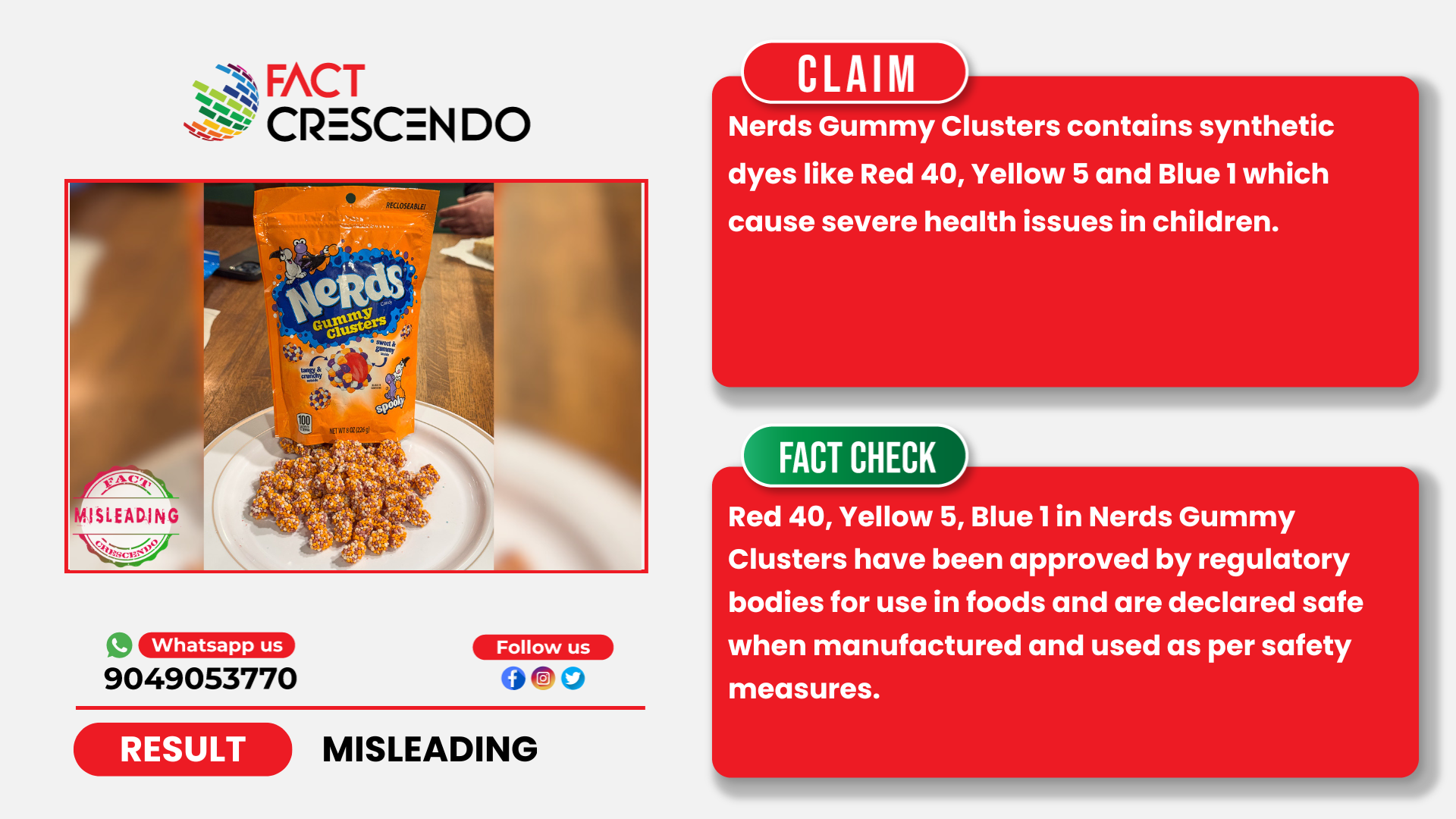
Social media posts have raised concerns about Nerds Gummy Clusters, claiming that the candy contains artificial food colors such as Red 40, Blue 1, and Yellow 5, which are allegedly harmful to children and linked to neurological disorders, hyperactivity, and other health problems. These claims have led many consumers to question whether the product is safe to eat.
However, Fact Crescendo found the claim to be misleading. Red 40, Blue 1, and Yellow 5 are approved food additives. So, their presence in Nerds Gummy Clusters do not make the product unsafe when consumed within the established limits.
Fact Check-
Red 40: Red 40 is a synthetic dye that’s used in a variety of foods. The full name of this dye is FD and C red no. 40. It’s considered a color additive. Red no. 40 consists of a chemical compound called Allura red AC.
The European Food Safety Authority (EFSA) reviewed the safety of Allura Red AC (E 129), a food colouring allowed in the EU, and confirmed it is safe within the established acceptable daily intake (ADI) of 0-7 mg/kg body weight. While a recent study suggested it might cause DNA damage in mice at high doses, long-term studies showed no evidence of cancer, even at doses far exceeding typical human consumption. Other genetic tests and studies on its breakdown products also indicated no significant harm. EFSA concluded that the observed DNA effects are unlikely to lead to cancer, reaffirming Allura Red AC’s safety when used as a food additive.
FDA has permitted the use of Red 40 in cereals, beverages, gelatins, puddings, dairy products, and confections.
Yellow 5: According to a study conducted in 2015, researchers found that food with Yellow 5 as an ingredient damages the DNA of white blood cells. It was also found that since gastrointestinal tracts are exposed directly to yellow 5, these cells may be more likely to develop cancer.
FDA and top researchers have reviewed the evidence and concluded that Tartrazine doesn’t pose an immediate threat to human health. However, research does suggest that this dye may harm cells over time, especially when cells are exposed to greater amounts than the recommended intake.
The EFSA reviewed the safety of Yellow 5, also known as Tartrazine is a yellow food dye used in many products. Older studies showed that only a tiny amount of Tartrazine is absorbed by the body, while most of it is broken down by gut bacteria and leaves the body in urine. An acceptable daily intake (ADI) of 7.5 mg per kg of body weight was set many years ago, but the studies used were not detailed enough or focused on mixtures of dyes instead of just Tartrazine. Because of this, EFSA advised for more research to fully understand if Tartrazine is safe and if the ADI needs to be updated.
FDA has also approved the use of Yellow 5 in confections, cereals, snack foods, condiments, baked goods, and yogurt.
Blue 1: The EFSA reviewed the safety of Blue 1, also known as Brilliant Blue FCF (E 133). It was previously approved with an acceptable daily intake (ADI) of 10 mg/kg body weight per day, set in 1984. After reviewing new data on how the dye is absorbed, processed, and its effects on health, the EFSA decided to lower the ADI to 6 mg/kg body weight per day. This decision was based on updated studies showing the dye is safe at this level. The EFSA also found that most people’s intake is below this new ADI.
Conclusion:
Fact Crescendo found the claim to be misleading. Red 40, Yellow 5, Blue 1 have been approved by regulatory bodies for use in foods and are declared safe when manufactured and used as per safety measures. So the presence of these ingredients in Nerds Gummy Clusters are safe.
Title: Nerds Gummy Clusters: Is it safe or should be avoided? Know the facts.
Fact Check By: Siddharth Sahu
Result: Misleading
