

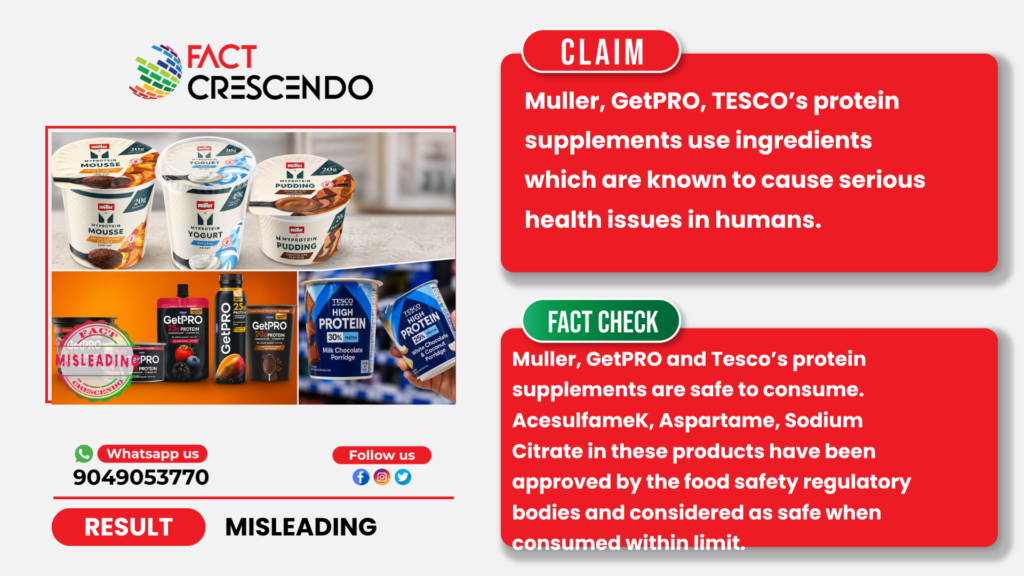
In recent weeks, social media users were found to raise concerns about the safety of protein supplements from popular brands like Muller, GetGrow, and Tesco. Social media claims suggest that these brands use harmful ingredients like aspartame, acesulfame K and sodium citrate which are known to cause serious health issues.
However, Fact Crescendo found the claim to be misleading. All the mentioned ingredients in Muller, GetPRO and Tesco’s protein products are safe and approved for use.
Fact Check-
Let’s check the safety of all the ingredients mentioned in the viral video.
Aspartame: Aspartame is a low-calorie sweetener which tastes sweet but does not contain any natural sugars and its calorie level is much less than sugar. It is 200 times sweeter than sugar that is why it is used in very less quantity. It is an artificial substance and made of two naturally occurring amino acids called aspartic acid and phenylalanine.These two amino acids are found in various foods and in the human body as well.
According to the World Health Organization (WHO), the International Agency for Research on Cancer (IARC) conducted a study and classified Aspartame as possibly carcinogenic to humans (Group 2B) based on limited evidence for cancer in humans. Group 2B category means possibly carcinogenic to humans. Gasoline engine exhaust, occupational exposure as hair dresser or barber etc falls under this classification.
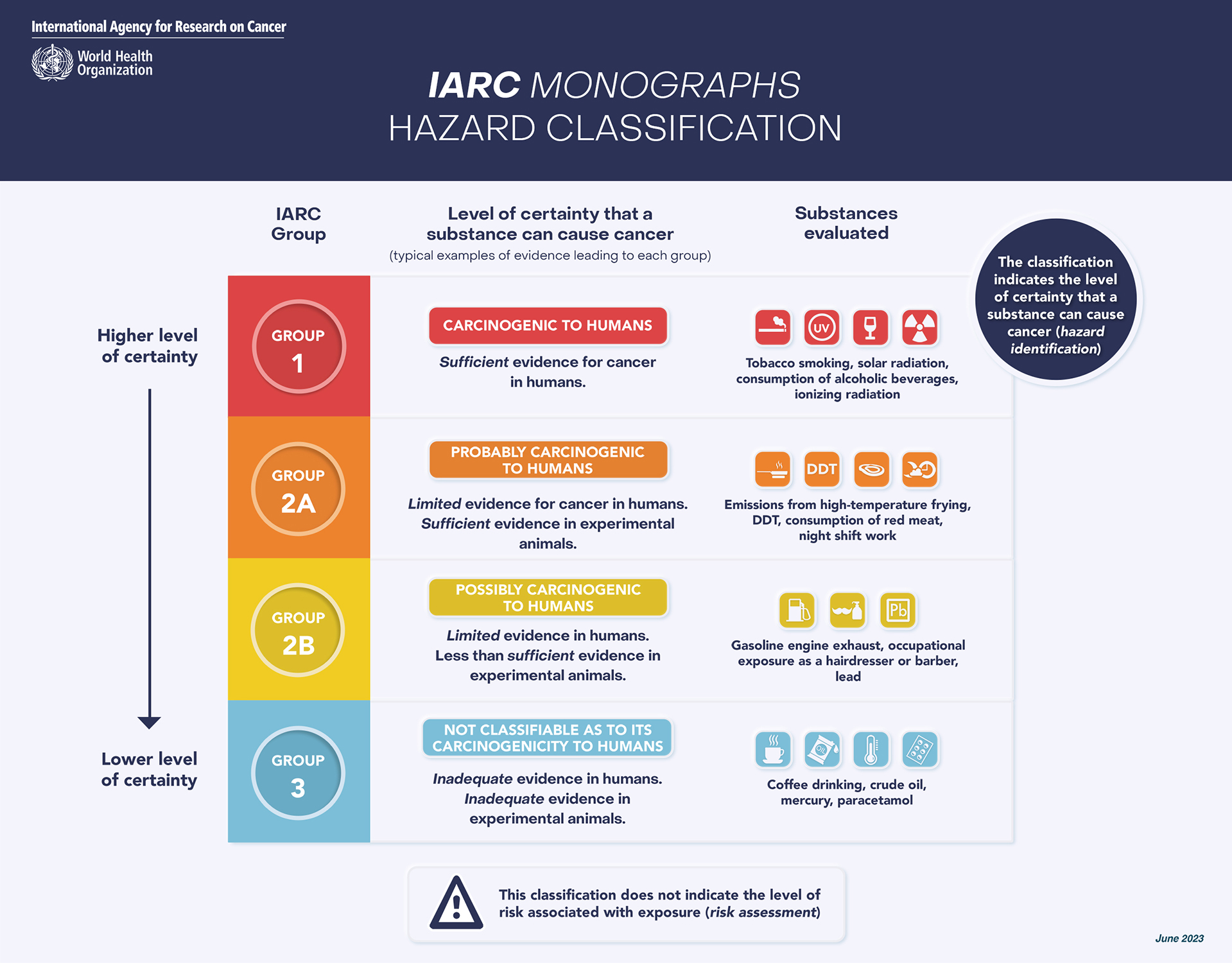
This classification was based on three studies that found a positive association between artificially sweetened beverages and liver cancer risk, though chance, bias, or other factors could not be ruled out. WHO also stated that the evidence of toxicity of Aspartame was not conclusive.
JECFA also concluded that there was no convincing evidence from experimental animal or human data that aspartame has adverse effects after ingestion. JECFA confirmed that aspartame is safe to consume within the daily limit of 0–40 mg per kilogram of body weight. That means, a 70 kg adult would need to drink more than 9–14 cans of diet soda in a day to go over the limit, as long as they don’t get aspartame from other foods.
Aspartame is safe when consumed in typical amounts, and even large single doses (up to 200 mg per kilogram of body weight, equivalent to drinking about 28 liters of diet soda) do not cause toxicity. Its breakdown products—methanol, phenylalanine, and aspartic acid—remain at levels far below those that could be harmful. The metabolite formate, which can be toxic if it accumulates, is efficiently excreted in urine, preventing dangerous buildup. Studies also confirm that consuming aspartame within the acceptable daily intake limit of 40 mg per kilogram of body weight poses no risk of brain toxicity or adverse behavioral effects, even under acute dosing conditions.
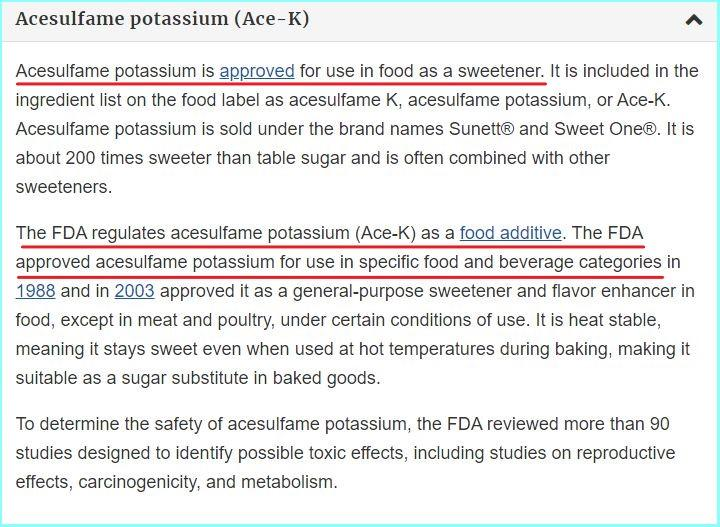
Acesulfame K: Acesulfame potassium, also known as Ace-K or E950 has been approved by FDA for use in food as a sweetener. The FDA approved acesulfame potassium (Ace-K) as a food additive in 1988 for certain foods and beverages, and in 2003, it was approved as a general sweetener and flavor enhancer. To ensure its safety, the FDA reviewed over 90 studies that looked at potential toxic effects, including its impact on reproduction, cancer risk, and metabolism.
According to another report, the FDA and National Cancer Institute (NCI) had confirmed that Ace-K is safe and that there is enough evidence to say that it does not cause cancer. In 2005, the National Toxicology Program conducted a large animal study where they gave mice acesulfame potassium, making up 3% of their diet, for over 40 weeks. This is roughly equal to a person consuming more than 1,000 cans of soft drinks daily. The study found no evidence of an increased risk of cancer in the mice.
Sodium Citrate: According to the European Commission’s Food Additives Database, Sodium citrate (E331) has been approved for use in the foods. The regulation has allowed the use of this only to the extent it is required to achieve its purpose like controlling acidity, stabilising texture, or improving emulsification.
It is considered as one of the lowest risk food additives because it is just a sodium salt of citric acid. After consumption, the body breaks it down and processes it. It does not accumulate in tissues or create toxic residues. International food safety authorities have found no evidence of carcinogenicity, genotoxicity, reproductive toxicity, or long-term organ damage at the levels used in foods.
Conclusion:
Fact Crescendo found the claim to be misleading. Muller, GetPRO and Tesco’s protein supplements are safe to consume. AcesulfameK, Aspartame, Sodium Citrate in these products have been approved by the food safety regulatory bodies and considered as safe when consumed within limit.
Title: Do Müller, GetPRO and Tesco Protein Snacks Contain Unsafe Ingredients?
Fact Check By: Siddharth Sahu
Result: Misleading
