

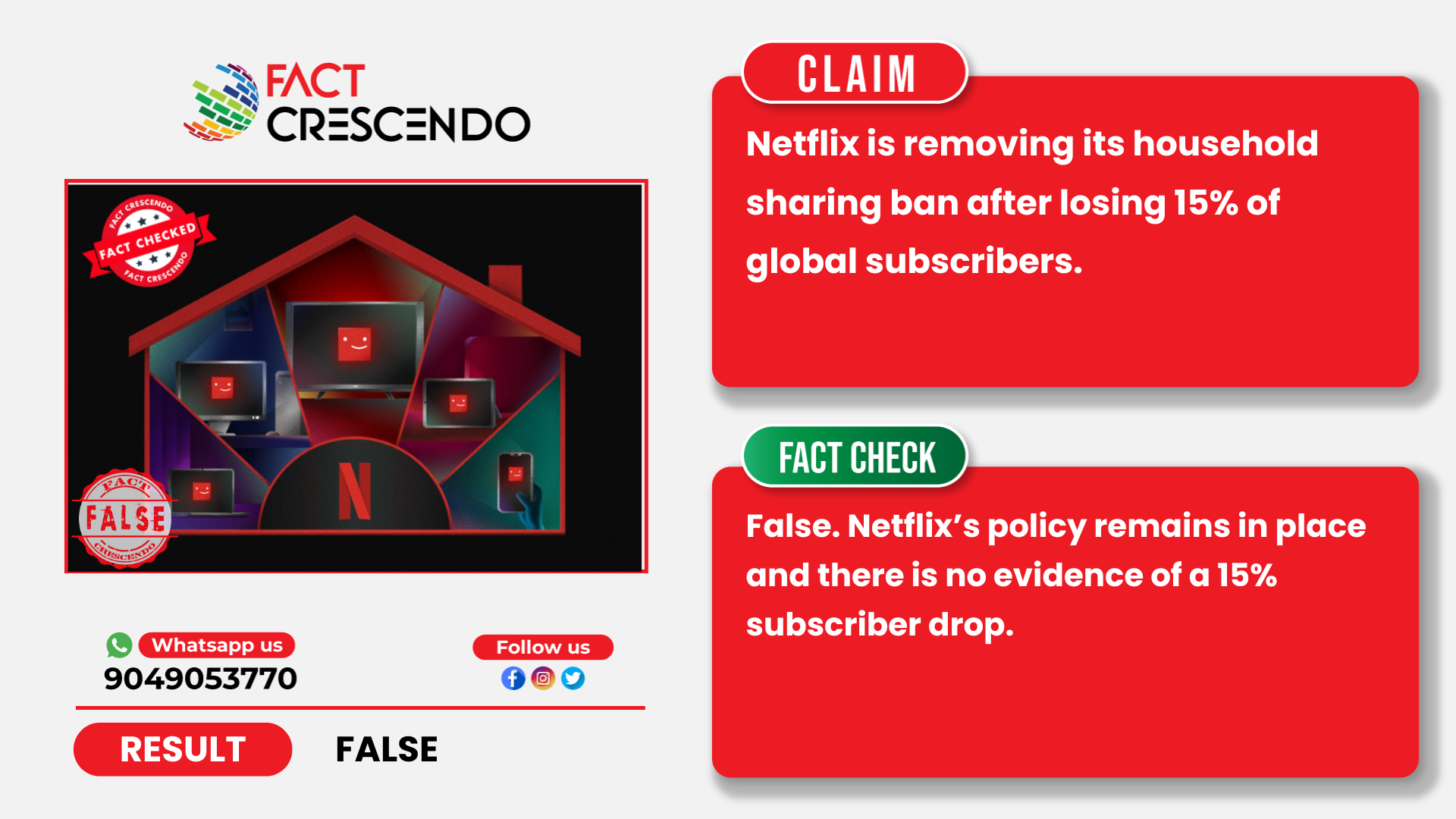
A claim circulating widely on social media platforms alleges that Netflix is reversing its household sharing ban after suffering a 15% drop in global subscribers. The claim has gained traction amid ongoing public debate over Netflix’s password-sharing restrictions introduced in recent years. However, we found this claim to be false.
Social Media Posts
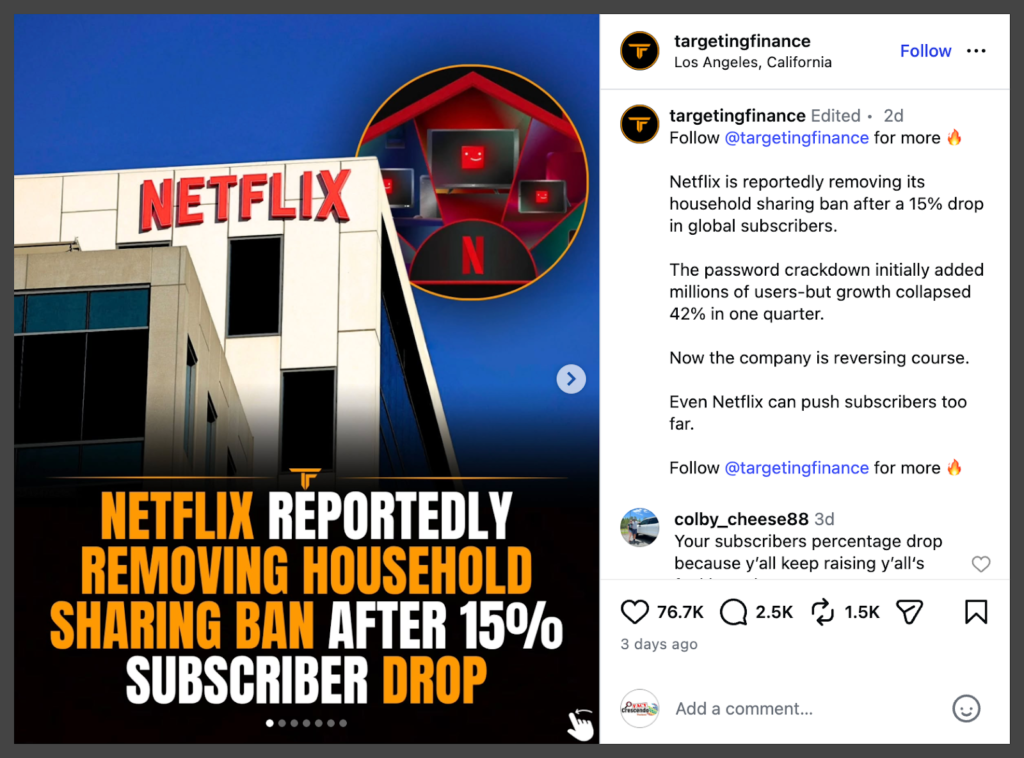
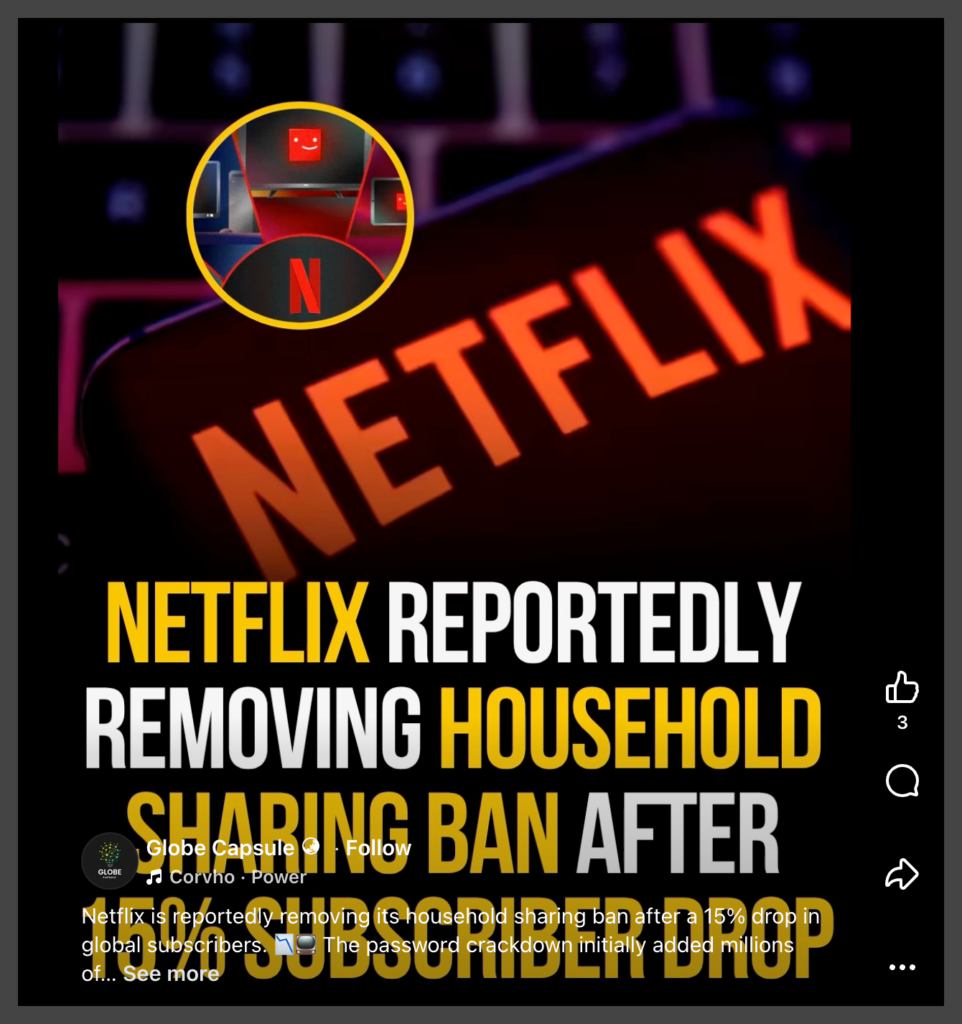
Posts circulating online typically state that Netflix is “removing its household sharing ban” due to a “15% drop in subscribers,” often without citing any sources. Variations of this claim appear across Instagram and Facebook.
Fact Check
Netflix’s Official Policy Remains Unchanged
Netflix’s current official policy restricts account sharing to a single household. The company’s help center states that “a Netflix account is meant to be used by people who live together in one household,” and notes that users “may not share their account outside of their household.” See the policy here.
The company defines a household as people living together at a primary residence. Under this definition, friends or family members in different locations are not intended to use the same account unless added through paid options. Additional details on how Netflix defines and enforces this policy are outlined in its official guide.
Netflix has reiterated this approach in newsroom updates, including its 2023 and subsequent communications about password sharing enforcement (see here). As of this article, Netflix has not announced a rollback of these rules.
Netflix enforces its household-based policy by requiring users to set a primary location and by linking account access to devices and network activity associated with that location. Accounts can be accessed while traveling, but the account remains tied to the primary household.
In regions where available, Netflix offers a paid “extra member” feature that allows a person outside the household to be added to an account. This is the company’s described method for cross-household access, and it is not free.
A review of Netflix’s official communication channels, including its newsroom, investor relations site, and press releases, shows no statements from executives or representatives confirming any reversal of the household sharing policy.
We also reached out to Netflix for further clarification, but as of this writing, we have not received a response.
The “15% Subscriber Drop” Claim Is Inaccurate
The claim that Netflix experienced a 15% drop in global subscribers is not supported by credible data. In fact, the company’s latest financial reporting shows continued growth.
According to Reuters, Netflix reported more than 325 million subscribers worldwide at the end of 2025, exceeding expectations and reflecting ongoing expansion rather than decline. Similarly, Variety reported strong subscriber gains in its coverage of Netflix’s Q4 2025 earnings.
This reflects an increase from roughly 301 million subscribers earlier in 2025, which is consistent with growth rather than a decline. By comparison, a 15% decrease from 325 million would amount to a loss of about 49 million subscribers, a change that would likely be reflected in widely reported financial and media coverage. We did not find credible reports indicating such a decline.
Beyond subscriber figures, Netflix’s recent business strategy also includes investments in new revenue streams. The company has expanded its ad-supported subscription tier, which has become an important part of its revenue growth. Reports indicate that Netflix’s advertising business generated over $1.5 billion in 2025 and is projected to grow further in the coming years, reflecting its increasing role in the company’s overall strategy. (Source)
Conclusion
The claim that Netflix is removing its household sharing ban after a 15% drop in subscribers is false. There is no official announcement indicating any policy reversal, and Netflix’s current guidance continues to limit account sharing to a single household. Additionally, subscriber data reported by the company and covered by major outlets shows continued growth, not a significant decline.

Title: Netflix Is NOT Reversing Its Household Sharing Ban After a “15% Subscriber Drop”
Fact Check By: Cielito Wang
Result: False
