

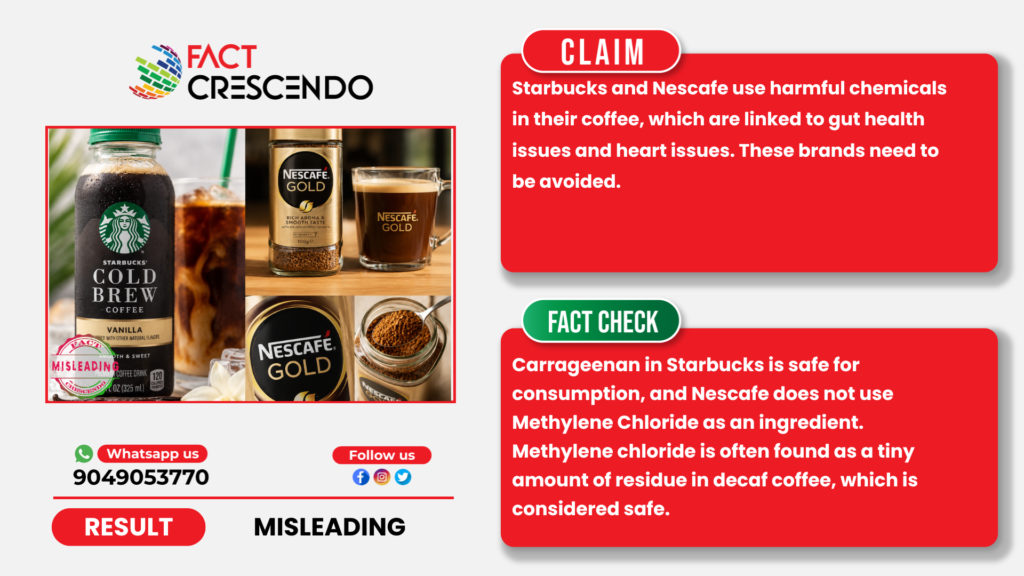
Social media posts have recently raised concerns about the safety of certain Starbucks and Nescafé products, claiming that these brands use carrageenan and methylene chloride which may pose health risks to consumers. The claim suggests that these chemicals lead to gut problems and heart issues.
However, Fact Crescendo found the claim to be misleading. Both the ingredients mentioned to be used in Starbucks and Nescafe are found to be safe. Carrageenan is safe and approved to be used. Methylene Chloride is not used as an ingredient but to decaf the coffee. A tiny residue may remain in coffee which is considered safe.
Fact Check-
Starbucks contains Carrageenan which affects gut health:
What is Carrageenan?
Carrageenan is an additive used to thicken, emulsify (improve mixing), and preserve processed foods and drinks’ texture, taste, shelf-life, and appearance. It comes from red seaweed also known as Irish Moss. In the late 1900s, researchers suggested that it may trigger inflammation, gastrointestinal ulcerations, and damage to the digestive system. The controversy about the safety of carrageenan increased to the extent that people had petitioned for products with it to be entirely removed or labelled with a warning.
According to a study, the FDA in 2012 rejected a request to ban carrageenan in food but didn’t fully review all scientific research. The report on the study further tried to encourage consumers to resist using products with carrageenan which will eventually put pressure on the brands to stop using the ingredient in their products.
Is Carrageenan safe?
Further research on this led us to the National Institute of Health’s report on the use of carrageenan as a food additive. According to the report, food-grade carrageenan does not get absorbed by the body. It remains stable in the digestive system. Studies show that carrageenan does not cause cancer or promote tumors, and its effects on the immune system are not relevant to its oral consumption. Toxicological studies on carrageenan at very high doses (much higher than human exposure) show no harmful effects. International food safety organizations, like JECFA, have reviewed carrageenan and consider it safe for consumption.
EFSA evaluated the food additive carrageenan (E407) and processed Eucheuma seaweed (E 407a). Studies show that carrageenan is not absorbed by the body, is not toxic even in large amounts, and does not cause cancer or genetic damage. Processed Eucheuma seaweed is also considered safe. However, there are still some uncertainties about its chemistry, how much people are exposed to, and some biological effects. Because of these unknowns, the current safe intake limit of 75 mg per kg of body weight per day has been set. More research is being done to better understand carrageenan’s effects.
Nescafe contains Methylene Chloride which is linked to heart disease:
What is Methylene Chloride?
Methylene Chloride, also known as Dichloromethane is a colorless, volatile liquid chemical with a sweet, chloroform-like odor. It is widely used as an industrial solvent for its characteristic to dissolve many substances and evaporate quickly.
Does Nescafe use Methylene Chloride as an ingredient in its coffees?
After looking at the ingredient lists of a few Nescafe products, we found that Methylene Chloride is not used as an active ingredient in Nescafe’s products. Nescafe, on its website, has clarified that it uses Methylene Chloride to decaf the coffees.
Previously, the company used Benzene to decaf but after it was discovered to be carcinogenic, the company switched to Methylene Chloride. However, there has been more controversy about methyl chloride, due to exposure to high amounts being toxic and leading to central nervous system damage.
A National Geographic article explained that some decaf coffee is made using Methylene Chloride to remove caffeine from coffee beans. However, this chemical has been linked to cancer and other health problems in workers who are exposed to large amounts of it, so some health advocacy groups want it banned from food processing.
But experts cited no reason for consumers to panic because only tiny traces of methylene chloride are allowed to remain in decaf coffee. Various tests have found the levels of this chemical to be below the established limits. The current evidence suggests that decaf coffee made with methylene chloride remains within safety standards. The article also stated that Swiss Water Process, the ethyl acetate (sugarcane) process, and the CO₂ process can be used to make decaf coffee.
According to the U.S. FDA regulations, methylene chloride may be used as a solvent to remove caffeine from coffee beans during the decaffeination process. The regulation instructed the manufacturers to follow good manufacturing practices and strictly limits the amount of methylene chloride that can remain in the final product. For roasted decaffeinated coffee and instant decaffeinated coffee extract, the maximum permitted residue is 10 parts per million (ppm).
Conclusion:
Fact Crescendo found the claim to be misleading. Carrageenan in Starbucks coffee is safe for consumption. Nescafe does not use Methylene Chloride as an ingredient but in the process to decaf coffee. A tiny residue of Methylene Chloride can be found in coffee but the amount is safe and not dangerous.
Title: Are Starbucks and Nescafe Products Harmful Due to Carrageenan and Methylene Chloride?
Fact Check By: Siddharth Sahu
Result: Misleading
