

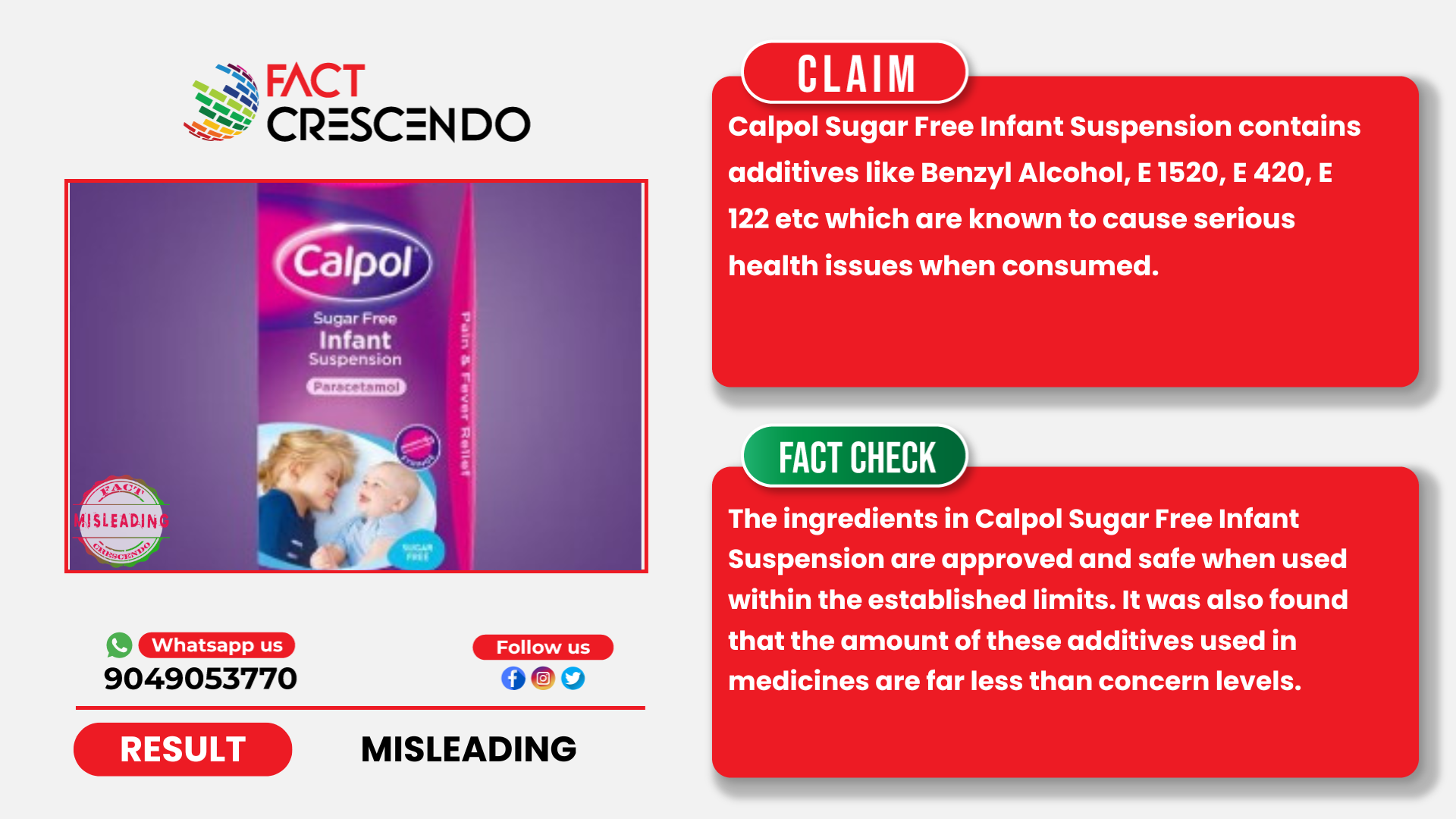
Calpol Sugar Free Infant Suspension is a liquid medicine for babies and young children that contains paracetamol. It is mainly prescribed to reduce fever and to relieve mild to moderate pain.
Recently, social media users were seen raising concerns over the safety of this medicine. The claim suggests that Calpol Sugar Free Infant Suspension contains many harmful ingredients like E 1520, E 420, E 122, E 214, Benzyl Alcohol etc which are not fit for consumption by infants. It was also mentioned that these ingredients are known to cause serious health issues rather than healing the sick.
However, Fact Crescendo found the claim to be misleading. All the mentioned ingredients are approved by regulatory bodies after studies showed these to be safe for use.
Fact Check-
Propylene Glycol (E 1520): As per the information available on CDC website, Propylene glycol is a synthetic liquid substance that absorbs water. It is also used to make polyester compounds, and as a base for deicing solutions. Propylene glycol is used by the chemical, food, and pharmaceutical industries as an antifreeze. The Food and Drug Administration (FDA) has classified it as an additive that is “generally recognized as safe (GRAS)” for use in food. It is used to absorb extra water and maintain moisture in certain medicines, cosmetics, or food products.
The National Institute of Health’s article stated that propylene glycol is a commonly used ingredient in medicines, foods, and cosmetics. It helps in dissolving and stabilizing other ingredients. The U.S Food and Drug Administration considers it safe when used within the approved amounts.
However, in rare situations, when the ingredient is consumed in high doses toxicity has been noticed. Infants, people with kidney or liver problems, and critically ill patients may be more vulnerable because their bodies clear the substance more slowly. These cases are uncommon and mainly associated with excessive pharmaceutical exposure rather than the small regulated amounts used in everyday medicines.
The European Food Safety Authority (EFSA) reviewed the safety of propylene glycol and concluded that it is safe for use as a food and drug additive within approved limits. The scientific review found no evidence that E1520 causes genetic damage, cancer, or reproductive problems at normal exposure levels. EFSA noted that the body can absorb and break down propylene glycol into substances that are naturally processed and removed from the body.
Sorbitol (E 420): Sorbitol is a water soluble compound found naturally in some foods. It’s also commercially manufactured from corn syrup for use in packaged foods, beverages, and medications. It is used to preserve moisture, add sweetness, and provide texture to products, as well as potentially support digestive and oral health.
Side Effects of Sorbitol: Consuming sorbitol in large amounts can cause bloating and diarrhea in some people. It may be accompanied by abdominal cramping or nausea. Some rare side effects like dehydration, electrolyte imbalance, and allergic reactions can also be seen.
Is Sorbitol Safe? According to the National Institute of Health, Sorbitol is commonly used as a sweetener and inactive ingredient in medicines. It is Generally Recognized As Safe (GRAS).
Benzyl Alcohol: The European Medicines Agency (EMA) in an article clarifies that Benzyl alcohol can be dangerous for newborn and premature babies because their bodies cannot break it down properly. A high dose of 100-200mg/kg/day given through injection can cause ‘Gasping Syndrome’ which can lead to the death of babies.
Because of safety concerns, health authorities set an Acceptable Daily Intake (ADI) limit of 0-5mg/kg body weight per day. Extra caution needed to be followed in case of children under 3 years of age.
According to the EFSA, Benzyl Alcohol is used in many foods, medicines, cosmetics, some injectable products etc. Review of various studies revealed that a small amount of Benzyl Alcohol is considered safe for adults and older children. It is not considered carcinogenic or genotoxic at normal exposure level. The human body breaks it down into harmless substances.
However, newborn babies and young children are more sensitive because their bodies cannot remove it efficiently. Therefore, a safe daily intake level of 4 to 5mg per kg body weight per day is set.
Azorubine (E 122): Azorubine is a monoazo dye that occurs as red powder or granules. It is mostly used in beverages, confectionery, bakery, dairy fats and oil, meat, seafood, pharmaceuticals etc.
The Joint FAO/WHO Expert Committee on Food Additives (JECFA) established an Acceptable Daily Intake (ADI) of 0-4 mg per kilogram of body weight in 1983. Under international food standards, maximum permitted levels (MPLs) for azorubine have been set for more than 35 food categories. The European Food Safety Authority (EFSA) also established the same ADI of 0-4 mg/kg body weight in its 2009 assessment. On the contrary, the United States has never authorized azorubine for use in food products. It was only previously permitted in external drugs and cosmetics before being removed from the list in 1963.
In 2007, The Times reported that certain studies have linked the use of additives like E 122 to the hyperactive behaviour in children. Many groups had pointed out that while many food manufacturers reduced or removed these additives from foods and drinks, some children’s medicines still contained them.
However, health authorities and regulatory bodies have clarified that the amount of these additives in medicines are much smaller than those consumed through food. Also, there was no clear evidence that medicines containing these additives directly cause hyperactivity.
Conclusion:
Fact Crescendo found the claim to be misleading. The ingredients in Calpol Sugar Free Infant Suspension are approved and safe when used within the established limits. It was also found that the amount of these additives used in medicines are far less than concern levels.
Title: Viral Claims About Calpol Sugar-Free Infant Suspension Ingredients Are Misleading
Fact Check By: Siddharth Sahu
Result: Misleading
