

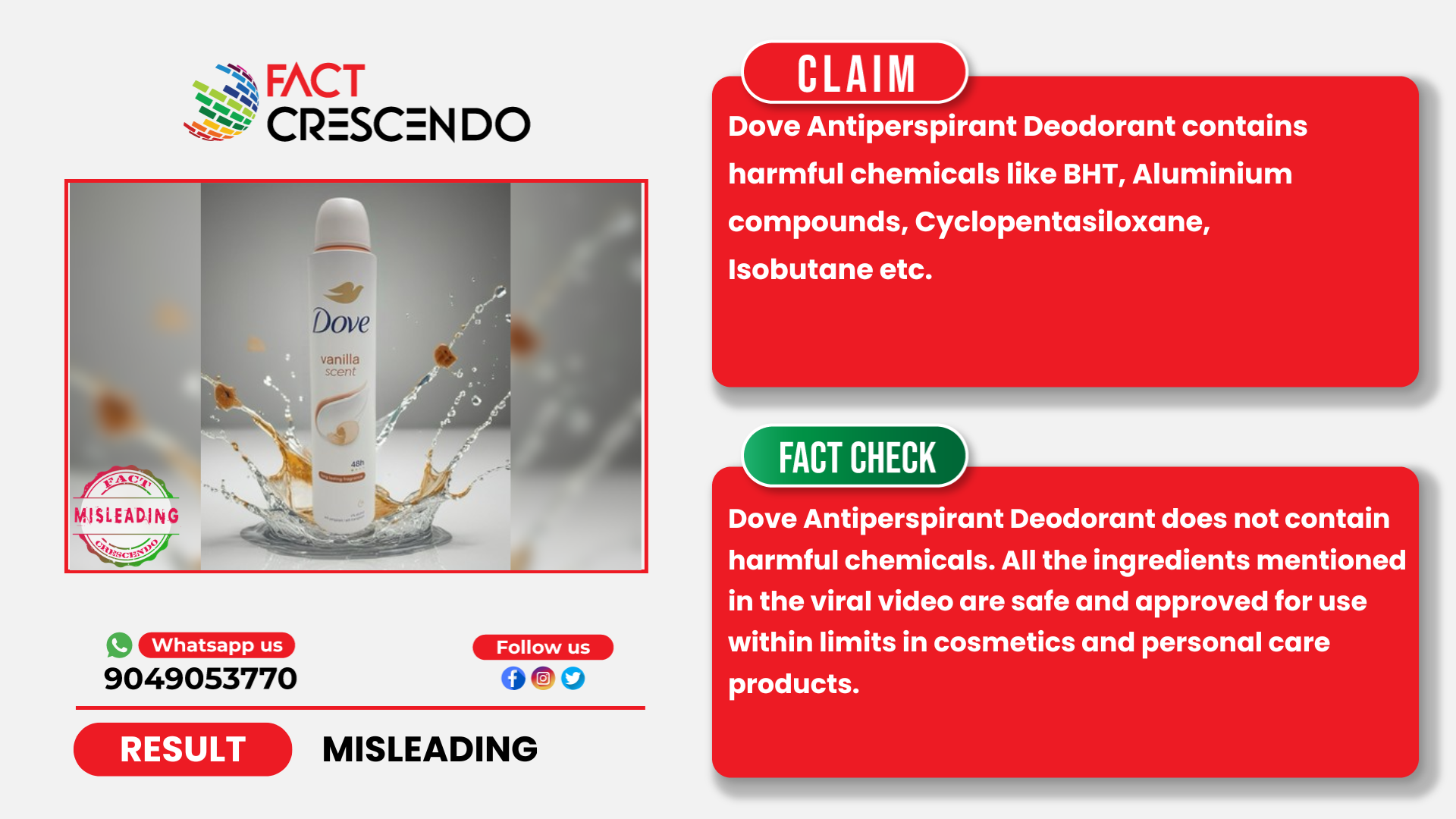
Many social media posts claim that Dove deodorants and antiperspirants contain harmful chemicals such as isobutane, cyclopentasiloxane, BHT, and other ingredients, and warn consumers to avoid using the products.
However, Fact Crescendo found the claim to be misleading. All the ingredients in Dove Antiperspirant Deodorant are safe and approved by the regulatory bodies. The claim is based on incomplete facts.
Fact Check-
Let’s check the facts about the safety of the ingredients mentioned in the viral video.
BHT: Butylated Hydroxytoluene or BHT is widely used in cosmetics and personal care products at very low concentrations. Only a small amount of it is absorbed by the skin, but it remains in the skin with little to no systemic exposure. It is not considered to be genotoxic, carcinogenic, or harmful to reproduction. However, animal studies show that high oral doses can affect the liver, kidneys, and lungs. Usually these effects occur at levels much higher than typical cosmetic use.
According to the European Commission’s Scientific Committee on Consumer Safety (SCCS), BHT is considered safe when used within specific limits in cosmetic products. The review found that BHT does not pose a risk to human health. It is considered as safe when its concentration is up to 0.001% in mouthwash, 0.1% in toothpaste, and up to 0.8% in other cosmetic products.
Based on the results from both animal studies and human clinical data, the Cosmetic Ingredient Review (CIR) Expert Panel has carefully evaluated BHT (butylated hydroxytoluene). They concluded that BHT does not pose a risk when used in cosmetics and personal care products at permissible levels. This means BHT is considered safe for consumers in cosmetic formulations, such as lotions, creams, antiperspirant deodorant, and makeup, as long as it is used within the recommended concentrations.
Aluminium Chlorohydrate: After reviewing the newly provided data, the Scientific Committee on Consumer Safety (SCCS) concluded that aluminium compounds are safe to use in cosmetics when used within specific limits. It found that aluminium is safe at concentrations of up to 6.25% in non-spray deodorants and antiperspirants, 10.6% in spray deodorants and antiperspirants, 2.65% in toothpaste, and 0.77% in lipsticks. The SCCS also stated that the amount of aluminium absorbed from cosmetic products is very small and does not increase the body’s overall aluminium exposure to harmful limits.
The Cancer Council of Australia also stated that there is no evidence to support the claim that deodorants or antiperspirants cause cancer. The rumours about aluminium compounds in deodorants or antiperspirants emphasizes that aluminium prevents us from getting rid of toxins in our sweat, which clog up lymph nodes and lead to breast cancer. This rumor is wrong and lacks fact.
Cyclopentasiloxane: Cyclopentasiloxane is a clear, odorless, silicone-based ingredient commonly used in cosmetics such as lotions, creams, deodorants, hair products, and makeup. It helps products spread smoothly and gives a silky feel.
According to the Scientific Committee on Consumer Safety (SCCS), the ingredient does not irritate the skin or eyes and does not cause skin allergies. Only a very little amount of it is absorbed through the skin and most of it is removed through breathing within 24 hours.
It has low toxicity when swallowed, inhaled or applied to the skin. It was found that during animal studies in rats, very high doses given to rats caused temporary increases in liver weight. However, there was no damage to the liver and the effect subsided once the exposure was stopped. It was also found that it did not affect fertility or reproduction. Some changes in the reproductive organs of female rats were seen when they inhaled it at very high levels (223ppm), which is much higher than what people are exposed to while using cosmetics.
Another study found cyclopentasiloxane to have low toxicity and it is poorly absorbed through the skin as most of it evaporates before entering into the body. The small amount which is absorbed, gets removed from the body by exhalation. It is not genotoxic and does not cause developmental or reproductive toxicity either.
Isobutane: It is a common ingredient in cosmetics, used as aerosol propellants. It is produced from natural gas and petroleum. Cosmetic Ingredient Review considers it as a stable ingredient. During studies, it was found that it did not cause mutations in the standard tests, so the chance of this ingredient being genotoxic was ruled out.
During animal studies it was found that a very high concentration of Isobutane can be fatal, but such levels are much higher than normal exposure. Some of the side effects are mild irritation of the skin and eyes, but it does not last much. Even in human studies no serious health effects were found.
According to the National Institute of Health, Isobutane is a stable and non-reactive gas and does not form harmful substances. Therefore, it is generally considered safe when used as intended. Studies have shown that a very small amount of it comes in contact with people, due to which its exposure level is quite low. It was also found that it does not damage DNA or cause any other serious health hazards.
Conclusion:
Fact Crescendo found the claim to be misleading. Dove Antiperspirant Deodorant does not contain harmful chemicals. All the ingredients mentioned in the viral video are safe and approved for use within limits in cosmetics and personal care products.
Title: Claims That Dove Deodorants Contain Harmful Chemicals Are Misleading.
Fact Check By: Siddharth Sahu
Result: Misleading
