

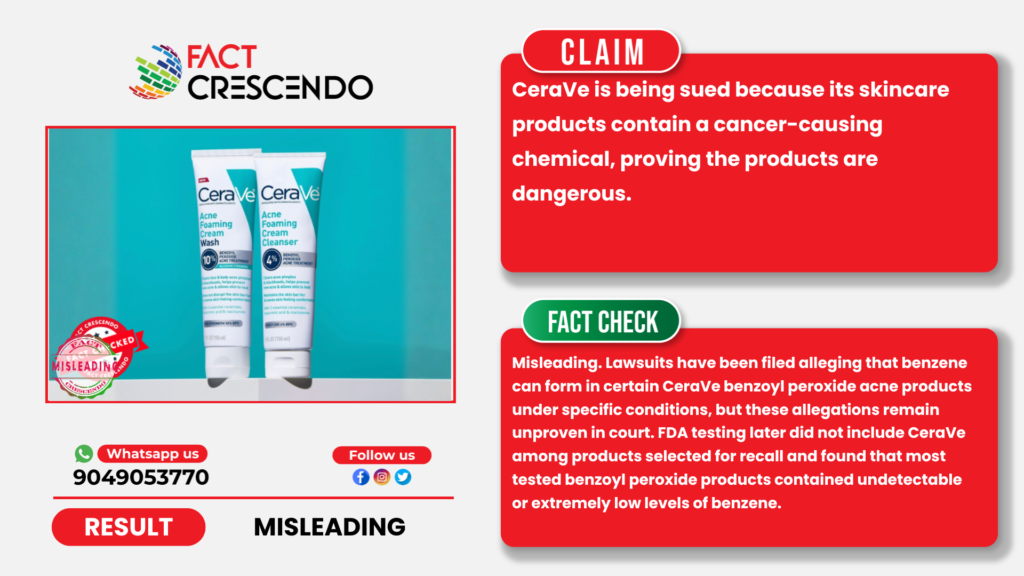
Viral social media posts claim CeraVe is being sued because a “cancer-causing chemical” was allegedly found in its skincare products. As a globally popular, dermatologist-recommended brand, these allegations have sparked widespread concern.
Our review confirms that while L’Oréal USA faces lawsuits concerning CeraVe acne products containing benzoyl peroxide, the claims are misleading. These posts often omit critical details regarding U.S. regulatory findings and the fact that the allegations remain unproven in court.
Social Media Posts
Posts circulating on Facebook, Instagram, and TikTok claim that: “CeraVe is being sued for a cancer-causing chemical in its products.”
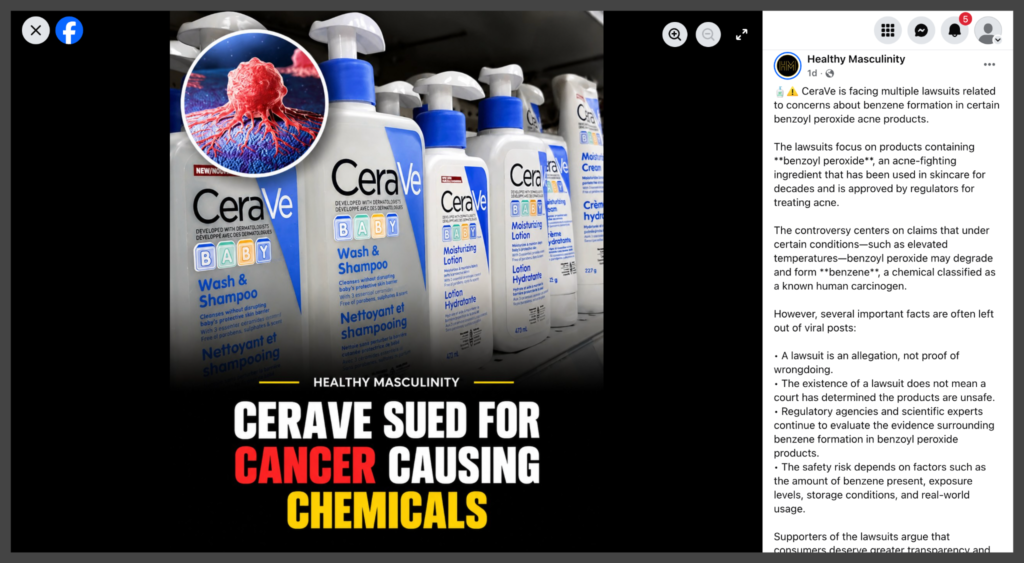
Below are few other posts with the same narrative
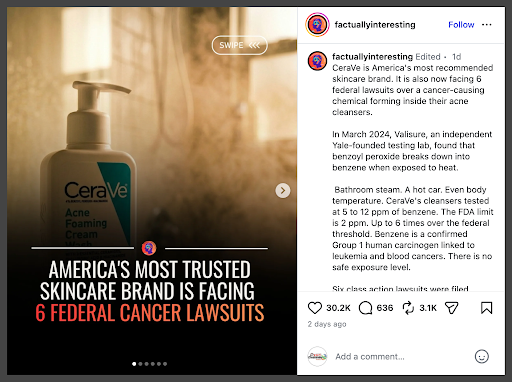
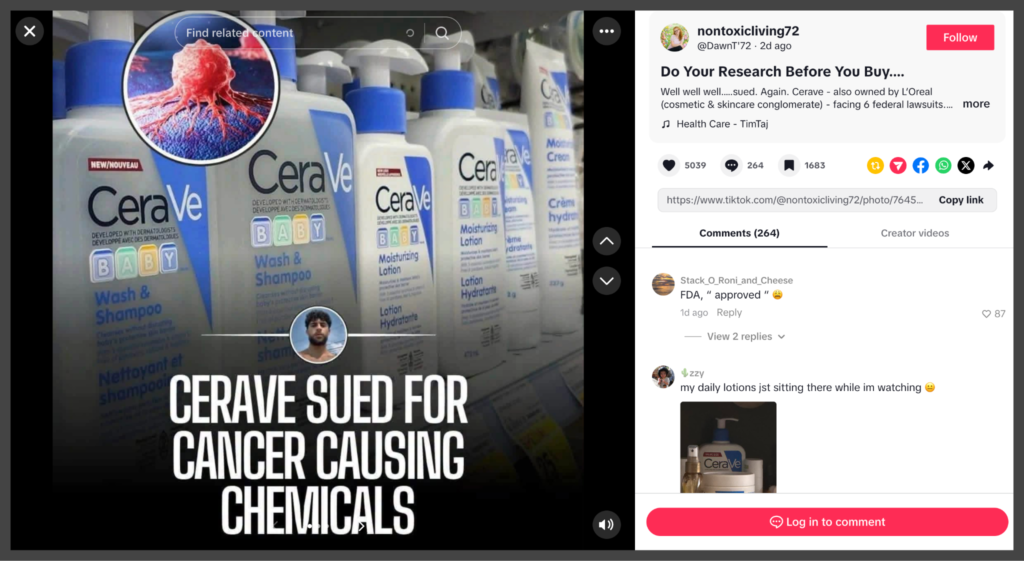
Source | Archive Source | Archive
Fact Check
What Triggered the Lawsuits?
The controversy began on March 5, 2024, when independent testing laboratory Valisure submitted a Citizen Petition to the FDA claiming that benzoyl peroxide (BPO) acne treatments could degrade into benzene under certain storage conditions, particularly elevated temperatures.
Valisure reported finding benzene in numerous benzoyl peroxide products and requested that regulators investigate and recall affected products.
Shortly afterwards, several class-action lawsuits were filed against manufacturers of acne treatments containing benzoyl peroxide, including L’Oréal USA, the parent company of CeraVe.
One of the earliest lawsuits, Grossenbacher v. L’Oréal USA Inc., filed in March 2024 in federal court in Louisiana, alleged that two CeraVe acne products: CeraVe Acne Foaming Cream Cleanser (4% benzoyl peroxide) and CeraVe Acne Foaming Cream Wash (10% benzoyl peroxide) contained benzene levels allegedly ranging from 5 to more than 12 parts per million (ppm), based on Valisure’s testing.
The plaintiffs argued that consumers were not adequately warned about the alleged contamination and sought damages as well as class-action certification.
However, it is important to emphasize that lawsuits represent allegations made by plaintiffs. Filing a lawsuit does not establish that the allegations are true, nor does it constitute a regulatory finding.
(Sources: Class Action, Class Action, About Lawsuits)
Benzene Was Not Alleged To Be An Added Ingredient
The legal action against CeraVe focuses on the chemical stability of benzoyl peroxide (BPO) rather than its intentional ingredients. The complaints argue that BPO can degrade into benzene as a byproduct, particularly when stored or transported at high temperatures.
This distinction is vital, as the scientific investigation focuses on chemical breakdown over time rather than the deliberate addition of benzene. In response, industry groups like the American Acne and Rosacea Society have emphasized BPO’s long-standing safety record while waiting for final regulatory guidance.
(Sources: American Acne and Rosacea Society, C & en)
Is CeraVe Facing Six Lawsuits?
By early 2025, reports indicated that multiple class-action lawsuits involving L’Oréal products, including CeraVe acne cleansers, had been filed and that plaintiffs were seeking consolidation of related litigation.
However, the number of lawsuits varied depending on the reporting date, and the existence of multiple lawsuits does not indicate liability or wrongdoing.
The litigation remains ongoing, and no court has issued a final determination establishing that CeraVe products caused harm or violated consumer protection laws. As of publication, no court has ruled that CeraVe products caused cancer or violated consumer protection laws.
(Sources: Bloomberg Law, About Lawsuits, About Lawsuits 2)
What Did FDA Testing Find?
An important piece of context often missing from viral posts is that the FDA conducted its own independent testing after the lawsuits and Valisure petition generated widespread public attention.
On March 11, 2025, the FDA announced the results of testing 95 benzoyl peroxide acne products. The agency reported that more than 90 percent of tested products contained either undetectable or extremely low levels of benzene.
Based on its own testing, the FDA identified only a small number of products with elevated benzene levels, leading manufacturers to voluntarily remove certain lots from retail shelves.
Notably, CeraVe was not included among the products identified for recall. The FDA announcement did not list either CeraVe Acne Foaming Cream Cleanser or CeraVe Acne Foaming Cream Wash among the affected products.
The agency also stressed that the recalls were retail-level actions intended to remove specific lots from store shelves. Consumers were not instructed to discard products already in their possession.
The FDA’s March 2025 announcement identified the following products for voluntary retail-level recall after testing detected elevated benzene:
La Roche-Posay Effaclar Duo Dual Action Acne Treatment
Walgreens Acne Control Cleanser
Proactiv Emergency Blemish Relief Cream
Proactiv Skin Smoothing Exfoliator
SLMD Benzoyl Peroxide Acne Lotion
Walgreens Tinted Acne Treatment Cream
In addition, Zapzyt Acne Treatment Gel was voluntarily recalled by its manufacturer following separate testing. CeraVe products were not included on this list.
The absence of a recall does not necessarily mean a product was found to be completely free of benzene. Rather, the FDA stated that the vast majority of tested products contained either undetectable or extremely low levels, and only a limited number exceeded the agency’s threshold for retail-level action.
The FDA provided its own risk assessment concerning the potential exposure to benzene detected in the tested acne products. The agency officially stated that the risk of a person developing cancer from such exposure is “very low,” even with daily use for decades, clarifying that this exposure would contribute only a very small increase to an individual’s lifetime cancer risk.
Furthermore, the FDA also cautioned that the use of unvalidated testing methods by third-party laboratories can produce inaccurate results and potentially overestimate benzene levels. Legal analyses published following the FDA announcement observed that the agency’s findings were substantially narrower than the claims reported in the original Valisure petition. (Source)
Why Did the FDA Find Far Less Benzene Than the Original Lab?
A detail often missing from viral posts is how the original benzene findings were produced. The figures came from Valisure, a private commercial laboratory, which reported elevated benzene only after heating benzoyl peroxide products to temperatures as high as 158°F (70°C), far hotter than the conditions in which consumers normally store or use them. Independent experts, including cosmetic chemist Dr. Michelle Wong, have argued that such high-heat conditions do not reflect real-world use, which helps explain why the FDA’s own testing detected far lower benzene levels than Valisure reported. (Source)
Valisure’s testing has also faced questions about possible conflicts of interest. The lab sells independent product testing and has filed a series of benzene petitions, covering hand sanitizer, sunscreen, and other products, that were repeatedly followed by class-action lawsuits, and several manufacturers have questioned its ties to plaintiffs’ attorneys. This does not prove the underlying chemistry is wrong, but it is useful context when weighing alarming claims online.
It is also worth clarifying that the concern applies only to CeraVe’s benzoyl peroxide acne products; the brand’s standard moisturizers and hydrating cleansers do not contain benzoyl peroxide and are not part of these lawsuits. (Source)
Conclusion
The assertion that CeraVe is facing litigation due to a “cancer-causing chemical” is misleading. This claim conflates actual legal proceedings with inaccurate or partial conclusions regarding cancer hazards, product recalls, and FDA investigations.
Lawsuits were filed against CeraVe’s parent company alleging that benzoyl peroxide acne cleansers could degrade into benzene under certain conditions. However, these allegations remain the subject of ongoing litigation and have not been proven in court.
More importantly, the FDA’s independent testing of 95 benzoyl peroxide acne products did not identify CeraVe among the products selected for recall. The agency found that most tested products contained either undetectable or extremely low levels of benzene and stated that the cancer risk associated with the detected levels was very low.
Title: Viral Claims About CeraVe and Cancer-Causing Chemicals Lack Important Context
Fact Check By: Cielito Wang
Result: Misleading
