

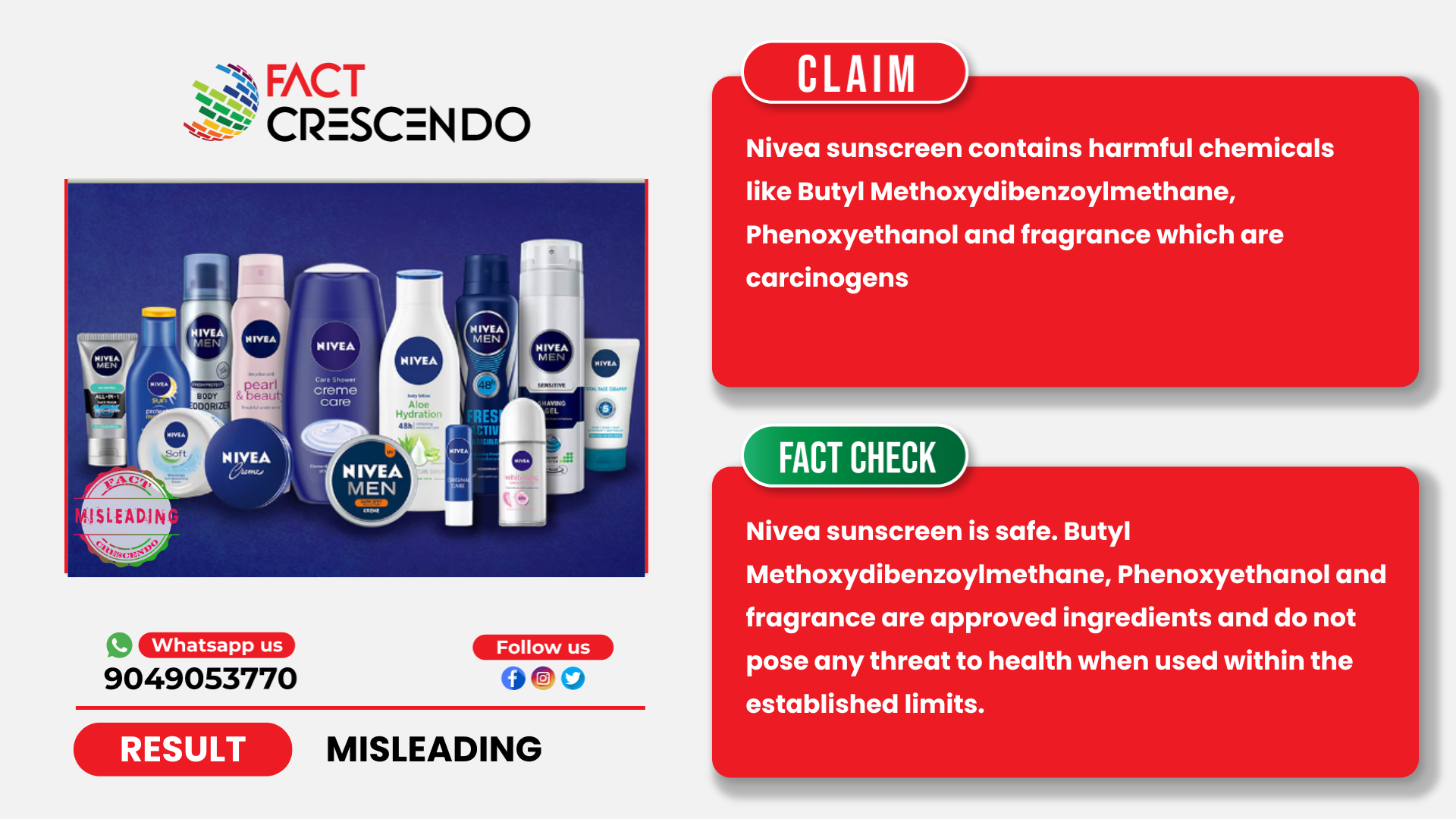
Recent social media posts have raised alarm over the ingredients used in Nivea sunscreen. Several users are claiming that the product contains chemicals like butyl methoxydibenzoylmethane, phenoxyethanol and fragrance which are dangerous and harmful.
However, Fact Crescendo found the claim to be misleading. Nivea sunscreen contains all approved ingredients. Butyl Methoxydibenzoylmethane, Phenoxyethanol and fragrance are considered safe when used within established limits and concentration.
Fact Check-
Let’s check the facts of all the ingredients mentioned in the viral video.
Butyl Methoxydibenzoylmethane: Butyl methoxydibenzoylmethane, also known as Avobenzone, blocks UVA rays even when a small amount is used in sunscreen. Its primary drawback is that its UV protective capability diminishes quickly and significantly due to photodegradation.
It is allowed as an active ingredient in sunscreens in many places, but the approved amount varies. In the U.S., the FDA allows up to 3% of it when mixed with other sunscreen ingredients. The European Union and Canada recommend up to 5%. In Asia and South Africa, the approved amount is also up to 5%. Japan allows a higher limit of up to 10% in products.
The Cosmetic Ingredient Review (CIR) panel reviewed the safety of butyl methoxydibenzoylmethane along with other similar ingredients like Oxybenzone. It is approved for use in over-the-counter (OTC) sunscreens.
A report says that avobenzone is the only sunscreen ingredient approved by the FDA that mainly blocks UVA-1 rays. It covers a broad range of UVA rays but breaks down quickly in sunlight. To prevent this, it’s usually combined with other ingredients like octocrylene and oxybenzone. Research shows that mixing avobenzone with octocrylene provides strong UVA protection.
Studies have shown that only a small amount of this ingredient passes through the skin into the body. It has low acute toxicity, meaning it is not poisonous in normal use. It does not cause skin irritation or allergic reactions, however a few rare cases of light related allergy were seen.
During animal studies, it was found that Butyl Methoxydibenzoylmethane did not have harmful effects on hormones, immunity or other major organs. It did not damage DNA or increase the risk of cancer.
Phenoxyethanol: Phenoxyethanol is a synthetic chemical substance widely used as a preservative in the preparation of skin, cosmetic, and personal care products. It is mainly responsible for the prevention of bacteriological and fungal contamination. Studies, including tests on humans, found that it does not cause serious harm, not an allergen, and not toxic to the body in the amounts generally used. The Cosmetic Ingredient Review Expert Panel reviewed it in 1990 and again in 2007 and confirmed it is safe to use in cosmetics at levels usually under 1%. The FDA also reviewed it and approved it for limited use in food packaging. The same ingredient has also been approved as a preservative by the European Union to be used in cosmetics.
Fragrance: Fragrance is not just one simple ingredient. It is made using various ingredients to give a pleasant and sweet smell to the products or food. It is used to make the products smell better.
According to Cancer Council Australia, there is no scientific evidence that fragranced products such as perfumes, scented toilet paper, or baby wipes cause cancer in humans. Although some fragrance ingredients have been shown to cause cancer in laboratory animals, but only at concentrations many times higher than those used in consumer products. Thousands of different chemicals are used to make fragrances, and each fragrance is a mix of many of these chemicals. Experts and safety groups check and test these chemicals to make sure they are safe to use.
Fragrance ingredients, including diethyl phthalate (DEP), are regularly tested for safety. In 2002, the Cosmetic Ingredient Review (CIR) panel confirmed that DEP is safe in the amounts used in cosmetics. The safety of fragrance chemicals is evaluated by the Research Institute for Fragrance Materials (RIFM), which follows a four-step process to assess risks, exposure levels, and safe limits. Based on this research, the International Fragrance Association (IFRA) sets guidelines that ban or limit certain ingredients if needed. A recent study found that people who use a lot of scented products are exposed to these chemicals at levels far below what is considered harmful.
Fragrance formulas are complex mixtures of many different natural and synthetic chemical ingredients, and they are the kinds of cosmetic components that are most likely to be trade secrets. FDA requires the list of ingredients under the Fair Packaging and Labeling Act (FPLA). But, this law is not allowed to be used to force a company to tell “trade secrets”.
Companies and individuals who manufacture or market cosmetics and other products containing fragrances have a legal responsibility for ensuring that their products are safe and properly labeled.
Conclusion:
Fact Crescendo found the claim to be misleading. Nivea sunscreen contains all approved ingredients. Butyl Methoxydibenzoylmethane, Phenoxyethanol and fragrance are considered safe when used within established limits and concentration.

Title: Are Harmful Chemicals Really Hiding in Nivea Sunscreen? Know the truth.
Written By: Siddharth Sahu
Result: False
