

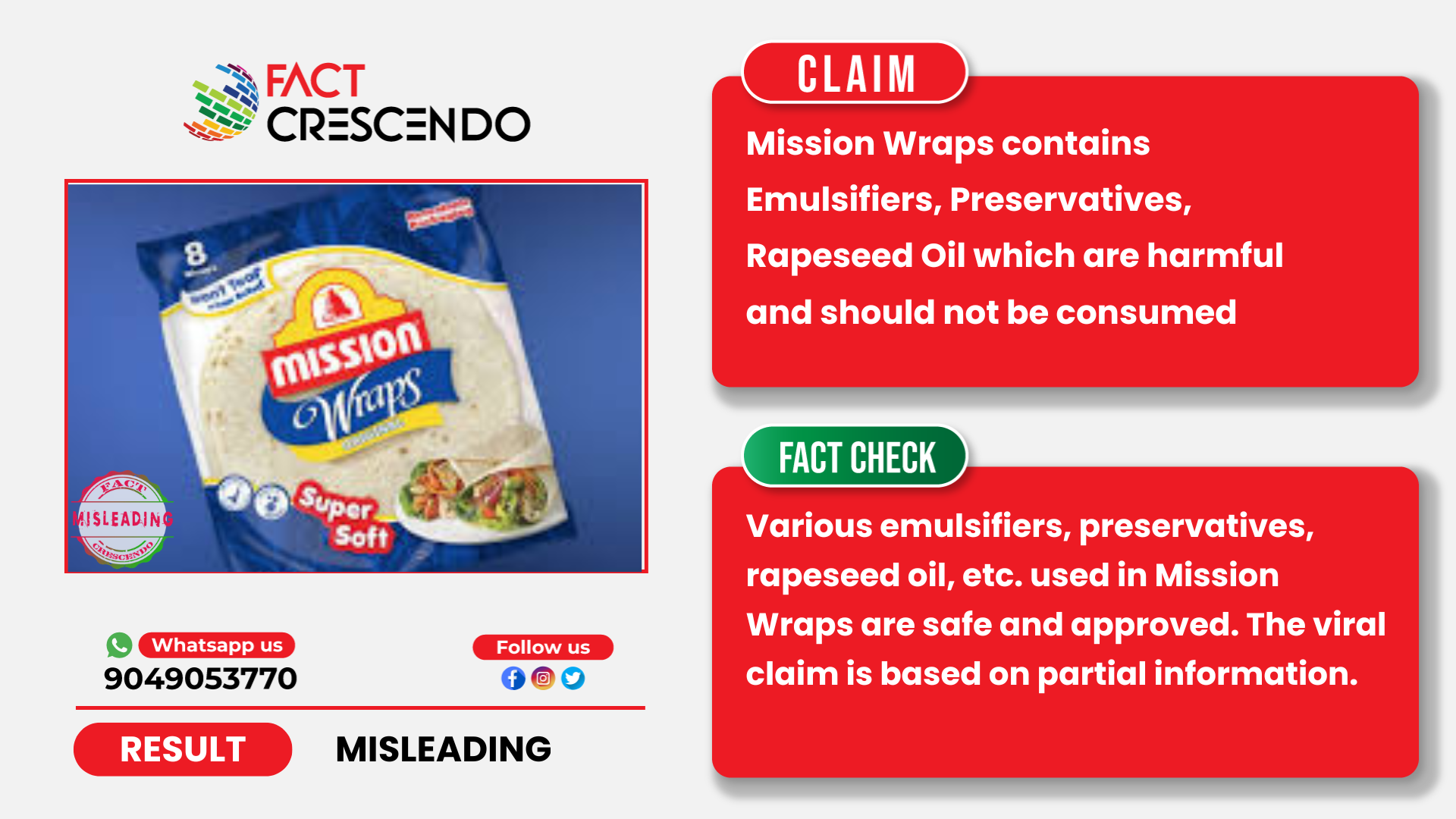
Recently, social media posts have raised concerns about the ingredients used in Mission Wraps, claiming that certain ingredients like emulsifiers, preservatives, and rapeseed oil are a risk to human health. The claim suggests that the product is highly ultra processed and not fit for consumption.
However, Fact Crescendo found the claim to be misleading. Various emulsifiers, preservatives, rapeseed oil etc used in Mission Wraps are safe and approved. The viral claim is based on partial information.
Fact Check-
Let’s check the facts of the ingredients used in the Mission Wraps.
E 471 Mono- and Diglycerides of Fatty Acids: EFSA reviewed the safety of mono- and di-glycerides of fatty acids (E471), a common food additive used as an emulsifier. The panel found that in the body, E471 is broken down into glycerol and fatty acids, which are normal substances already evaluated as safe. Studies conducted for short-term and long-term effects showed no harmful effects, including no evidence of cancer risk, genetic damage, or problems with reproduction or development. Based on all the evidence, EFSA concluded that E471 is safe at current usage levels and does not need a specific daily intake limit.
E 282 Calcium Propionate: EFSA reviewed the safety of Calcium propionate and other propionic acid and its salts. These substances also occur naturally in food. Earlier, the panel had not set an intake limit as the ingredient is considered low risk. Some side effects were seen in animal studies, but the main one occurred in an organ that humans do not have. So it was not considered relevant.
Other changes seen in dogs happened only at high levels. EFSA found no concern about cancer or DNA damage. The panel also found that the amount of calcium propionate people consume from food additives is much lower than levels that caused effects in studies. EFSA concluded that propionic acid and its salts including calcium propionate are safe at the levels currently allowed in food.
According to the FDA, this ingredient is mainly used as an antimicrobial agent and antioxidant which helps prevent the growth of mold and some bacteria and also protects the food from oxidation. It is generally recognized as safe (GRAS) when used in foods according to good manufacturing practices
E 200 Sorbic Acid: The European Food Safety Authority (EFSA) reviewed the safety of sorbic acid and its salts like potassium sorbate and calcium sorbate, which are commonly used as food preservatives in the EU. These additives were already approved under EU law and an acceptable daily intake (ADI) of 25 mg per kg of body weight per day was set. Studies showed that potassium sorbate is easily absorbed by the body and mostly broken down into carbon dioxide after digestion. Animal studies did not show harmful effects even at very high doses. No evidence suggesting that potassium sorbate damages DNA was found.
Rapeseed Oil: Rapeseed Oil is a vegetable oil extracted from rapeseed. The seeds are extracted and go through a process of drying and purification. The oil is then extracted by pressing the seeds, resulting in crude oil, which then undergoes a refining process.
Rapeseed oil, also known as Canola oil, is healthy because it is low in unhealthy saturated fats (only 4%) and high in good fats like oleic acid (55%) and other polyunsaturated fats. Unlike older rapeseed oils, canola oil has very low levels of erucic acid, which was once thought to be harmful. Because of its healthy fat profile, canola oil fits well with dietary guidelines aimed at reducing heart disease risk. It’s the most commonly used oil in Canada and is considered safe to eat by the U.S. FDA.
According to the Canola Council Canada’s website, Canola oil is good for the heart and may help lower the risk of heart disease when used instead of fats high in saturated fat. The U.S. FDA allows the use of canola oil. There are both genetically modified (GM) and non-GM types of canola. No matter if the canola is genetically modified or not, the oil is exactly the same because all proteins are removed during processing. Canola oil is considered safe to eat, even for babies in infant formula.
The Food Safety and Standard Authority of India (FSSAI) regulation for Rapeseed oil states that Rapeseed oil with low erucic acid must be made from clean seeds and be clear, free from bad smell, dirt, water, added colours, flavours or mineral oil. Erucic acid must not exceed 2%. Further, Rapeseed oil obtained by solvent extraction shall be supplied for human consumption only if it is refined, and it shall conform to the standard laid down under regulation.
Conclusion:
Fact Crescendo found the claim to be misleading. Various emulsifiers, preservatives, rapeseed oil, etc. used in Mission Wraps are safe and approved. The viral claim is based on partial information.
Title: Viral Claims About Mission Wrap Ingredients Lack Complete Facts.
Fact Check By: Siddharth Sahu
Result: Misleading
