

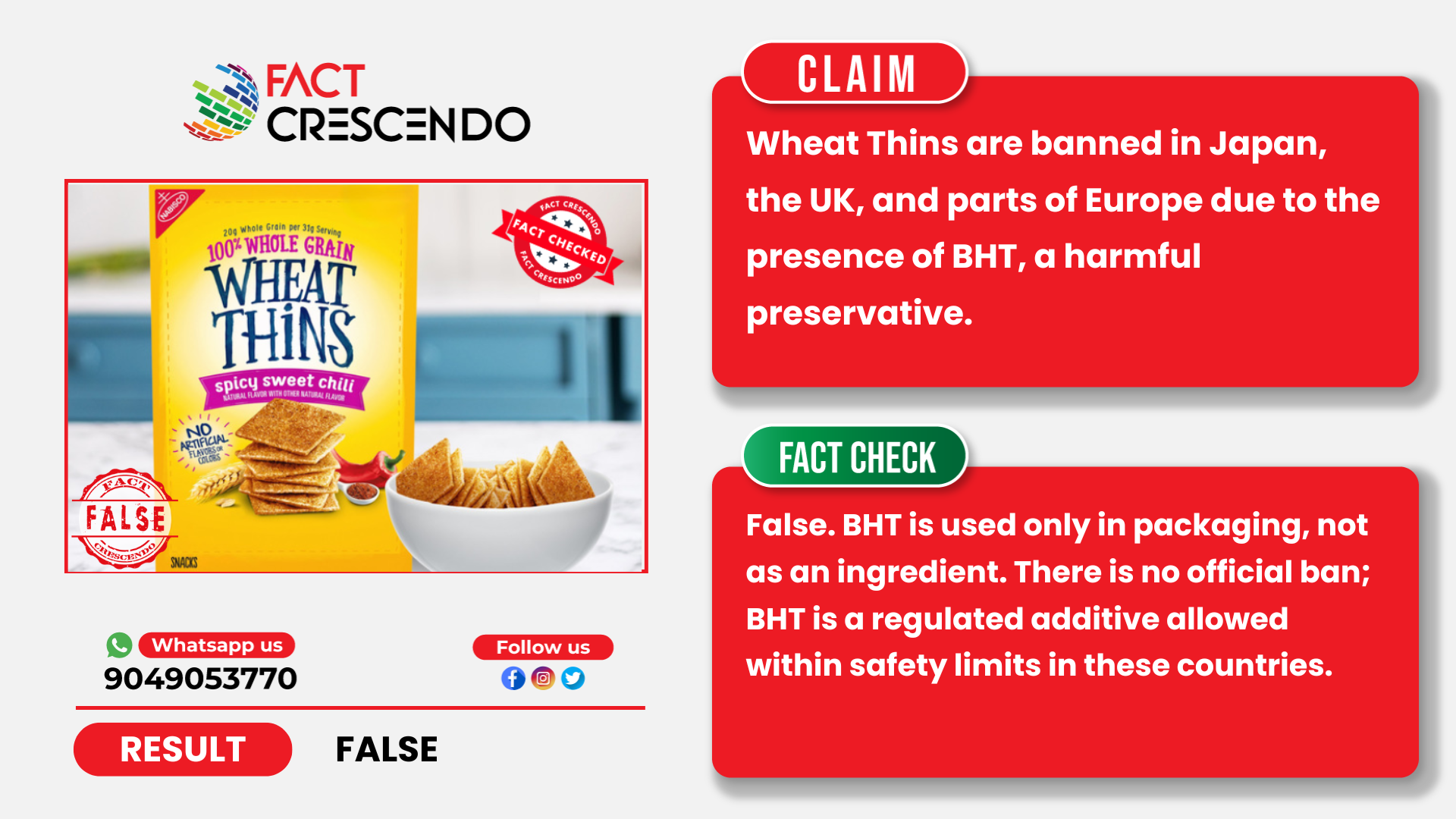
A claim circulating widely on social media platforms such as Facebook, Instagram, and LinkedIn alleges that Wheat Thins have been banned in Japan, the United Kingdom, and parts of Europe due to the presence of butylated hydroxytoluene (BHT), a synthetic preservative linked to serious health risks. The claim often frames BHT as a harmful chemical associated with endocrine disruption, organ toxicity, and cancer. However, a review of regulatory frameworks, product composition, and scientific evidence shows that this claim is misleading.
Social Media Posts
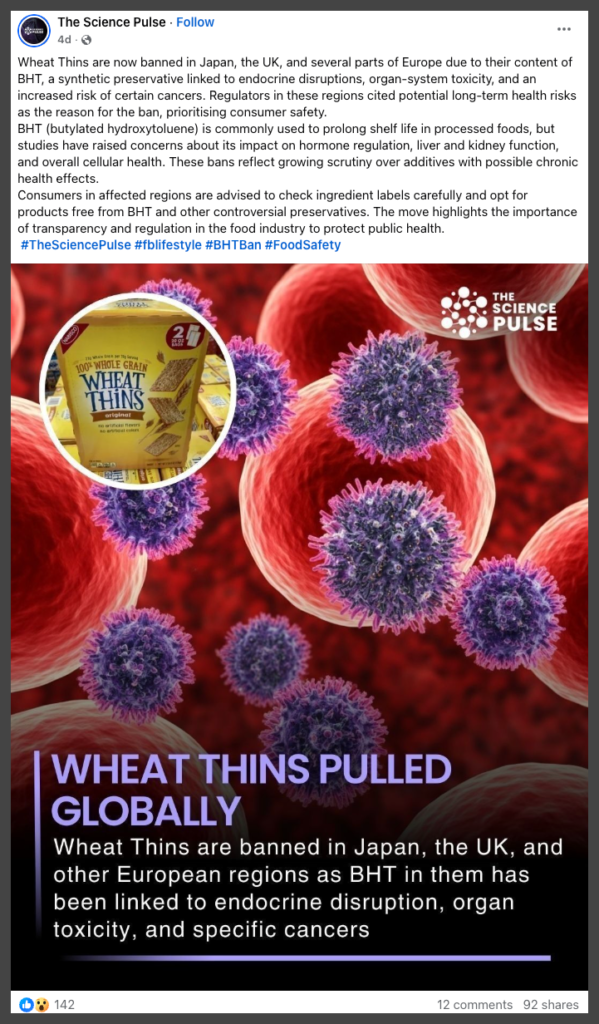
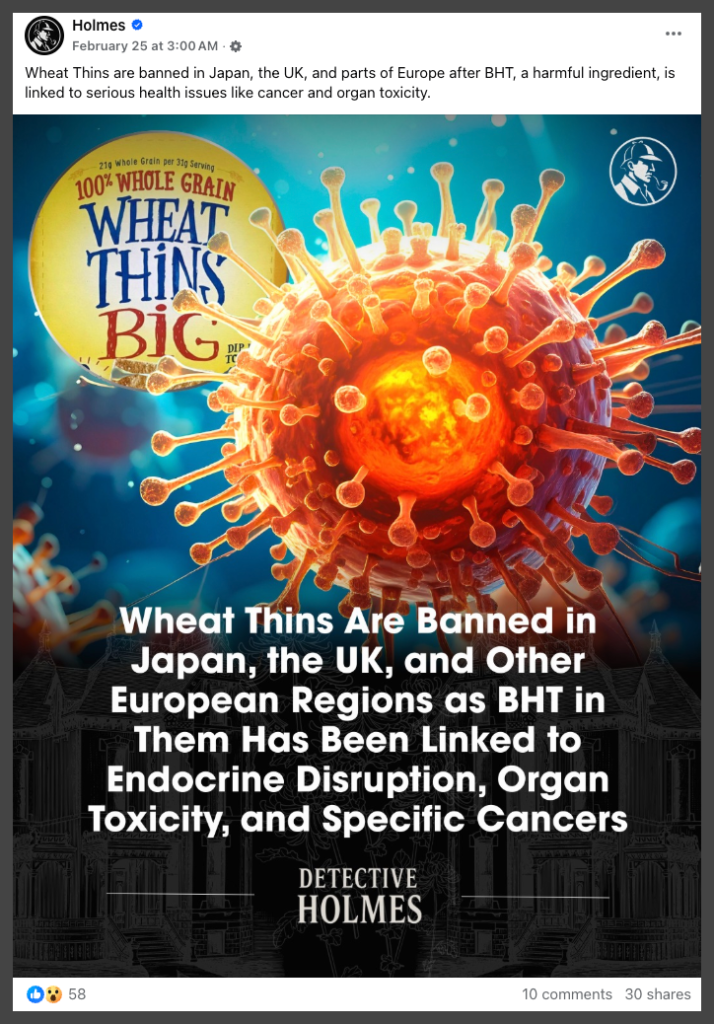
The claim appears in multiple viral posts, including those shared by multiple pages stating that “Wheat Thins are now banned in Japan, the UK, and several parts of Europe due to their content of BHT.” These posts often imply that the crackers themselves contain BHT and that health concerns have led to outright bans.
Fact Check
BHT is Not an Ingredient in Wheat Thins
Contrary to the viral claim, BHT is not an ingredient in Wheat Thins crackers. Product listings and ingredient labels for U.S. versions clearly state that “BHT is added to packaging material to preserve freshness”—not to the crackers themselves (Source). This distinction is critical: the chemical is used in the packaging liner, not in the food formulation.
Tasting Table confirms this, noting that “Wheat Thins themselves contain no BHT.” The compound is associated only with the packaging used to extend shelf life.
No Evidence of a “Ban” in Japan, the UK, or Europe
There is no official evidence that Wheat Thins are banned across Japan, the UK, or Europe due to BHT. In the European Union, BHT is an approved food additive (E321) under Regulation (EC) No 1333/2008, which governs the authorization and safe use of additives. The regulation allows additives to be used under specific conditions and limits, rather than banning them outright.
Similarly, UK food regulations, which largely follow EU frameworks, continue to permit approved additives within defined safety thresholds. Japan also allows BHT in certain food categories, such as fats and oils, within regulated limits rather than prohibiting it entirely.
In Japan, BHT is permitted in certain food categories such as fats and oils under regulated limits, rather than being banned outright. Regulatory controls restrict its use depending on food type and intended application. (Source)
Scientific assessments by regulatory bodies further support this. The European Food Safety Authority (EFSA) has evaluated BHT and established acceptable daily intake levels, reflecting controlled use rather than prohibition.
BHT Regulation and Safety Context
BHT is a synthetic antioxidant widely used to prevent oxidation in food and packaging. In the United States, the Food and Drug Administration (FDA) classifies BHT as “Generally Recognized as Safe” (GRAS) when used within prescribed limits under 21 CFR 172.115.
The FDA restricts total antioxidant levels, including BHT, to no more than 0.02% of the fat or oil content in food. This reflects a controlled risk-based approach rather than unrestricted use.
Health concerns surrounding BHT largely stem from high-dose animal studies. Research has shown that excessive exposure in animals may lead to liver or kidney effects and possible tumor promotion. However, international scientific bodies note that these findings do not translate directly to typical human dietary exposure. For instance, BHT has been classified by some authorities as “not classifiable as to its carcinogenicity to humans,” indicating insufficient evidence of cancer risk in humans at normal exposure levels.
EFSA and other regulatory agencies continue to monitor BHT, maintaining acceptable daily intake limits and periodically reassessing safety based on new data.
(Source: PMC (National Library of Medicine), PubMed, SAGE Journals, Norwegian Scientific Committee for Food and Environment (VKM))
Misinterpretation of “Content” vs. Packaging Use
A common concern is whether BHT can transfer from packaging into food, a process called “migration.” Migration refers to the movement of chemical substances from packaging materials into the food they contain, influenced by factors like storage time, temperature, and the type of food. According to the European Food Safety Authority (EFSA), this transfer is carefully studied to assess any potential health risks.
Research shows that migration involves the movement of small chemical compounds from packaging materials, inks, or adhesives into food, especially when exposed to heat or stored for extended periods. Food safety authorities recognize that factors like contact duration and temperature affect how much transfer occurs.
To protect consumers, regulations set strict limits on how much of any substance can migrate from packaging into food, ensuring that any transfer stays well within safe levels.
Conclusion
The claim that Wheat Thins are banned in Japan, the UK, and parts of Europe due to BHT is false.
BHT is not used as an ingredient in the crackers but is added to packaging material in some U.S. versions. There is no evidence of any regulatory ban in these regions. Instead, BHT remains a permitted and regulated substance under established safety limits.

Title: Wheat Thins Are Not Banned in Japan, UK, or Europe Due to BHT
Fact Check By: Cielito Wang
Result: False
