

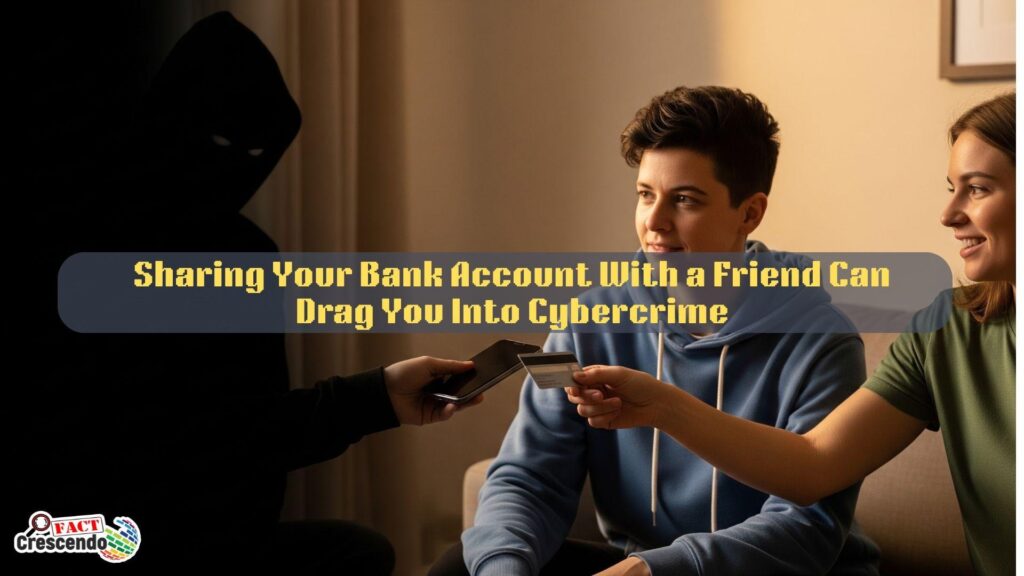
A recent cybercrime case from Bengaluru highlights how casually sharing banking access, even with someone trusted, can lead to serious legal and financial consequences.
An engineering student allegedly found himself linked to cyber fraud transactions worth nearly ₹7 crore after allowing a friend to temporarily use his bank account. According to the complaint, the student shared sensitive banking information, including internet banking credentials and an ATM-linked SIM card, believing he was helping someone in need.
Months later, authorities reportedly detected suspicious transactions routed through the account, leading to the account being frozen and a police investigation being launched.
Fact Crescendo (Media literacy initiative Factree) analysed this case to understand how cybercriminals misuse personal bank accounts, why “trust-based” fraud is increasing, and what precautions citizens should take to protect themselves.
How Fraudsters Exploit Trust
Unlike traditional hacking scams, many modern cybercrimes rely on social manipulation rather than technical expertise.
In this case, the alleged fraud did not begin with phishing links or malware. It reportedly began with trust.
The student was allegedly convinced by someone he knew personally to share:
- Net banking credentials
- ATM-linked SIM card
- Banking access documents
Fraudsters increasingly exploit:
- Friendships
- Relationships
- Workplace connections
- Social media contacts
- Emotional pressure
This type of manipulation is dangerous because victims often lower their guard when dealing with familiar people.
Why Sharing Bank Accounts Is Risky
A personal bank account is legally tied to its owner, regardless of who operates it.
If an account becomes linked to:
- Cyber fraud
- Money laundering
- Scam transactions
- Illegal fund transfers
the account holder may face:
- Frozen accounts
- Police investigations
- Financial scrutiny
- Legal notices
- Criminal proceedings
Even if someone claims they are “only borrowing” the account temporarily, the legal responsibility often remains with the account owner.
The Growing Threat of Mule Accounts
Cases like this are commonly linked to what investigators call “mule accounts.”
A mule account is a genuine bank account used by cybercriminals to receive, transfer, or withdraw stolen money. Fraudsters often recruit ordinary individuals to unknowingly become intermediaries in illegal financial transactions.
These accounts are commonly obtained through:
- Friendship-based requests
- Fake job offers
- Commission-based payment schemes
- Requests to “help transfer money”
- Social engineering tactics
Once money enters the account, it may quickly be transferred through multiple accounts to make tracking difficult.
Media Literacy Lessons From This Case
This case highlights an important digital-age reality: trust alone is not enough when dealing with financial access.
Many people believe cyber fraud only happens through unknown callers or suspicious links. However, criminals increasingly exploit personal relationships and emotional goodwill.
Media literacy today includes understanding:
- How financial systems can be misused
- Why digital identity protection matters
- The risks of sharing credentials
- The legal consequences of negligence online
Being cautious is not a sign of distrust, it is a form of digital self-protection.
Warning Signs Citizens Should Not Ignore
Be cautious if someone:
- Asks to use your bank account temporarily
- Requests ATM cards or SIM cards
- Seeks internet banking access
- Claims their account is “blocked”
- Promises commission for transactions
- Wants documents sent by courier or post
Legitimate financial activity never requires sharing complete banking control with another individual.
Precautions People Should Take
Never Share Banking Credentials
Do not share:
- Net banking passwords
- ATM cards
- UPI PINs
- Registered SIM cards
- OTPs
- Banking apps
Avoid Lending Your Bank Account: Your account should never be used by another person for receiving or transferring money.
Enable Banking Alerts: Activate SMS and email notifications to monitor all account activity.
Monitor Transactions Regularly: Check bank statements frequently for suspicious transfers or withdrawals.
Be Careful Even With Friends: Fraud can occur through known contacts. Verify requests independently before sharing sensitive information.
Secure Your SIM Card: A SIM linked to banking services provides access to OTPs and account recovery features.
How To Report Such Fraud
If you suspect your account has been misused:
1. Inform the Bank Immediately
Request temporary freezing of the account and report suspicious activity.
2. Call Cybercrime Helpline 1930
Report cyber fraud immediately through the national helpline.
3. File a Complaint Online
Complaints can be submitted at:
National Cyber Crime Reporting Portal
4. Preserve Evidence
Save:
- Chat messages
- Courier receipts
- Transaction alerts
- Account statements
- Contact details of involved individuals
5. Approach the Cyber Police
Visit the nearest cybercrime police station and submit a formal complaint.
The Bigger Digital Safety Lesson
The Bengaluru case demonstrates how cybercrime networks increasingly rely on ordinary people and everyday trust to move illegal money.
Cybersecurity today is not only about avoiding suspicious links — it is also about protecting personal access, financial identity, and digital responsibility.
Sharing banking access, even casually or emotionally, can have consequences far beyond financial loss. In the digital era, awareness and caution are essential forms of self-defence.

Title: Sharing Your Bank Account With a Friend Can Drag You Into Cybercrime
Fact Check By: Drabanti Ghosh
Result: Insight
