

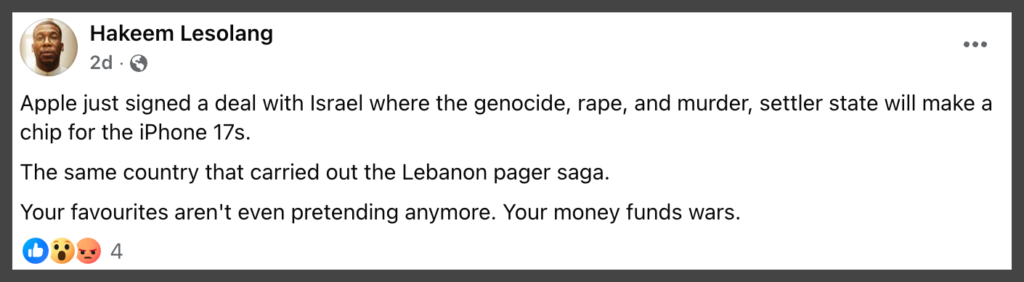
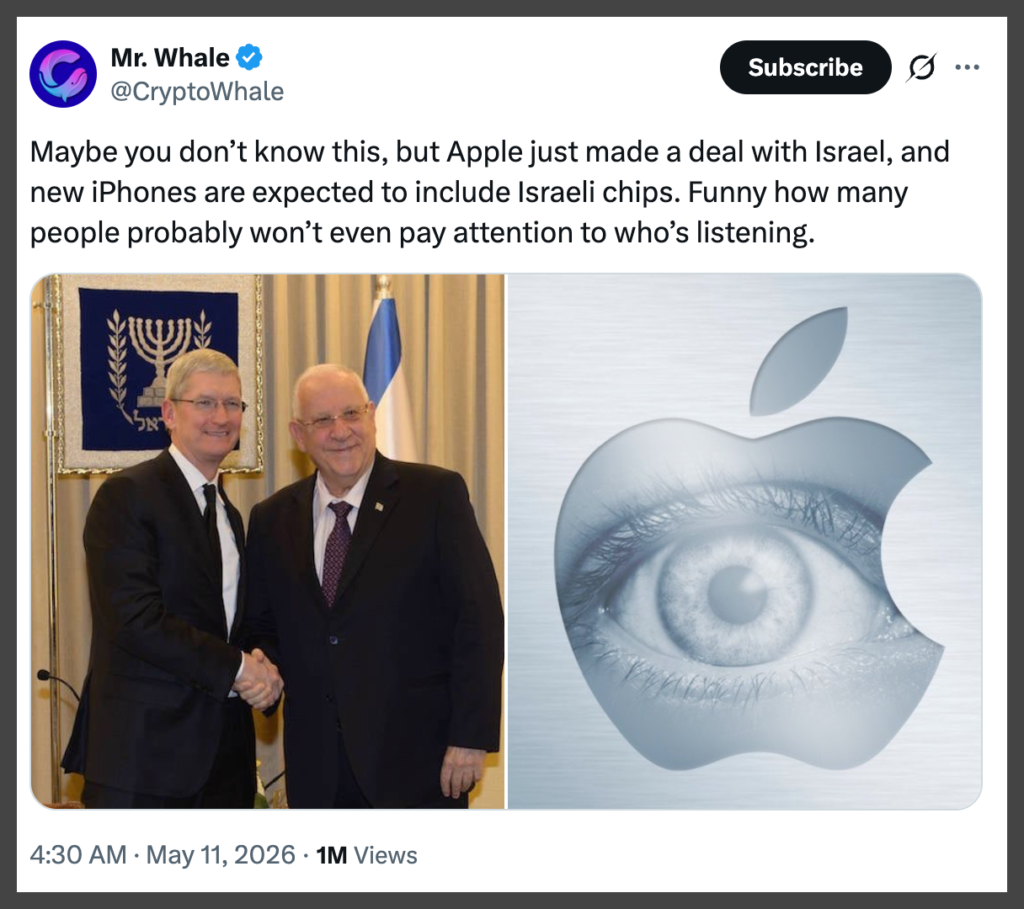
A claim circulating widely on social media alleges that Apple “just signed a deal with Israel” and will manufacture a chip specifically for the “iPhone 17s.” The claim has spread across online platforms, often framed in a political context implying that Apple has entered a new state-level partnership with Israel to produce iPhone chips. However, after reviewing, we found the claim to be mostly misleading.
Social Media Posts
Posts spreading online claim that Apple has “signed a deal with Israel” to “make a chip for the iPhone 17s.”
Fact Check
There Is No Evidence of a New “Deal With Israel” for an iPhone Chip
There is no credible evidence that Apple recently signed a government-level or state-to-state agreement with Israel to manufacture chips for the “iPhone 17s.”
A review of Apple announcements, Israeli government statements, and reporting from major outlets found no official announcement of such a bilateral deal. Apple’s official iPhone pages for the iPhone 17 lineup do not mention any special agreement with Israel.
Reuters reported in January 2026 that Apple acquired Israeli AI startup Q.ai, a company specializing in machine learning and audio technologies. However, this was a corporate acquisition, not a sovereign chip-manufacturing agreement between Apple and Israel.
According to Reuters, Apple said Q.ai worked on technologies related to whispered speech recognition and audio enhancement. The acquisition involved roughly 100 employees joining Apple, including founder Aviad Maizels, who previously founded PrimeSense, the Israeli company whose technology contributed to Face ID.
Apple Does Have Major R&D Operations in Israel
While the viral claim overstates the case, Apple does maintain significant engineering and semiconductor-development operations in Israel.
Apple operates major R&D centers in Haifa, Herzliya, and Jerusalem. Engineering teams based in Israel have contributed to Apple Silicon-related work over the years, including areas such as processor architecture, storage systems, wireless chips, camera systems, and modem technologies.
Israeli media and Apple-focused publications have repeatedly described Apple’s Israel operations as one of the company’s important chip-design and semiconductor engineering hubs. Reporting has linked Israel-based engineering work to technologies used across multiple generations of Apple Silicon, including the M1 family and connectivity-related systems.
In April 2026, Apple promoted longtime executive Johny Srouji to Chief Hardware Officer, expanding his oversight beyond Apple Silicon and reinforcing the strategic importance of Apple’s global hardware and semiconductor engineering operations, including teams based in Israel.
Some Israeli reporting about the iPhone 17e has also claimed that its modem and wireless systems were developed with input from Apple’s engineering teams in Israel.
These points relate to engineering and design work, and they do not, on their own, indicate that iPhone chips are manufactured in Israel or that Apple has entered into a new agreement with the Israeli government to produce a special chip.
(Sources: Apple Newsroom, MacRumors, The Times of Israel, The Jerusalem Post)
Designing a Chip Is Not the Same as Manufacturing It
A key point in assessing this claim is the distinction between chip design and chip fabrication.
Apple designs many of its chips through Apple Silicon teams across several countries, including the United States and Israel. Over the years, coverage has described Apple’s Israel-based engineering teams as contributing to areas such as wireless connectivity, storage, and other silicon-related work.
That design work is separate from high-volume manufacturing (semiconductor fabrication). Public reporting generally suggests that Apple’s flagship iPhone processors are fabricated by external foundries (most notably TSMC), rather than being manufactured in Israel.
Technology and semiconductor industry outlets have consistently described Apple’s A19 and A19 Pro chips as being fabricated by TSMC using its third-generation 3nm “N3P” process, rather than being manufactured in Israel. (Source: MacRumors, Wccftech)
Reuters and The Wall Street Journal reported in May 2026 that Apple and Intel had reached a preliminary chip-manufacturing agreement after more than a year of negotiations. The reported discussions concern potential U.S.-based production diversification and are unrelated to Israel.
So, if “made in Israel” is intended to mean fabricated at scale, available public information does not substantiate that characterization.
There Is No Product Called the “iPhone 17s”—but the iPhone 17e Is Real
There is no official Apple product called the “iPhone 17s.” Apple’s 2025–2026 lineup consists of the iPhone 17, iPhone Air, iPhone 17 Pro, and iPhone 17 Pro Max, joined in March 2026 by the more affordable iPhone 17e. The term “17s” does not appear in Apple’s official product documentation or launch materials.
The closest real product to the viral “17s” is the iPhone 17e, and that matters here: it is the first “e” model to ship with Apple’s own C1X cellular modem. Reporting about the iPhone 17e and its Israel-linked engineering contributions may help explain the origin of the viral claim, although the exact source of the wording remains unclear.
Developing Technology in Israel Does Not Mean Apple Signed a Deal With Israel
One possible explanation is that these separate developments were combined and amplified online into a single narrative about a supposed deal between Apple and Israel.
First, in March 2026 Apple launched the iPhone 17e, the most affordable model in the iPhone 17 family. It is the first “e” model to carry Apple’s own C1X cellular modem and the N1 wireless chip—components Israeli outlets reported were developed with significant input from Apple’s engineering teams in Israel. Apple’s modem capability itself traces back to 2019, when the company acquired the majority of Intel’s smartphone modem business for about $1 billion, bringing over 2,200 engineers and thousands of wireless patents in-house.
Second, in January 2026 Apple acquired the Israeli AI startup Q.ai, a corporate purchase focused on audio and machine-learning technology.
As other fact-checks have noted, these two events were merged and exaggerated online into a single, false narrative: a supposed “state-level deal” to make a chip for an “iPhone 17s.” In reality, there is no “iPhone 17s”, the closest real product is the iPhone 17e, and there is no sovereign agreement. What exists is ordinary corporate engineering work and an acquisition, reframed as government-to-government politics.
Why This Matters
The significance of this claim extends beyond a simple product name error. Misunderstandings may arise when technical developments, corporate acquisitions, and geopolitical issues are combined into a single claim without supporting evidence.
The claim also exploits a common gap in public understanding of how the technology industry works. Designing a chip, fabricating it, and assembling a finished phone are three separate stages handled by different companies in different countries. Apple’s flagship processors are fabricated by TSMC, not manufactured in Israel, and engineering contributions from an R&D center are not the same as a national manufacturing agreement.
Conclusion
The claim that Apple signed a government-level “deal with Israel” to manufacture an “iPhone 17s” chip is misleading and unsupported by available evidence. While Apple maintains significant R&D and chip-design teams in Israel (including the acquisition of firms such as Q.ai), and while Apple’s Israel teams contributed to real components in the iPhone 17e such as the C1X modem, there is no credible reporting of a new state-to-state agreement.
iPhone processors are fabricated by external foundries, primarily TSMC, not manufactured in Israel, and “iPhone 17s” is not an official product. The claim likely stems from a misunderstanding of Apple’s R&D presence, and a distortion of the genuinely Israel-influenced chips in the iPhone 17e, versus large-scale semiconductor manufacturing or formal state-level agreements.

Title: Fact Check: No Evidence Apple “Signed a Deal With Israel” to Make a Chip for the “iPhone 17s”
Fact Check By: Cielito Wang
Result: Misleading
