
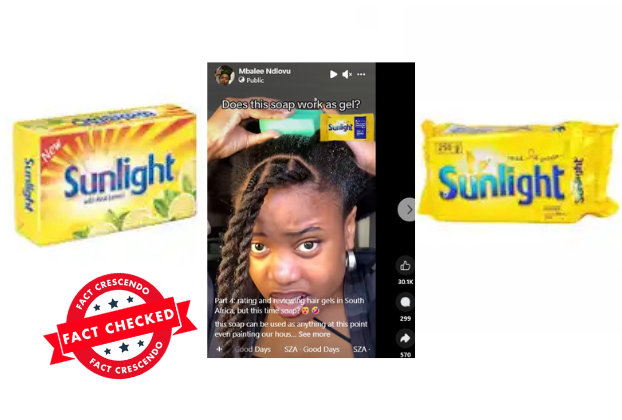
Sunlight is one of the most widely used household laundry soaps in the world, well recognized for its strong grease-removing properties. This visibility also makes the product a common subject of viral claims, including allegations that it can function as a substitute for hair gel, raising concerns about its safety when used on hair and scalp.
In this fact-check, we examine each claim critically, separating what appears to work from what is actually happening at a chemical and hair structure level.
Social Media Post
A viral social media video claims that a “Sunlight” washing bar can be used as a substitute for hair gel, showing it styling 4C hair with noticeable hold and shine. While the creator acknowledges possible dryness, the video strongly suggests that the method “works”.
Fact Check
Claim 1: Can a laundry soap bar realistically function as a hair styling product, or is the effect temporary and misleading?
At a surface level, yes, it can appear to work. Soap creates a film over hair strands, which can stiffen and hold them in place once dry. This mimics the basic function of hair gel.
However, hair gels are engineered with polymers (like PVP or carbomers) designed to provide flexible hold without damaging the hair shaft. Read here. Laundry soap, on the other hand, is designed to strip oils, remove dirt, and break down grease, not to preserve hair integrity. Read here
What appears in the video is not a controlled styling effect. It is a temporary coating and stiffening that can occur when soap residue and strong cleansing agents dry on the hair. The resulting “hold” is a side effect, rather than an intended styling outcome.
Therefore, laundry soap can temporarily stiffen hair because of how surfactants and soap residues interact with the hair shaft. When soap dries, it leaves a film that can hold hair in place.
Claim 2: What ingredients are in washing bars like Sunlight, and are they safe for direct use on hair and scalp?
Typical laundry bars (including Sunlight-type soaps) contain sodium salts of fatty acids (soap base), sodium carbonate (alkaline builder), surfactants (strong cleansing agents), and fragrance and colour additives. Read here.
The major issue is pH. Hair and scalp function best at a pH of ~4.5–5.5. Read here. Soaps (including Sunlight bars) are highly alkaline (pH 9–11), which disrupts this balance. Read here.
This matters because alkaline substances increase hair shaft damage by raising the cuticle (outer layer), increase friction between strands, and make hair more porous and fragile. Additionally, those harsh cleansers can irritate the scalp and strip natural oils. Read here and here.
Claim 3: Does the visible “shine and hold” indicate healthy hair styling?
Hair science shows that a healthy shine of hair comes from smooth, intact cuticles and moisture balance. Read here and here. Soap does the opposite. It lifts the cuticle and increases roughness.
The “shine” seen in the video is unlikely to be true hydration or hair health. Instead, it is most likely due to a buildup of residue that creates a reflective layer, stripped natural oils, a waxy or soap film coating, or cuticles that have been flattened by stiffness, which can reflect light for a short time. The “hold” is also misleading. It is not flexible styling control. It is stiffness from residue, and it can make hair feel stiff instead of naturally styled.
Thus, the effect is only cosmetic and lasts for a short time. It does not mean that hair is healthy.
Claim 4: Is it proof of efficacy that the hair stays intact even after being exposed to rain?
Water resistance in this case is misleading. Soap residue can form a stiff, semi-waxy layer that makes hair clump and harden when dry. However, that stiffness reduces hair elasticity, and hair becomes more brittle. Additionally, repeated wetting and drying with residue worsens damage.
Professional styling products are designed to balance hold, flexibility, and washability. Soap fails on all three. The experts confirm that chemical damage reduces the tensile strength and flexibility of hair fibres. Read here. Therefore, what looks like durability is actually rigidity, which increases hair damage risk.
Claim 5: What are the potential risks of using laundry soap on hair
This is where the real consequences show up. Documented risks of using high-alkaline cleansers on hair include severe dryness (natural oils stripped away), cuticle damage (leading to rough, tangled hair), breakage and split ends, scalp irritation or dermatitis and increased frizz and loss of curl definition, especially for 4C hair. Read here
Especially for tightly coiled hair types (like 4C), which already struggle with moisture retention, this kind of treatment is particularly aggressive.
To sum up, these risks are supported by established research in hair science.
Conclusion
The viral claim that a Sunlight washing bar can be used as a substitute for hair gel is partly true in appearance but misleading in substance. The soap can make hair look shiny and provide “hold” for a short time, but this isn’t because it works well for styling. What may look like effective styling, including stiffness and resistance to moisture, is actually short-term rigidity rather than controlled, flexible hold. More importantly, the claim overlooks the difference between something that produces a visible result and something that is safe and suitable for that purpose. Laundry soap is formulated for cleaning fabrics, not for maintaining the structure, moisture balance, or health of human hair and scalp. Current medical guidance remains clear: laundry soap should not be used on hair or scalp.
Title: Can Sunlight Laundry Soap Really Work as Hair Gel?
Fact Check By: Rashmitha Diwyanjalee
Result: Misleading