

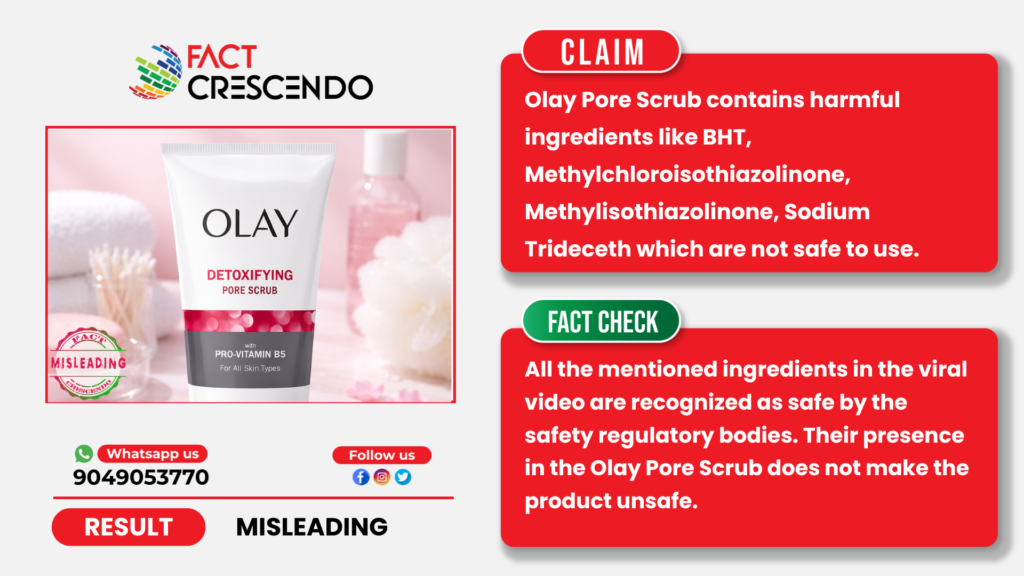
Recently, social media users were seen claiming that Olay Pore Scrub contains harmful ingredients like BHT, Methylchloroisothiazolinone, Methylisothiazolinone, Sodium Trideceth etc which makes the product unsafe for use.
However, Fact Crescendo found the claim to be misleading. Presence of BHT, Methylchloroisothiazolinone, Methylisothiazolinone, Sodium Trideceth in Olay Pore Scrub does not make the product unsafe. All the ingredients are recognized as safe.
Fact Check-
BHT: Butylated Hydroxytoluene or BHT is widely used in cosmetics and personal care products at very low concentrations. Only a small amount of it is absorbed by the skin but it remains in the skin with little to no systemic exposure. It is not considered to be genotoxic, carcinogenic or harmful to reproductive organs. However, animal studies show that high oral doses can affect the liver, kidneys, and lungs. Usually these effects occur at levels much higher than typical cosmetic use.
According to the European Commission’s Scientific Committee on Consumer Safety (SCCS), BHT is considered safe when used within specific limits in cosmetic products. The review found that BHT does not pose a risk to human health. It is considered safe when its concentration is up to 0.001% in mouthwash, 0.1% in toothpaste, and up to 0.8% in other cosmetic products.
Based on the results from both animal studies and human clinical data, the Cosmetic Ingredient Review (CIR) Expert Panel has carefully evaluated BHT (butylated hydroxytoluene). They concluded that BHT does not pose a risk when used in cosmetics and personal care products at permissible levels. This means BHT is considered safe for consumers in cosmetic formulations, such as lotions, creams, and makeup, as long as it is used within the recommended concentrations.
Methylchloroisothiazolinone: According to a report, Methylchloroisothiazolinone (MCI) is often combined with methylisothiazolinone (MI) under the brand name Kathon CG. In the United States, it’s currently used in concentrations of up to 15 parts per million (ppm) in rinse-off products and 8 ppm in other cosmetics.
In 2014, the European Commission’s science group recommended a ban on using MCI/MI in leave-on products like body creams. This was to help reduce skin allergies. However, they said it’s still okay to use in rinse-off products like shampoos and shower gels, but only in very tiny amounts (0.0015%).
According to the Cosmetic Ingredient Review (CIR), the European Cosmetics Regulation allows the use of a mixture of Methylchloroisothiazolinone (MCI) and Methylisothiazolinone (MI) in cosmetic products up to 0.0015%. In 2004, the European safety committee reviewed MI and found it safe for use in both leave-on and rinse-off products up to 0.01%. However, over time, dermatologists noticed a rise in allergic skin reactions, especially in Europe, linked to MI in leave-on cosmetics like lotions and wet wipes. After reviewing new evidence in 2013, the committee concluded that there is no safe amount of MI for leave-on products. They did, however, confirm that rinse-off products, such as shampoos and shower gels, can still safely contain MI at a concentration of up to 0.0015%.
Methylisothiazolinone: According to National Institute of Health, the Expert Panel for Cosmetic Ingredient Safety concluded that Methylisothiazolinone is safe for use in rinse-off cosmetic products at concentrations up to 100 ppm (i.e. 0.01%) and safe in leave-on cosmetic products when they are formulated to be non-sensitizing.
According to 2019–2020 data, Methylisothiazolinone was used in over 900 products, mostly in bath soaps, shampoos, and conditioners. The amount used in products ranges from extremely tiny (0.000002%) up to about 0.01% (100 ppm). It is sometimes used in products that can touch the eyes or be sprayed into the air, like hair sprays. However, most spray particles are large enough that they don’t go deep into the lungs.
In Europe, MI is only allowed in rinse-off products (like shampoo) at very small amounts—no more than 0.0015% (15 ppm). Experts in the EU have said that no safe level has been proven for leave-on products like lotions or wet wipes because they can cause allergic skin reactions. They also warn that MI should not be added to any products that already contain a mixture of MCI/MI, to avoid increasing the risk of allergies.
Sodium Trideceth Sulfate: Sodium Trideceth Sulfate is a common ingredient in personal care and household products for its cleansing and foaming properties. According to the National Institute of Health, studies revealed that there was no toxicity found in this ingredient under normal use conditions. However, there may occur some cases of mild skin or eye irritation when the ingredient is used at higher concentrations or prolonged exposure.
Conclusion:
Fact Crescendo found the claim to be misleading. The ingredients like BHT, Methylchloroisothiazolinone, Methylisothiazolinone, Sodium Trideceth etc in Olay Pore Scrub are considered safe by the regulatory bodies.
Title: Does Olay Pore Scrub contain harmful ingredients? Know the truth.
Fact Check By: Siddharth Sahu
Result: Misleading
