

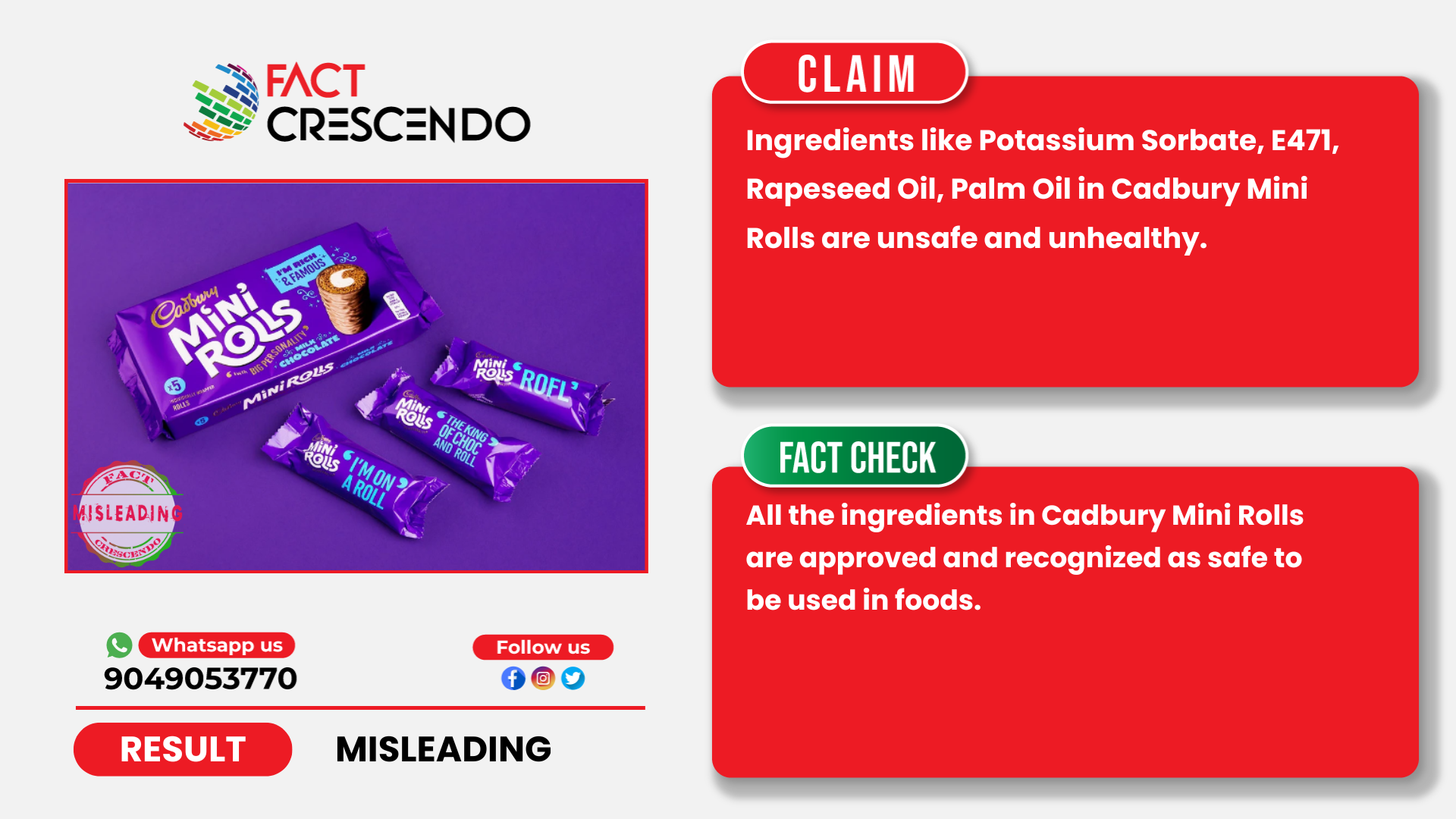
Cadbury Mini Rolls are small sponge cakes that come in various flavors and are favorite among various age group people. But several posts claiming that Cadbury Mini Rolls contain unhealthy and unsafe ingredients like palm oil, rapeseed oil, emulsifiers and preservatives are going viral on social media.
However, Fact Crescendo found that the claim was shared without proper and complete information. All the ingredients in Cadbury Mini Rolls are approved to be used in food products and are recognized as safe.
Fact Check-
Let’s check the facts about each of the ingredients mentioned in the post.
Palm Oil: The U.S. Food and Drug Administration had found that during high temperature refining of palm oils two contaminants 3-MCPD esters and glycidyl esters can form. These substances are considered harmful to the kidney and have potential link cancer. The FDA is actively researching these contaminants to better understand their occurrence in foods and to develop methods for reducing their levels during oil processing.
Palm oil is approved for use in food. The FDA recommended the manufacturers to minimize the presence of these contaminants to ensure safety of the consumers.
Several studies were conducted to check the safety of palm oils, palm olein etc after large scale frying. It was found that when these oils are used in factories for making potato chips or french fries, they stay in good condition even after many hours of continuous use. These oils were found to show low damage, low acidity and stable quality. In fast-food cooking, these oils remain safe and usable even after several days if it was used under acceptable smoke point value.
Malaysian Palm Oil Council (MPOC) has clarified that Palm oil is safe for people to consume when used within recommended amounts. According to many scientific studies, it does not cause heart disease or cancer. Palm Oil Council had also pointed out that it contains antioxidants like Vitamin E, and the concerns about processing contaminants like 3 MPCD are low and within international safety limits.
Rapeseed Oil: Rapeseed Oil is a vegetable oil extracted from rapeseed. The seeds are extracted and go through a process of drying and purification. The oil is then extracted by pressing the seeds, resulting in crude oil, which then undergoes a refining process.
Many people consider Rapeseed oil as an industrial oil. But in many regions of the world, rapeseed oil is also known as Canola oil. After the purification process Rapeseed oil becomes Canola oil but many places labelled canola oil as rapeseed oil. So, it will not be appropriate to call rapeseed oil solely an industrial oil.
Canola oil is healthy because it is low in unhealthy saturated fats (only 4%) and high in good fats like oleic acid (55%) and other polyunsaturated fats. Unlike older rapeseed oils, canola oil has very low levels of erucic acid, which was once thought to be harmful. Because of its healthy fat profile, canola oil fits well with dietary guidelines aimed at reducing heart disease risk. It’s the most commonly used oil in Canada and is considered safe to eat by the U.S. FDA.
The FDA had also approved the use of Rapeseed oil as a food ingredient to improve texture and consistency of the products. Its use is allowed only under strict safety and purity standards, including limits on acidity and contaminants to ensure it remains safe for consumption.
E 471 Mono- and Diglycerides of Fatty Acids: EFSA reviewed the safety of mono- and di-glycerides of fatty acids (E471), a common food additive used as an emulsifier. The panel found that in the body, E471 is broken down into glycerol and fatty acids, which are normal substances already evaluated as safe. Studies conducted for short-term and long-term effects showed no harmful effects, including no evidence of cancer risk, genetic damage, or problems with reproduction or development. Based on all the evidence, EFSA concluded that E471 is safe at current usage levels and does not need a specific daily intake limit.
Potassium Sorbate: Potassium sorbate is a chemical food additive which is used as a preservative in foods. It prevents the growth of molds, fungi and yeast. It can be found in many food products like cheese, chewing gums, processed meat, citrus fruits, wine and in personal care products etc.
According to a report, regulatory agencies such as the FDA, the United Nations Food and Agriculture Organization, and the European Food Safety Authority (EFSA) have determined that potassium sorbate is “generally regarded as safe,” (GRAS). When one eats potassium sorbate as a food additive, it passes through the system harmlessly as water and carbon dioxide. It does not accumulate in the body.
The European Food Safety Authority (EFSA) reviewed the safety of sorbic acid and its salts like potassium sorbate and calcium sorbate, which are commonly used as food preservatives in the EU. These additives were already approved under EU law and an acceptable daily intake (ADI) of 25 mg per kg of body weight per day was set. Studies showed that potassium sorbate is easily absorbed by the body and mostly broken down into carbon dioxide after digestion. Animal studies did not show harmful effects even at very high doses. No evidence suggesting that potassium sorbate damages DNA was found.
Conclusion:
Fact Crescendo found the claim to be incomplete information. All the ingredients in Cadbury Mini Rolls are approved and recognized as safe to be used in foods.
Title:Cadbury Mini Rolls contain unhealthy and unsafe ingredients? Check the facts.
Fact Check By: Siddharth SahuResult: Misleading
