

McCain French Fries is owned by McCain Foods, a Canadian company founded in 1957. The company started as a small family business which grew into one of the world’s largest producers of frozen potato products including French fries.
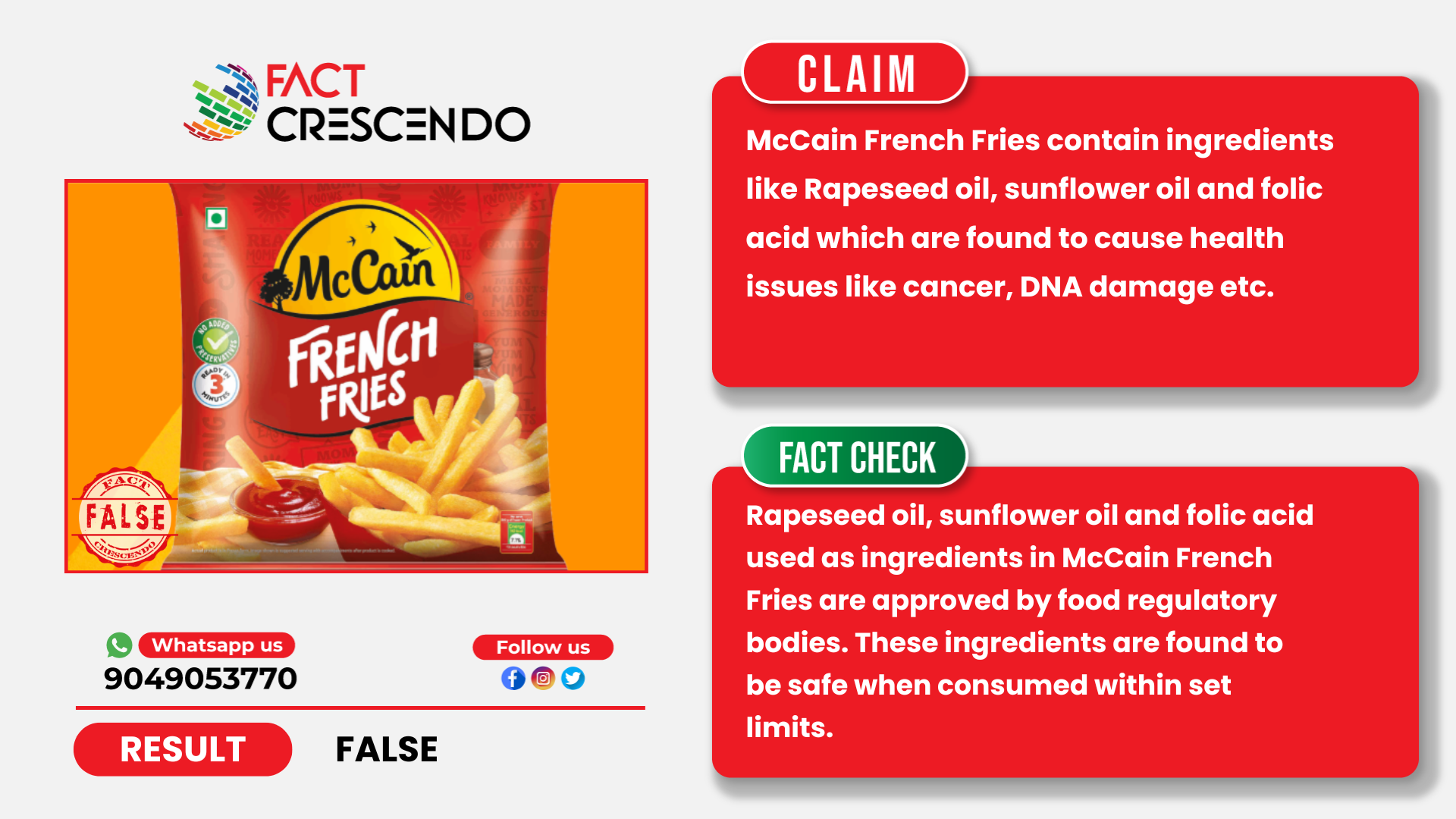
Recently, social media claims suggest that the French fries by McCain contain many harmful ingredients which are found to cause serious health issues in humans. Some of the ingredients mentioned are rapeseed oil, sunflower oil and folic acid.
However, Fact Crescendo found that ingredients in McCain French fries are safe and have been approved by food safety regulatory bodies. The mentioned ingredients are safe when consumed within the prescribed limits.
Fact Check-
Let’s check the safety and facts of the ingredients mentioned in the viral video
Rapeseed Oil: Rapeseed Oil is a vegetable oil extracted from rapeseed. The seeds are extracted and go through a process of drying and purification. The oil is then extracted by pressing the seeds, resulting in crude oil, which then undergoes a refining process.
It is true that Rapeseed oil is also an industrial oil. But in many regions of the world, rapeseed oil is also known as Canola oil. After the purification process Rapeseed oil becomes Canola oil but many places labelled canola oil as rapeseed oil as well. So, it will not be appropriate to call rapeseed oil solely an industrial oil.
Canola oil is healthy because it is low in unhealthy saturated fats (only 4%) and high in good fats like oleic acid (55%) and other polyunsaturated fats. Unlike older rapeseed oils, canola oil has very low levels of erucic acid, which was once thought to be harmful. Because of its healthy fat profile, canola oil fits well with dietary guidelines aimed at reducing heart disease risk. It’s the most commonly used oil in Canada and is considered safe to eat by the U.S. FDA.
The Food Safety and Standard Authority of India (FSSAI) regulation for Rapeseed oil states that Rapeseed oil with low erucic acid must be made from clean seeds and be clear, free from bad smell, dirt, water, added colours, flavours or mineral oil. Erucic acid must not exceed 2%. Further, Rapeseed oil obtained by solvent extraction shall be supplied for human consumption only if it is refined and it shall conform to the standard laid down under regulation.
The FDA had also approved the use of Rapeseed oil as a food ingredient to improve texture and consistency of the products. Its use is allowed only under strict safety and purity standards, including limits on acidity and contaminants to ensure it remains safe for consumption.
Sunflower Oil: EFSA explained that sunflower oil is generally safe for people, animals, and the environment when used properly. It is also used as a fungicide on vegetables. It is not toxic, does not cause health problems, and breaks down naturally without leaving harmful residues. EFSA even agreed that there are no major risks to consumers, workers, or the environment when exposed to it. However, some areas need more data for further study, but overall the oil is considered safe and suitable for use for agricultural purposes as well.
The Food and Drug Administration (FDA) includes sunflower seed oil and its triglycerides or fatty acids on its list of indirect food additives. These ingredients can be used in special coatings that might touch food by accident. The CIR Panel studied sunflower seed oil, hydrogenated sunflower seed oil, and sunflower seed acid and found these to be safe when used in cosmetics and personal care products as well.
Folic Acid: Folate or Folic acid is a type of Vitamin B, found in leafy greens and helps in keeping DNA stable and supports cell functions. A lack of folate has been linked to various cancers, including colon, breast, ovarian, pancreatic, brain, lung, and cervical cancer. Overall, most research shows that folate from natural food sources helps protect against colon cancer. Many people don’t get enough folate, which is important for DNA repair and stability. A folate deficiency can lead to cancer by disrupting these processes.
Several studies have looked at whether folic acid (FA) supplements affect cancer risk. Researchers analyzed data from multiple clinical trials where people took FA supplements for various health reasons, with doses ranging from 0.4 to 40 mg per day. Most studies show that folic acid (FA) supplements do not significantly increase cancer risk. One analysis suggested a small (7%) increase, but the evidence wasn’t strong. No major links were found between FA and common cancers, though one study did show a 24% higher risk of prostate cancer but another study found a 53% lower risk of skin cancer (melanoma).
According to Lancet, a study over 5.2 years found that taking folic acid significantly increased blood folate levels but did not significantly affect overall cancer risk. There was no clear link between taking folic acid for a longer time and a higher cancer risk. Studies also found that folic acid did not significantly affect the risk of colon, prostate, lung, or breast cancer.
The Centers for Disease Control and Prevention (CDC) states that taking 400 micrograms (mcg) of folic acid daily is safe and effective, especially for women who can become pregnant, as it helps prevent serious birth defects. Intake of this value does not cause any harm.
Conclusion:
Fact Crescendo found the claim to be false. Rapeseed oil, sunflower oil and folic acid used as ingredients in McCain French Fries are approved by food regulatory bodies. These ingredients are found to be safe when consumed within set limits.

Title:McCain French Fries contain ingredients that are carcinogenic and cause other disorders? Know the facts.
Fact Check By: Siddharth SahuResult: False
