

Likely, each and every household is using cleaning products, and international brands like Clorox are famous among the general public. Meanwhile, there has been a lot of discussion about the ingredients of these products and health problems related to them. Some such posts are misleading. Here, we are talking about misleading claims targeting the Clorox brand.
Social Media Posts
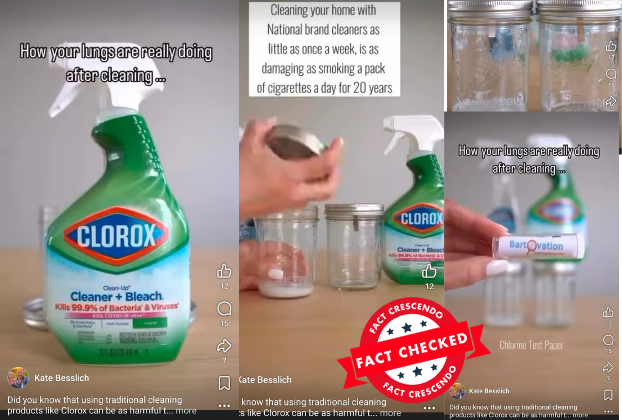
A viral video claims that using traditional cleaning products like Clorox is as harmful to the lungs as smoking an entire pack of cigarettes a day, citing a “lung study” and warning that repeated exposure to cleaning sprays causes serious long-term respiratory damage. The post says that as per a study ,people who regularly using conventional cleaning sprays at home or work experienced a decline in lung function comparable to smoking 20 cigarettes a day for up to 20 years. The post has footage of an experiment using chlorine test papers. It compares Clorox and some other product. Clorox and other products were added to separate beakers, and those were closed using lids. Each lid had chlorine papers. In the Chlorox beaker, the chlorine test paper became dark, while the other product’s chlorine test paper remained white.
This fact-check will examine whether these claims are supported by scientific evidence.
Fact Check
Claim 1. Is using Clorox or similar household cleaners really comparable to smoking a pack of cigarettes per day in terms of lung damage?
Multiple long-term studies have examined whether frequent use of household cleaners affects lung health. A 20-year European cohort study (ECRHS) led by Svanes et al. found that women who regularly clean at home or as professional cleaners had slightly accelerated declines in lung function compared to non-cleaners. In raw numbers, non-cleaning women lost about 18.5 mL of FEV₁ per year on average, while women cleaning at home lost about 22.1 mL/yr and women cleaning for work lost about 22.4 mL/yr. This ~3–4 mL/yr additional loss, accumulated over 20 years, is roughly comparable to the effect seen in people who smoke 10–20 cigarettes per day. The size of the effect was comparable to smoking 10 to 20 cigarettes daily during the study period.
However, this does not mean every cleaning session is as toxic as a cigarette. The study measured the impact of chronic, repeated exposure, often daily or weekly use over decades. For example, women who used spray cleaners at least once per week had faster lung decline than non-users, and full-time professional cleaners who face daily exposure to industrial-strength products showed the steepest decline. In contrast, occasional home cleaning like once a week showed only a modest effect.
Claim 2. What do scientific studies actually say about long-term lung function and exposure to household cleaning products?
Several large studies align with this picture. A meta-commentary in the American Journal of Respiratory and Critical Care Medicine notes that cleaning exposures are a known risk factor for respiratory problems in workers. The Svanes study showed that weekly spray use or other cleaning exposures were statistically linked to lung-function decline in women.
A separate Nurses’ Health Study found that nurses who used disinfectants at least once weekly had a roughly 22–32% higher risk of developing chronic obstructive pulmonary disease (COPD) over many years. Importantly, all these studies controlled for smoking and other factors, and still found a modest effect of cleaning products.
Claim 3. Do bleach-based cleaners like Clorox cause permanent lung damage when used as directed in normal household conditions?
Bleach is a strong disinfectant, and it is potentially toxic in high concentration, but normal household use is considered safe with proper precautions. Clorox’s own safety data sheet explicitly states that “No protective equipment is needed under normal use conditions”. In other words, using diluted bleach to clean toilets, sinks, or counters with ventilation does not require a respirator or pose a known long-term hazard. Medical literature echoes this: a case-report introduction notes that “chlorine-containing bleach is commonly used as a household cleaning agent” and that it is generally “safe for household use”, although very high or accidental exposures can cause lung injury.
In fact, toxicological guidelines show how much exposure causes harm. Chlorine gas has a very low safety threshold, Occupational Safety and Health Administration (OSHA) limits continuous workplace exposure to 0.5-1.0 parts per million (ppm). One can smell chlorine at roughly 0.2–0.4 ppm, and it’s the odor threshold. In a normal well-ventilated home, diluted bleach fumes typically stay far below 0.5 ppm. For perspective, a household bleach solution is mostly water, e.g., 1/4 cup in a bucket, and is used briefly then rinsed away. Government and health agencies agree that breathing small amounts of bleach vapor is not known to cause chronic lung disease.
Claim 4. Are claims of “toxic chemicals” based on real-world exposure levels, or on hazard-based comparisons taken out of context?
The claims about “toxic chemicals” in cleaners often confuse hazard, what a chemical can do at high dose with risk, what happens at low exposure. Every chemical has a hazard statement, but the risk depends on dose. For example, some companies who say they have natural products point out hazards like “attacks respiratory membranes, can lead to permanent lung damage” or “harmful or fatal if swallowed.” These statements are true for concentrated bleach, but misleading in context: you aren’t ingesting Clorox or breathing it at those levels when you simply mop your floor.
Regulatory authorities set exposure limits precisely to distinguish safe use from danger. For example, New Jersey’s chlorine fact sheet warns “Repeated exposure can lead to permanent lung damage,” but then lists an OSHA limit of 1 ppm. That’s a very small amount, far above what you encounter by cleaning a tile with bleach. Thus the real-world risk from diluted bleach is low when used properly.
Claim 5. Is the video presenting independent health evidence, or promoting a competing product using fear-based framing?
The viral video’s chlorine-strip experiment is not an objective test of real-world risk. Taping a chlorine-sensitive strip to the lid of a closed jar of concentrated Clorox bleach will indeed turn it dark as the bleach slowly off-gasses free chlorine. A different cleaner shows no change, which indicates that bleach contains active chlorine. It does not prove that spraying bleach in a bathroom puts you into a sealed chlorine chamber. In practice, bleach is used diluted, in the open air, and any small vapors dissipate quickly. Clorox’s own guidelines say use bleach only in well-ventilated areas and never to “use in a small, enclosed space.” In short, the demo uses a closed, unnatural scenario to exaggerate exposure. It also omits context: Clorox bleach solutions on a floor or shower tile will mostly react with grime and evaporate; a home user would rarely see the heavy “chlorine” smell in normal use. In reality, OSHA’s limit of 1 ppm (time-weighted) means long-term daily exposure to bleach would have to keep the air at that level to match workplace hazard — again, not what happens with a quick bathroom spray and wipe.
Conclusion
Credible research shows that chronic, heavy exposure to cleaning chemicals over years can modestly speed up the normal age-related decline in lung function, roughly on the order of a light smoker. But this is not the same as saying each spray of Clorox is like lighting a cigarette. Normal household use of bleach, which is diluted as directed, with good ventilation, and never mixed with other chemicals, is not known to cause permanent lung damage.
The claims in the viral video simplify the scientific findings and do not account for differences in exposure levels. The video may also have a commercial purpose, as it promotes an alternative cleaning product. Health experts recommend using bleach according to label instructions with adequate ventilation, or choosing milder cleaning alternatives such as soap and water, vinegar, or baking soda when suitable. Normal household cleaning with bleach, when done properly, is not equivalent to smoking cigarettes.
Title:Is Cleaning with Clorox as Harmful as Smoking?
Fact Check By: Rashmitha DiwyanajaleeResult: Misleading
