

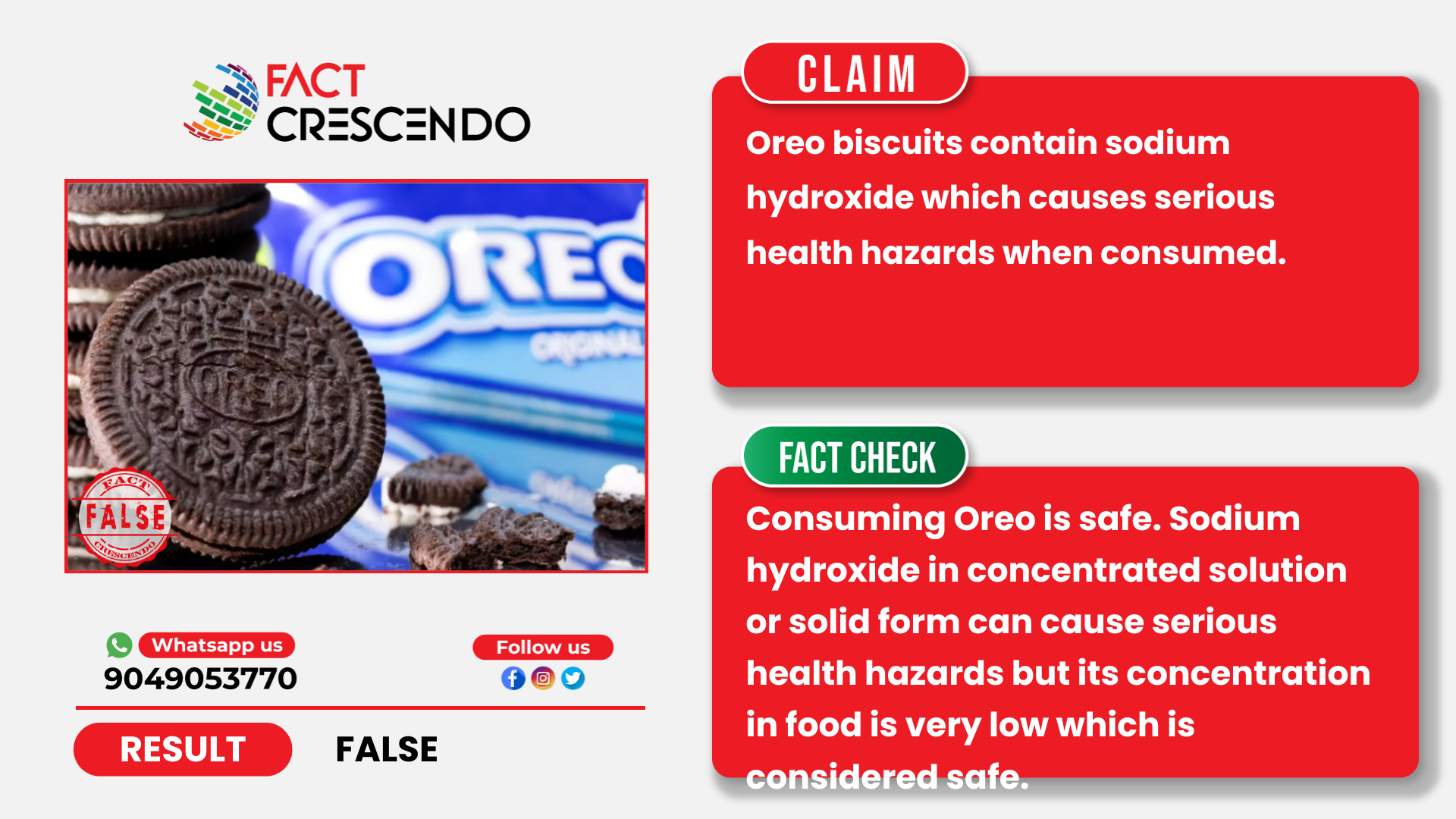
Oreo was first created by Nabisco (National Biscuit Company) and came to market in 1912. Later the company was acquired by Mondelez International in 2012. Over the time, it has expanded into international markets and is easily available in stores in many countries.
But recently, social media users are raising their concern on the safety of Oreo. The claim suggests that Oreo contains Sodium Hydroxide, an ingredient which is also present in paints and helps in degreasing machinery. When it is slightly overused, it damages human tissues and causes inflammation to the esophagus and stomach lining.
Fact Check-
Let’s check the facts of Sodium hydroxide.
What is Sodium Hydroxide?
Sodium hydroxide is also known as lye or soda, or caustic soda. It is used in several food processing applications, such as curing foods like olives or helping to brown Bavarian-style pretzels, giving them their characteristic crunch. Sodium hydroxide is also used to remove skins from tomatoes, potatoes and other fruits and vegetables for canning and also as an ingredient in food preservatives that help prevent mold and bacteria from growing in food.
Is Sodium Hydroxide harmful?
According to the Centers for Disease Control and Prevention (CDC), it is a highly corrosive substance that can cause injury when someone comes in direct contact with a concentrated form of the substance. It can burn the skin, damage the eyes, irritate the lungs if inhaled, and severely injure the mouth, throat, stomach, and intestines if swallowed. Children are more vulnerable to this substance.
Long-term or repeated exposure to sodium hydroxide dust or mist can damage the nose, skin, and digestive tract, leading to ulcers. Overall, sodium hydroxide is dangerous only when people are exposed to its concentrated form or repeated doses and not when it is neutralised in industrial or in food processing.
Is the use of sodium Hydroxide in food safe?
The U.S. Food and Drug Administration (FDA) had listed sodium hydroxide (NaOH) in the Substances Added to Food inventory and in the list of GRAS (Generally Recognized As Safe) It means sodium hydroxide is permitted for use in food when used according to good manufacturing practices.
According to the Oregon Department of Human Services, sodium hydroxide is harmful in highly concentrated solutions or in solid form. Direct skin contact with pure crystals or powder can produce immediate irritation, rashes or even burns. Inhalation of crystals or powder can be very injurious to the respiratory tract. Household cleaners and laundry products that contain moderate to high amounts of sodium hydroxide can irritate the skin and may cause serious burns if they stay on the skin for too long. Very strong solutions can damage the skin and deeper tissues almost immediately. However, very low-strength solutions (less than about 1000 parts per million) are generally considered safe for brief skin contact.
In contrast, hydroxide levels in foods and drinks are extremely low. Even foods that are considered the most alkaline usually contain no more than about 2 ppm of hydroxide.
Conclusion:
Fact Crescendo found the claim to be false. Sodium hydroxide in concentrated solution or solid form can cause serious health hazards but its concentration in food is very low which is considered safe.

Title:Concerned about the use of sodium hydroxide as an ingredient in Oreo? Check the facts.
Fact Check By: Siddharth SahuResult: False
