

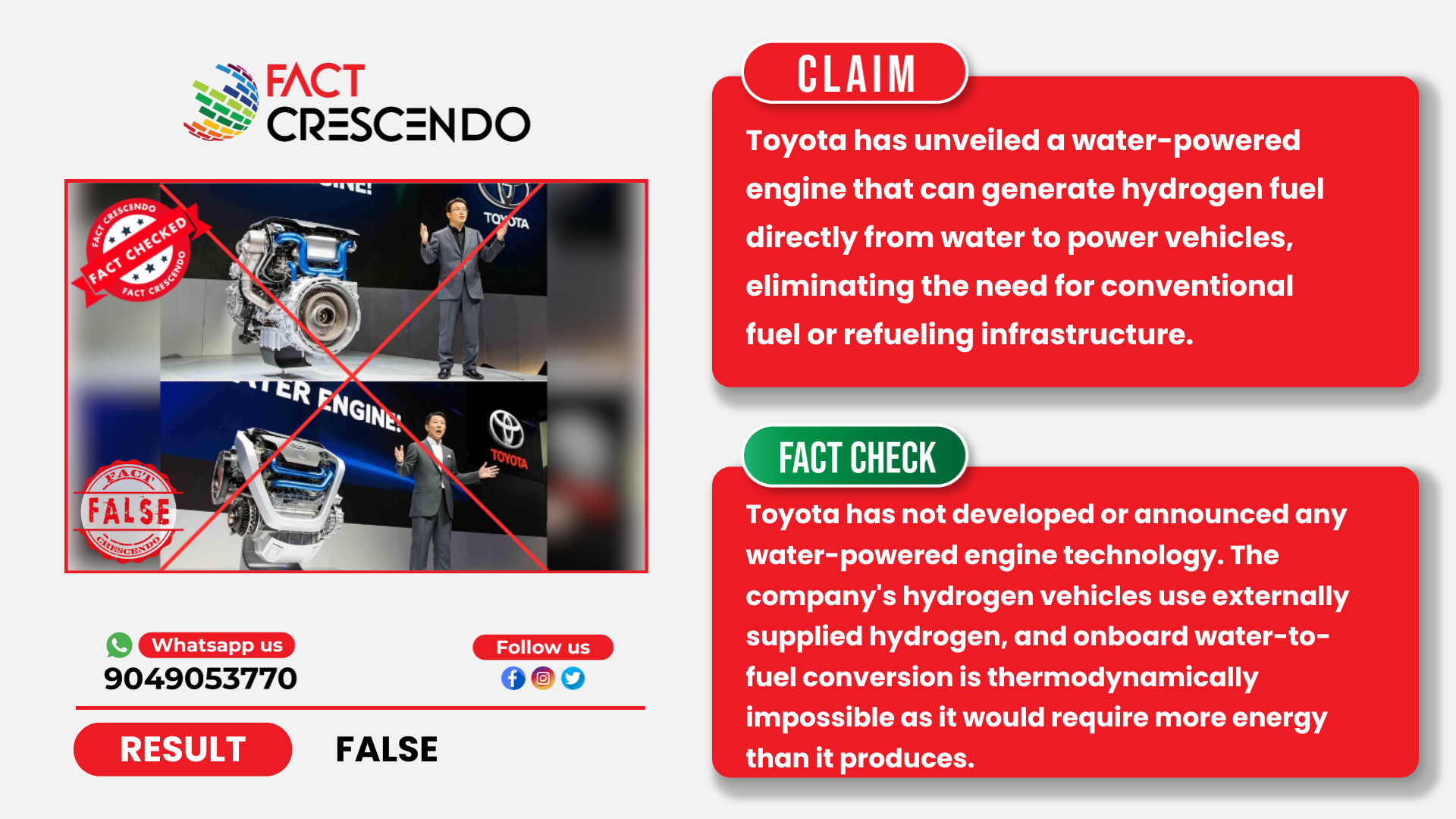
A claim circulating on social media platforms states that Toyota has unveiled a “water-powered engine” that can generate hydrogen fuel directly from water to power vehicles. The posts describe the technology as a breakthrough that eliminates the need for conventional fuel or refueling infrastructure. However, our investigation found that the claim is false.
Social Media Posts
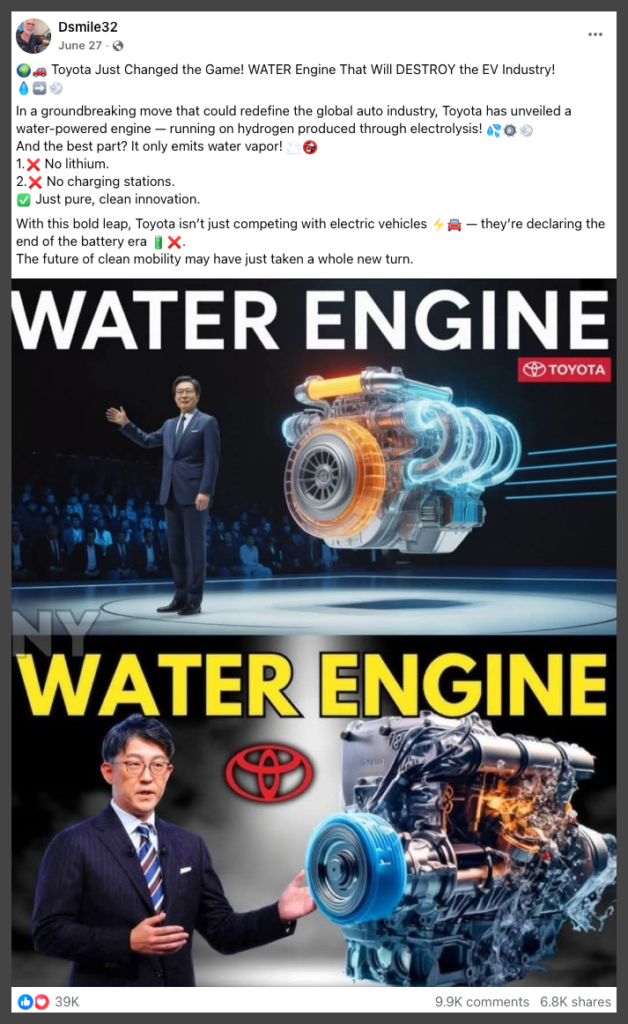
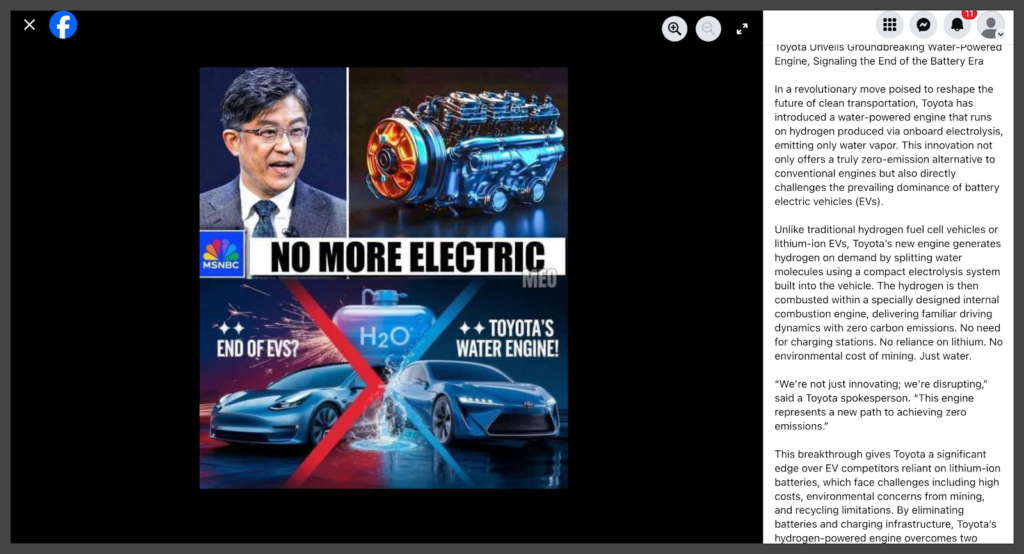
Multiple posts claim that Toyota has developed a water-powered engine. The claim has gained widespread attention across social media.
Fact Check
Toyota Has Not Developed a Water-Powered Engine
Toyota has not announced, demonstrated, or commercialized any vehicle that produces fuel by splitting water onboard to power itself. According to Toyota’s own global explanation of hydrogen fuel cell technology, vehicles such as the Toyota Mirai generate electricity by combining hydrogen stored onboard with oxygen from the air in a fuel cell system. In this process, water is produced only as a by-product, not as a source of energy or fuel.
Toyota Japan’s official hydrogen information further describes the company’s fuel cell activities in the context of promoting hydrogen as a key energy carrier for achieving carbon neutrality. These efforts include fuel cell electric vehicles, hydrogen combustion engines, and stationary fuel cell systems, without any reference to technology that produces hydrogen directly from water onboard vehicles.
Toyota’s hydrogen strategy also includes the development of water electrolysis systems to support hydrogen supply chains. However, Toyota explicitly frames these systems as stationary and industrial applications, designed for large-scale hydrogen production and energy infrastructure rather than onboard vehicle fuel generation.
Why the Claim Is Scientifically Impossible
Water is a stable combustion product, meaning it already exists in a low-energy state. Splitting water into hydrogen and oxygen through electrolysis requires more energy input than the energy that can be recovered when hydrogen is later used in a fuel cell or combustion process. This is consistent with the first law of thermodynamics, which states that energy cannot be created from nothing. Any onboard electrolysis system would require an external power source and would lose energy at each conversion step, making it impractical as a means of propulsion (Source).
Source of the Confusion: Hydrogen Engines and Water Injection
Some viral posts confuse Toyota’s hydrogen combustion engine research with the false claim of a “water-powered engine.” Toyota is testing hydrogen internal combustion engines (H2-ICEs), which burn hydrogen gas that has been stored in fuel tanks, similar to how conventional engines burn gasoline, but using hydrogen instead. These experimental hydrogen engines still require hydrogen to be produced elsewhere and stored onboard in pressurized tanks. They do not extract hydrogen from water while the vehicle is running.
In internal combustion engines, water injection is a technique that cools the air-fuel mixture and prevents engine knock by lowering combustion temperatures. This cooling allows engines to operate at higher performance levels without premature ignition, and can also help reduce certain emissions. However, water injection does not create hydrogen or act as a fuel source, it simply manages heat during combustion (Source).
According to Forbes, water injection does not generate hydrogen and does not function as a fuel source. Energy analysts have noted that this misunderstanding has contributed significantly to the spread of the claim.
Conclusion
The claim that Toyota has developed a water-powered engine is false. Toyota has not created any vehicle capable of generating hydrogen fuel from water onboard to power itself. The viral posts stem from misunderstandings about Toyota’s legitimate hydrogen fuel cell vehicles, which rely on externally supplied hydrogen, and its hydrogen combustion research, which may use water only for cooling purposes, not as fuel.