

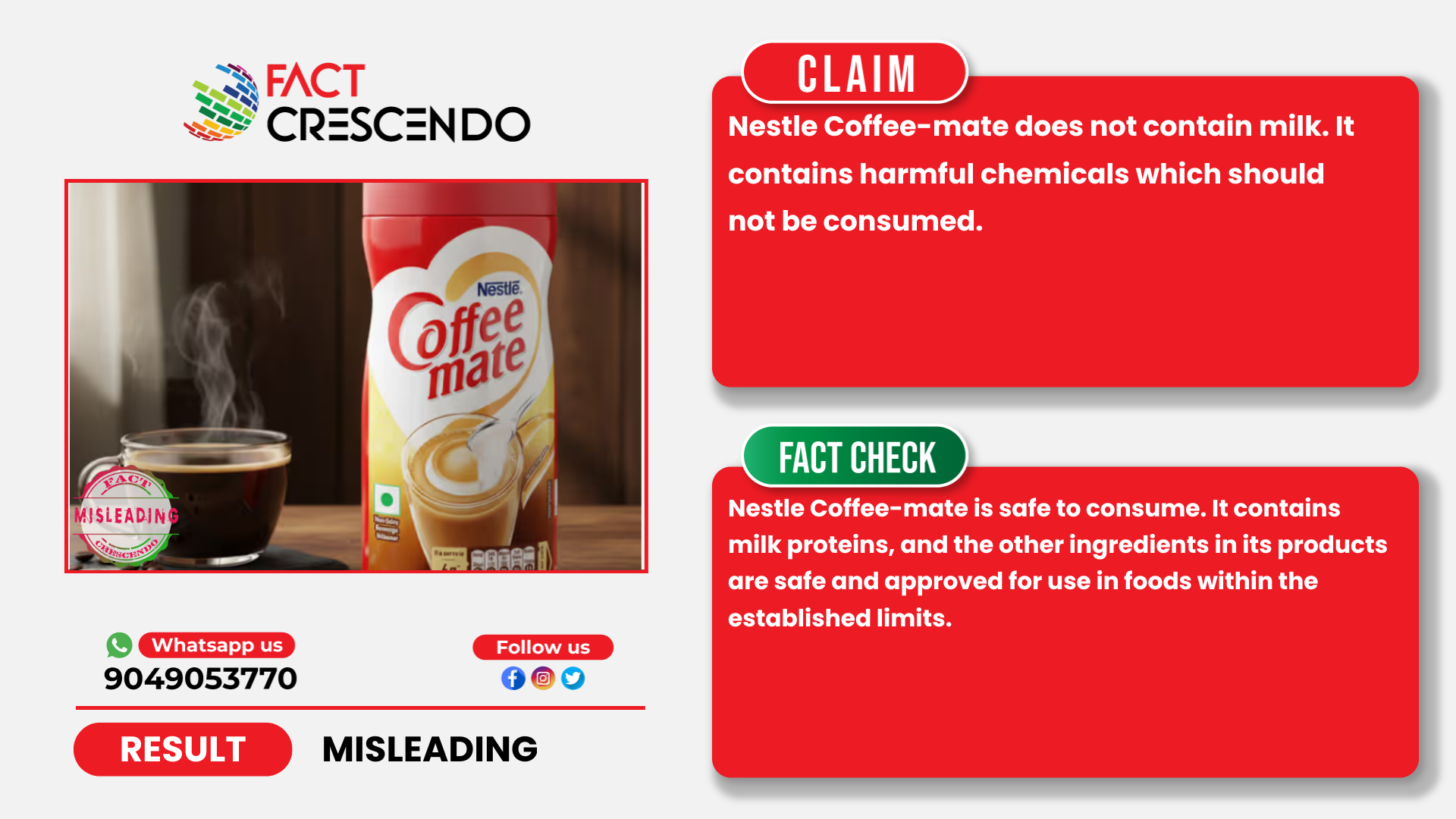
Social media posts are claiming that Nestle Coffee-mate creamer does not contain milk and instead contains ingredients such as dipotassium phosphate and soyabean oil that are harmful to human health and unsafe for consumption. These claims have raised concerns about the safety and composition of the product.
However, Fact Crescendo found the claim to be misleading. Although Nestle Coffee-mate does not contain milk, it contains milk protein. Other ingredients mentioned in the video are safe and approved.
Fact Check-
Nestle Coffee-mate does not contain milk?
We checked the list of ingredients in three different varieties of Nestle coffee-mate products. We found that all the three Nestle coffee-mate, original, light and fat free, does not contain direct milk, but contains milk proteins (Sodium Caseinate). So, it will not be completely right to claim that the products do not contain any milk.
Nestle Coffee-mate Original is marketed as a non-dairy creamer, so it is not equivalent to ordinary milk or a conventional milk-based cream. The absence of the word “milk” as a primary ingredient does not mean the product is necessarily completely free of all milk-derived ingredients
Therefore, the claim that Coffee-mate contains “no milk” is misleading. The creamer is non-dairy but contains a milk-derived ingredient.
What is Sodium Caseinate which is used as milk protein?
Sodium caseinate is a compound derived from casein, a protein present in the milk of mammals. It is the dominant protein in cow’s milk and is used in many milk-based products like ice cream and cheese as well.
Soybean Oil: High Oleic Soyabean Oils (HOSBO or HOSO) has been evaluated for its effect on human health and overall safety. A clinical trial involving 60 participants was conducted and found that HOBSO diets help in reducing cholesterol. However, when compared to regular soybean oil, HOSBO resulted in slightly higher LDL cholesterol and apoB levels.
Health Canada’s assessment confirmed that high-oleic soybeans, produced through gene-editing, are safe and nutritious as conventional soybeans, with no increased toxicity. Overall, HOSBO is considered safe for consumption and may be a healthier alternative to oils high in saturated fats.
According to the US Soyabean Export Council (USSEC), the panel established a Codex standard after collaborating with various domestic and international partners to facilitate a Codex standard for HOSO. The standard aims to facilitate trade by establishing a universally recognized benchmark for the product.
Dipotassium Phosphate: Dipotassium phosphate is an FDA-recognized food ingredient and is permitted for use in food. The FDA lists it for functions such as regulating pH, stabilizing food, emulsifier, and serving as a nutrient supplement. It is recognized as GRAS (Generally Recognized as Safe) by the U.S. FDA and is permitted for use as a food ingredient under conditions described by the regulation. It is permitted in 21 CFR 182.6285 of the regulation.
According to the World Health Organization (WHO), JECFA has concluded that phosphate salts, including dipotassium phosphate, can be safely used within established intake limits. The committee established a Maximum Tolerable Daily Intake (MTDI) of 70 mg/kg body weight per day for phosphorus from phosphoric acid and phosphate salts. JECFA also found that estimated dietary exposure among infants was not a safety concern when phosphorus levels remained within established nutritional limits.
Conclusion:
Fact Crescendo found the claim to be misleading. Nestle Coffee-mate contains milk proteins in its products, and the other ingredients are safe and approved for use in foods within the established limits. Nestle Coffee-mate is safe to consume.
Title: Does Nestlé Coffee-mate Contain No Milk and Harmful Chemicals?
Fact Check By: Siddharth Sahu
Result: Misleading
