

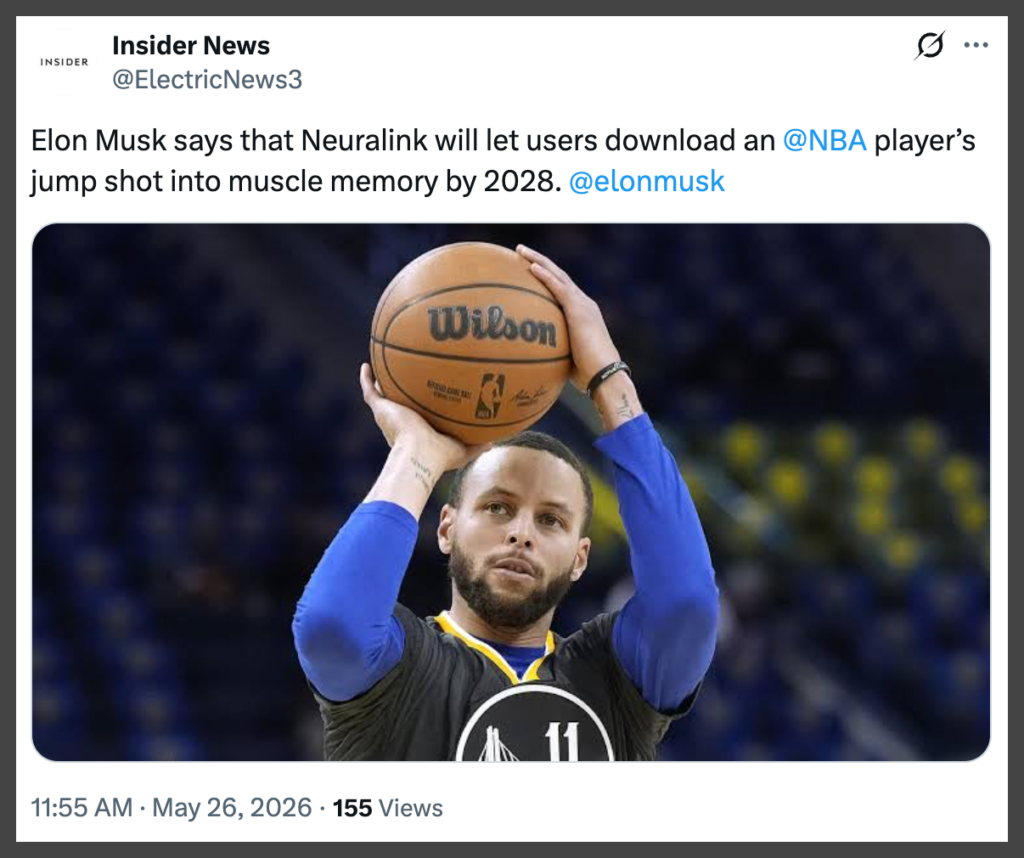
A viral social media post claims that Elon Musk said Neuralink would allow users to “download an NBA player’s jump shot directly into muscle memory by 2028.” The claim has circulated widely on social media, often accompanied by graphics resembling sports news headlines or technology announcements. However, our investigation found no evidence that Musk ever made such a statement. Available evidence shows the quote originated from a satire account and was later shared online without context as a genuine announcement.
Social Media Posts
The viral claim typically appears alongside graphics stating: “Elon Musk says that Neuralink will let users download an NBA player’s jump shot into muscle memory by 2028.” Versions of the post have appeared across Instagram, Facebook, and X.
Fact Check
The Claim Originated From a Satire Account
Our investigation found that the quote did not originate from Elon Musk, Neuralink, or any official NBA source.
The assertion was first circulated by Hoops Crave. This specific account is recognized for sharing comedic and satirical NBA-related material instead of verified news reports. Furthermore, the primary post on X was generated by Hoops Crave directly, rather than being an announcement from Neuralink or Elon Musk himself.
The Times of India independently reviewed the viral claim and concluded that there is no evidence that Musk ever announced plans to use Neuralink technology to transfer basketball skills or “download” an NBA player’s jump shot into users’ muscle memory.
What Elon Musk Has Actually Said About Neuralink
Elon Musk has repeatedly described Neuralink as a medical brain-computer interface designed to restore lost capabilities in people with severe neurological conditions. The company’s public mission statement describes its goal as creating technologies that “return autonomy to people with unmet medical needs”.
Neuralink’s first brain-computer interface platform, known as Telepathy, is designed to allow people with paralysis to control computers, phones, and other devices using neural signals alone. (Source)
Musk has also discussed longer-term ambitions including restoring communication and vision. Neuralink is currently recruiting participants for its VOICE study, which aims to convert neural activity associated with speech directly into text or synthesized voice for patients with severe speech impairments caused by ALS, stroke, spinal cord injury, or similar conditions (Source).
Although Musk frequently makes ambitious predictions regarding the future of brain-computer interfaces, no public interview, presentation, social media post, or Neuralink publication contains claims about downloading athletic skills, implanting memories, or transferring professional sports abilities between individuals.
What Neuralink Is Actually Testing
Neuralink has entered human clinical testing, but its research remains in an early medical stage.
According to Reuters, the company reported in January 2026 that it had enrolled 21 participants in clinical trials worldwide, up from 12 participants several months earlier. Neuralink stated that no serious adverse events related to the implant had been reported among trial participants.
The company’s official clinical trials website currently lists studies involving computer cursor control, robotic arm control, speech restoration, and future visual restoration technologies rather than cognitive enhancement or skill transfer applications.
The first participant implanted with Neuralink’s device demonstrated the ability to move a cursor, browse the internet, play games, and interact with social media using thought alone. However, these capabilities involve decoding existing neural signals and converting them into digital commands rather than writing new information into the brain (Source).
Reuters previously reported that Neuralink’s initial PRIME study was designed to enroll only three patients, with the study expected to continue through 2031, highlighting how early the technology remains in its clinical development process.
Why “Downloading a Jump Shot” Is Far Beyond Current Science
Modern brain-computer interfaces function by recording and decoding signals that already exist inside a person’s brain and translating those signals into commands for computers or assistive devices.
The viral claim implies something fundamentally different: recording the neural representation of an elite basketball player’s motor skills and transferring those learned movements directly into another person’s nervous system.
Current neuroscience has not demonstrated the ability to encode, transfer, and reproduce complex learned behaviors such as shooting mechanics, hand-eye coordination, proprioception, timing, and years of athletic training. Existing brain-computer interface research remains focused on restoring lost function rather than implanting entirely new abilities into healthy individuals.
Even competing brain-computer interface companies currently focus on medical goals such as speech restoration and mobility assistance rather than cognitive enhancement or skill uploads, reflecting the present limitations of the field (Source).
Conclusion
The claim that Elon Musk said Neuralink would allow users to “download an NBA player’s jump shot into muscle memory by 2028” is a satirical claim that was later circulated as factual information.
Available evidence shows the quote originated from a satire account and was later shared without context as genuine news. Musk has never publicly made such a statement, and Neuralink’s current clinical research is focused on medical applications such as restoring communication, movement, and vision for people with severe disabilities.
While brain-computer interfaces are advancing rapidly, transferring professional athletic skills directly into the human brain remains far beyond the capabilities of current neuroscience and Neuralink’s publicly demonstrated technology.

Title: Did Elon Musk Say Neuralink Will Let Users Download an NBA Player’s Jump Shot by 2028?
Written By: Pranpreeya
Result: False
