

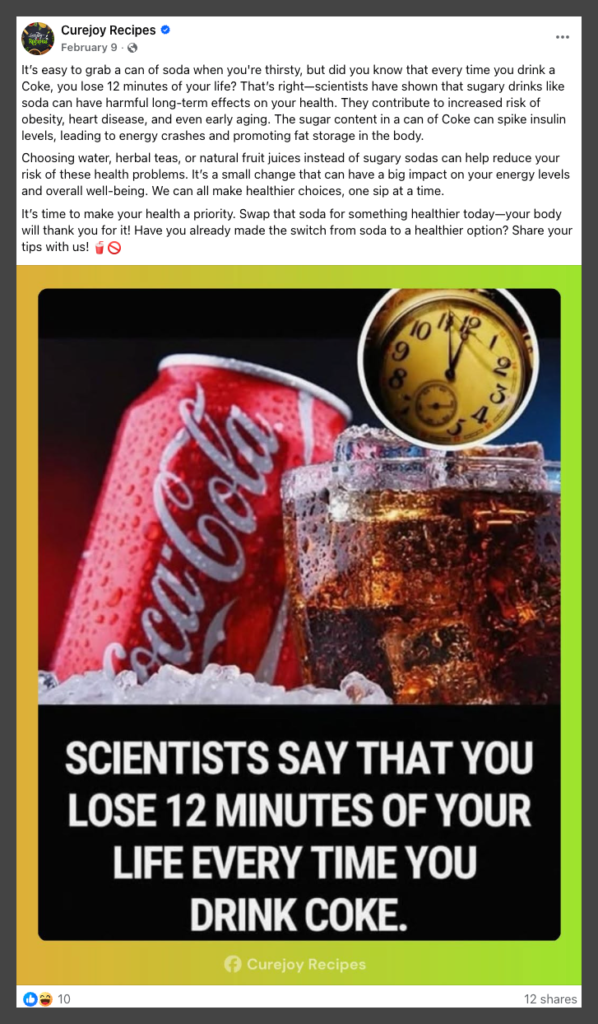
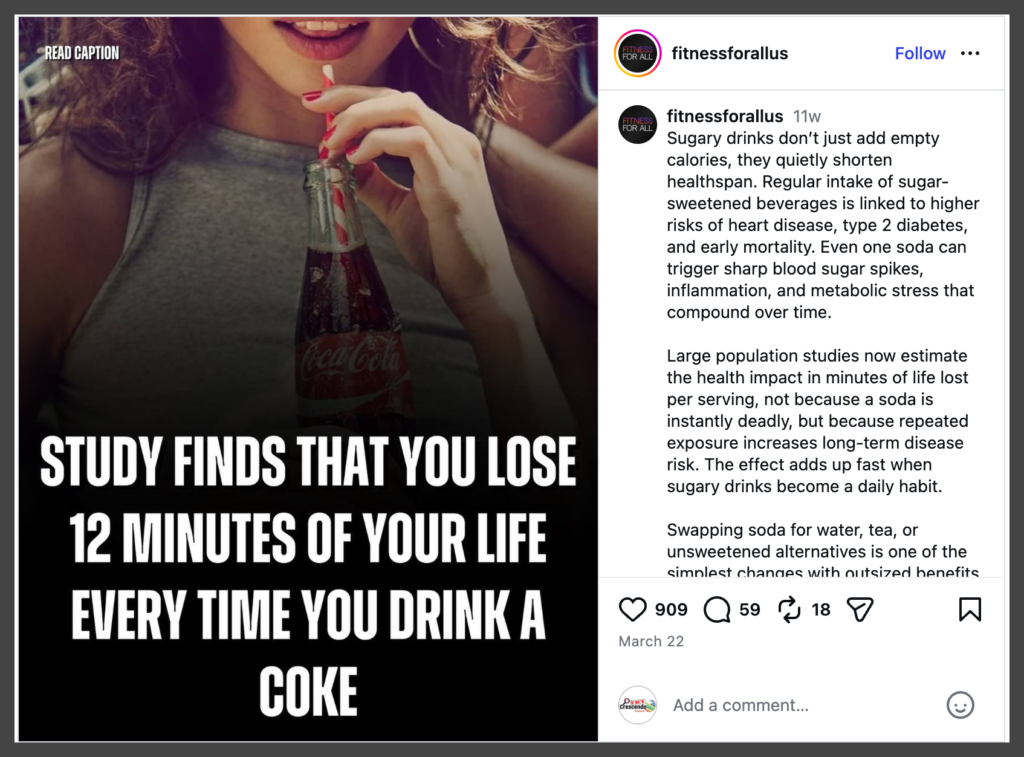
A viral claim circulating across social media platforms alleges that scientists have found that drinking a single can of Coca-Cola or other sugary soda “takes 12 minutes off your life.” Many posts present the figure as a precise scientific measurement, suggesting that every can consumed directly reduces a person’s lifespan by exactly 12 minutes. However, our review found that the claim is missing context. The study did not conclude that drinking a Coke literally shortens an individual’s life by 12 minutes. Instead, it estimated a reduction in “healthy life expectancy” using a population-based statistical model.
Social Media Posts
The claim has circulated widely in recent years through social media posts, often stating that “scientists found that every Coke you drink takes 12 minutes off your life” or “one can of soda cuts 12 minutes from your lifespan.”
Source | Archive Source | Archive
Fact Check
What the University of Michigan Study Actually Found
The claim is based on a 2021 study from the University of Michigan that analyzed 5,853 common foods in the U.S. Researchers created the Health Nutritional Index (HENI), a tool designed to estimate the average gain or loss in healthy life expectancy associated with consuming specific foods.
According to the study, this index translates complex dietary risks into minutes per serving. Using this methodology, researchers estimated that a serving of sugar-sweetened beverages was associated with approximately 12 minutes of healthy life lost per serving. However, this estimate referred to healthy life expectancy at a population level, not an individual’s literal lifespan.
Crucially, the researchers explained that these minutes refer to healthy life expectancy, which is the time spent in good health, rather than a literal reduction of a person’s total lifespan. The original study is available here and the university’s detailed explanation can be found here.
What Does “12 Minutes Lost” Actually Mean?
While it is tempting to view the “12 minutes” as a direct countdown to death with every can of soda, that is not how the science works. The HENI metric is a population-level statistical tool, not a personal prediction. It estimates how dietary habits affect large groups of people over time based on broad health data. The University of Michigan emphasizes that this model is meant to make nutritional risks easier to understand for the general public, rather than predicting a specific outcome for any one individual.
Limitations of the HENI Metric
The “12-minute” figure is not a literal countdown for any one person. Instead, it is a statistical estimate based on the Health Nutritional Index (HENI). This tool looks at large groups of people to see how certain foods might affect health trends across an entire population. Because everyone is different, with unique genetics, exercise habits, and medical histories, this number cannot predict exactly how a single can of soda will affect your personal health. For more details on these limitations, see the original study and the University of Michigan materials.
Furthermore, the scientific framework of the HENI system has faced scrutiny from the academic community. Nutritional experts point out that using time-based metrics to represent dietary dangers can mask inconsistencies in statistical modeling, such as confounding variables, the potential for reverse causality, and the assumption that health risks from various foods are simply cumulative. (See Archer et al., critical perspectives on dietary risk estimates)
Coca-Cola’s Specific Ingredients and Health Implications
While the University of Michigan research evaluated sugar-sweetened beverages as a general category, the social media claim focuses on Coca-Cola. Examining the beverage’s components and relevant health data from independent studies provides further context for this assertion.
Sugar Content: A standard 355ml can contains 39 grams of added sugar. According to the World Health Organization, this amount constitutes approximately 78% of the suggested daily intake limit for a 2,000-calorie diet, which recommends that added sugars make up less than 10% of total energy intake.
Phosphoric Acid: Included for acidity and flavor, phosphoric acid has been studied for its potential relationship with bone mineral density. While epidemiological observations have noted correlations between high cola intake and lower bone density in certain demographics, clinical evidence regarding the effects of moderate consumption levels remains varied within the scientific literature.
Caramel Color (Class IV): This coloring agent contains 4-methylimidazole (4-MEI), a byproduct of the manufacturing process. While the International Agency for Research on Cancer (IARC) lists 4-MEI as a possible carcinogen based on laboratory studies, the U.S. FDA and other international regulatory bodies currently classify its presence in beverages as safe for human consumption within established regulatory limits.
Caffeine: A single can provides approximately 34mg of caffeine. For scientific context, this is roughly one-third of the caffeine content found in an 8-ounce cup of coffee. Scientific consensus generally identifies this amount as being within a standard range for most adults, though intake recommendations vary for children and pregnant individuals.
None of these ingredients were individually assessed in the HENI study. Therefore the “12 minutes” figure is derived from the SSB category’s aggregate nutritional profile and is not a direct measure of any single ingredient’s effect on health.
What Science Says About Sugary Drinks
While the viral claim differs from the specific methodology of the study, there is substantial evidence linking regular consumption of sugar-sweetened beverages to adverse health outcomes. A major study published in Nature Medicine estimated that sugar-sweetened beverages contributed to approximately 2.2 million new cases of type 2 diabetes and 1.2 million new cases of cardiovascular disease globally in 2020. Researchers concluded that sugary drink consumption is associated with increased risks of both type 2 diabetes and cardiovascular disease.
Although these findings do not validate the claim that a single can of soda literally shortens a person’s life by 12 minutes, they do support the broader scientific consensus that frequent consumption of sugar-sweetened beverages is associated with adverse health outcomes.
Factors Influencing Health Outcomes
Health experts generally evaluate foods and beverages within the context of overall dietary patterns rather than in isolation. While frequent consumption of sugar-sweetened beverages has been associated with increased risks of obesity, type 2 diabetes, cardiovascular disease, and premature mortality, these outcomes are influenced by a combination of factors including total diet quality, physical activity, genetics, and other lifestyle behaviors.
For this reason, public health recommendations typically focus on limiting the intake of sugary drinks and maintaining balanced dietary habits rather than attributing health outcomes to a single food or beverage. The University of Michigan study itself emphasized small dietary substitutions and overall eating patterns as the most effective way to improve long-term health outcomes, rather than eliminating individual foods entirely (Source).
Understanding the Difference Between Lifespan and Healthy Life Expectancy
Expert interpretation of the study requires distinguishing between chronological age and “healthy life expectancy.” While total lifespan refers to the number of years a person is alive, healthy life expectancy specifically measures the years lived in good health, free from chronic diseases or significant disability. The 12 minutes cited in headlines refers to this disease-free living rather than a literal reduction of the time remaining until death. Furthermore, it is critical to understand that the Health Nutritional Index (HENI) is designed as a relative tool for comparing the nutritional value and health impact of different foods on a population level. It is not intended to be a predictive model for an individual’s personal lifespan, as individual outcomes are influenced by a complex array of genetic and lifestyle factors. As noted by Newsweek, the goal of the metric was to translate nutritional risks into an easily understandable scale for the public rather than to provide a literal countdown for any one person.
Conclusion
The claim that scientists say every Coke “takes 12 minutes off your life” is missing context. The figure originates from a legitimate University of Michigan study, but the research estimated changes in healthy life expectancy using the Health Nutritional Index (HENI), not a literal reduction in lifespan. While regular consumption of sugar-sweetened beverages is associated with increased risks of obesity, diabetes, and cardiovascular disease, the “12 minutes” figure is a population-level statistical estimate rather than a prediction of what happens each time an individual drinks a can of Coke.
The study estimated changes in healthy life expectancy across populations, not the precise effect of a single beverage on an individual’s lifespan. As a result, viral claims that present the figure as a literal countdown oversimplify the underlying science.

Title: Scientists Do Not Say Every Coke Literally Takes 12 Minutes Off Your Life
Written By: Pranpreeya P
Result: Missing Context
