

A viral claim circulating across social media platforms alleges that YouTube has reached an agreement with FIFA to broadcast FIFA World Cup 2026 matches “free and live.” Many posts present the announcement as if YouTube itself has become the main official broadcaster for the tournament.
However, our review of FIFA’s official announcement and multiple credible reports found that the claim is misleading. FIFA did announce a partnership with YouTube, but the agreement does not mean YouTube will freely livestream the entire World Cup to viewers worldwide.
Social Media Posts
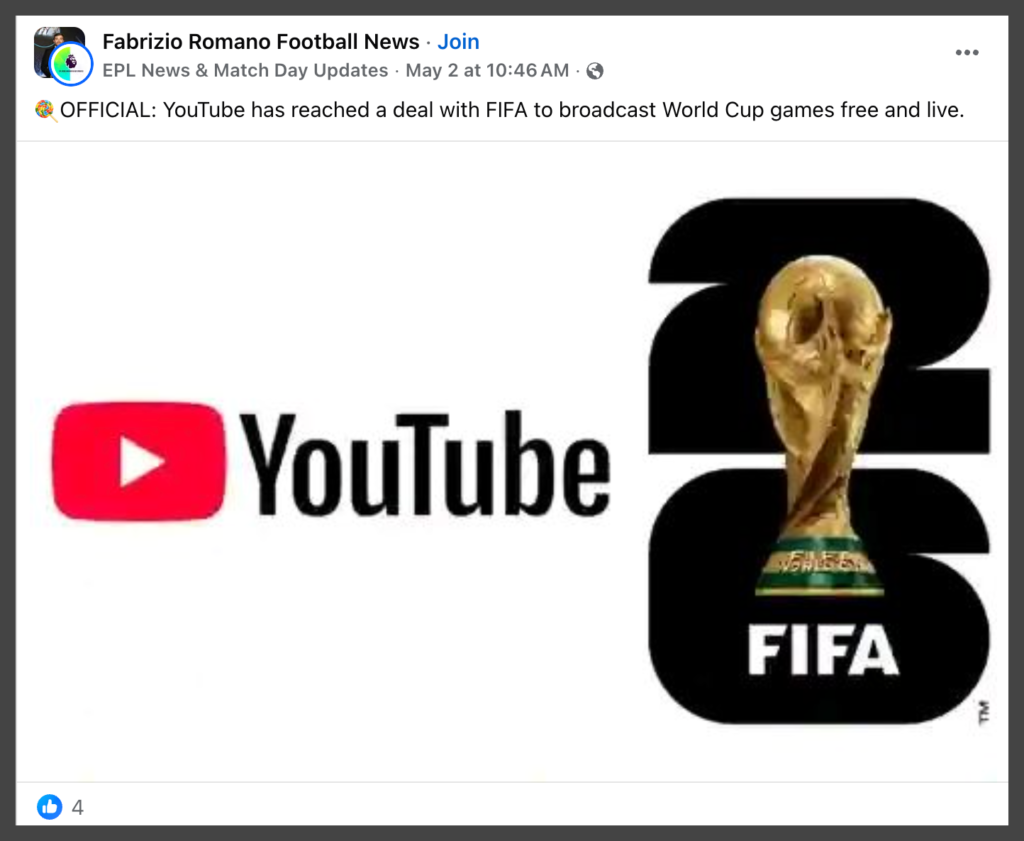
Facebook users claimed that YouTube reached a deal with FIFA to broadcast World Cup games for free and live.
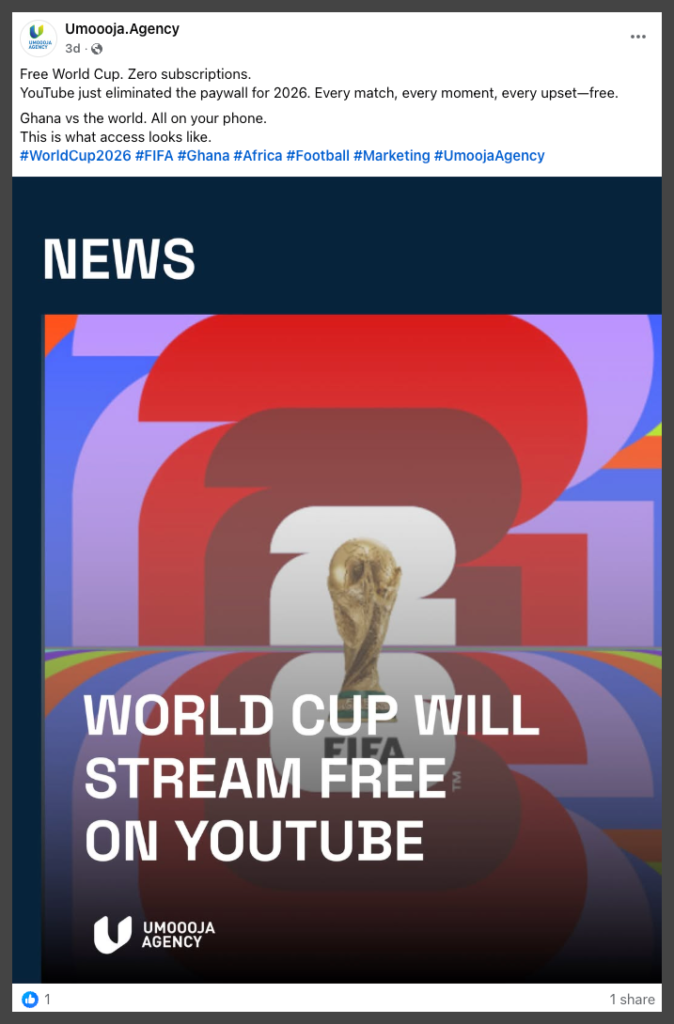
Below is another instance of the same claim implying that the FIFA world cup would be streamed live via YouTube.
Fact Check
FIFA’s Official Statement Does Not Say YouTube Will Broadcast the Entire Tournament
FIFA’s official announcement states that YouTube will become a “Preferred Platform” for the FIFA World Cup 2026, not the exclusive or primary global broadcaster. According to FIFA, the agreement is designed to help official media partners and creators distribute selected World Cup content through YouTube.
FIFA explained that official media partners will have the option to livestream the first 10 minutes of every match on their own YouTube channels, stream a select number of full matches depending on territory and broadcaster agreements, and publish highlights, Shorts, behind-the-scenes footage, and video-on-demand content.
The official FIFA release specifically states: “Media Partners will have the option of live streaming the first 10 minutes of every match on their YouTube channel.”
It also says that partners may stream “a select number of matches in full,” not the entire tournament.
The 10-minute live stream is not automatic for all viewers globally. It only activates if the rights-holding broadcaster in each territory chooses to implement it on their YouTube channel. A fan in the United Kingdom, Germany, or France can only access those 10 minutes if their local broadcaster (BBC, MagentaTV, or M6) actively switches on its YouTube channel option. In markets without a confirmed broadcaster, this option does not exist at all.
Rights-Holding Broadcasters Still Control the Main Live Coverage
An important distinction is the difference between a streaming platform and a broadcast rights holder.
Broadcast rights holders are the companies or television networks that legally purchase permission from FIFA to air World Cup matches in specific countries or territories. In the United States, FOX Sports and Telemundo are the official FIFA World Cup 2026 English- and Spanish-language broadcast rights holders through 2026, according to official announcements from FOX Sports.
A streaming platform such as YouTube can host content uploaded by rights holders, but that does not automatically make YouTube the official broadcaster of the event.
The World Intellectual Property Organization (WIPO) explains that broadcasting rights determine which companies are legally authorized to distribute sports content to audiences, while streaming platforms may host content only within the permissions granted by those agreements.
In this case, FIFA’s agreement allows licensed media partners to use YouTube as an additional distribution platform for limited content. The main live rights remain with FIFA’s contracted broadcasters.
Reporting from ESPN also noted that the agreement encourages rights-holding broadcasters to show the first 10 minutes of matches on YouTube, and that only selected matches may be streamed in full depending on the broadcaster and territory.
Similarly, reporting from SportsPro Media and Dawan Africa stated that full live rights remain with broadcasters, while YouTube is used as an additional distribution and engagement platform.
The scale of existing broadcast contracts makes global free streaming impossible:
FIFA is targeting approximately $3.9 billion in broadcast rights revenue from the 2026 World Cup cycle alone, according to BestMediaInfo. Each of those contracts grants a broadcaster legal exclusivity within their territory. Freely streaming all matches on YouTube would simultaneously breach every one of those exclusive contracts, exposing FIFA to hundreds of breach-of-contract claims. This structural reality makes the viral claim logically impossible.
YouTube was not FIFA’s first “Preferred Platform” – TikTok was:
A further sign that the “Preferred Platform” designation is a deliberate distribution strategy and not a broadcast rights deal is that YouTube was actually FIFA’s second Preferred Platform partner, not its first.
On January 8, 2026, FIFA named TikTok its first-ever Preferred Platform in a deal that similarly allowed official broadcasters to live-stream parts of matches and post curated clips on TikTok. The YouTube deal, announced on March 17, 2026, followed the same structure. As SportsPro Media reported, the Preferred Platform designation creates an additional content distribution layer on top of, not instead of, existing broadcast rights.
The Partnership Is Framed as Expanding Digital Distribution
FIFA’s announcement describes the partnership to expand the tournament’s digital reach and support distribution through YouTube alongside existing broadcast arrangements.
The announcement references creator collaborations, archival footage, behind-the-scenes access, highlights, and other promotional video content, and says the partnership is intended to “maximise the tournament’s impact across the evolving media landscape.”
YouTube’s description similarly states that official media partners “will be able to livestream the first 10 minutes of every match and a select number of full games.”
Neither FIFA’s announcement nor YouTube’s description says the entire tournament will be available for free, worldwide, as full live streams on YouTube.
Why Brazil is the exception and why it matters for the viral claim:
One important reason this claim spread widely is that it contains a kernel of truth that applies specifically to Brazil. CazeTV, the Brazilian YouTube channel operated by creator Casimiro Miguel, separately negotiated and secured full FIFA broadcast rights for Brazil in July 2025, months before the global YouTube Preferred Platform deal was announced.
Under this separate arrangement, CazeTV will stream all 104 matches of the 2026 World Cup free and live on YouTube for Brazilian audiences. This is the largest live YouTube broadcast arrangement in history, building on CazeTV’s record of 6.9 million concurrent devices for Brazil vs Croatia at the 2022 World Cup quarter final.
However, CazeTV’s deal is a separate territorial broadcast rights agreement and not the global YouTube Preferred Platform deal. Brazilian fans benefiting from CazeTV’s coverage does not mean viewers elsewhere in the world have similar access.
Context: Why FIFA pursued the YouTube partnership : FIFA’s own streaming platform, FIFA+, was designed to provide live coverage to global audiences and failed commercially as an independent destination. The YouTube deal emerged partly as a response to that failure, using YouTube’s existing global infrastructure and audience reach as an alternative distribution channel for promotional and limited live content. This context confirms that the YouTube arrangement is not a replacement for paid broadcast infrastructure but a supplement to it.
What This Means for India, Sri Lanka, Pakistan, and South Asia
The viral claim has particular relevance for viewers in South Asia, where the broadcast situation for the 2026 World Cup is unresolved and where the YouTube deal provides no effective remedy.
As of early May 2026, no broadcaster has been confirmed for India, Sri Lanka, Pakistan, or Bangladesh. FIFA’s Indian subcontinent media rights tender closed in September 2025 without a deal. FIFA initially sought approximately $100 million for a combined 2026 and 2030 World Cup rights package for India; that price was later reduced to $35 million. Even at the reduced price, no broadcaster has agreed to terms.
India’s largest digital sports platform, JioStar, formed through the Reliance–Disney merger, reportedly offered $20 million, which FIFA rejected, according to Storyboard18. The gap between FIFA’s asking price and the market’s willingness to pay reflects practical challenges: most 2026 matches will be played in North American time zones, meaning kick-off times fall in the early morning hours in India, reducing live viewership potential and making advertising inventory less commercially attractive.
Because the YouTube Preferred Platform deal works exclusively through local rights-holding broadcasters. and no such broadcaster exists for the Indian subcontinent, the YouTube arrangement does not give Indian, Sri Lankan, Pakistani, or Bangladeshi fans any legal live access to World Cup matches, not even the 10-minute window. The claim that YouTube has made the World Cup “free and live” is therefore most acutely misleading for exactly the audience most likely to share it in South Asia.
The situation in South Asia stands in contrast to China, where FIFA recently secured a deal with China Media Group for $60 million, a dramatic reduction from FIFA’s initial asking price of $300 million, illustrating the broader commercial pressure FIFA faces in Asian markets. Chinese fans will receive multi-platform coverage through state broadcaster CCTV. South Asian fans currently have no equivalent arrangement.
Conclusion
The claim that “YouTube has reached a deal with FIFA to broadcast World Cup games free and live” is misleading. While FIFA and YouTube did announce a partnership for the 2026 FIFA World Cup, the agreement does not make YouTube the tournament’s main free global broadcaster. Instead, FIFA’s licensed media partners may stream limited content on YouTube, including the first 10 minutes of matches and selected full games in certain territories. The primary live broadcasting rights remain with FIFA’s official rights-holding broadcasters.
The one market where something close to the viral claim is true is Brazil, where CazeTV will stream all 104 matches free on YouTube under a separately negotiated territorial broadcast rights deal. This arrangement does not extend to any other country.
For viewers in India, Sri Lanka, Pakistan, and Bangladesh, neither the YouTube Preferred Platform deal nor any other arrangement has resolved the broadcast rights vacuum as of the date of publication. South Asian fans should not rely on the viral claim as a guide to accessing the tournament.Readers are advised to verify broadcast arrangements directly with FIFA’s official broadcaster listings or authoritative regional media reports before the June 11, 2026, tournament kick-off.

Title: FIFA Did Not Announce That YouTube Will Broadcast the Entire 2026 World Cup Free and Live
Written By: Fact Crescendo Team
Result: Misleading
