

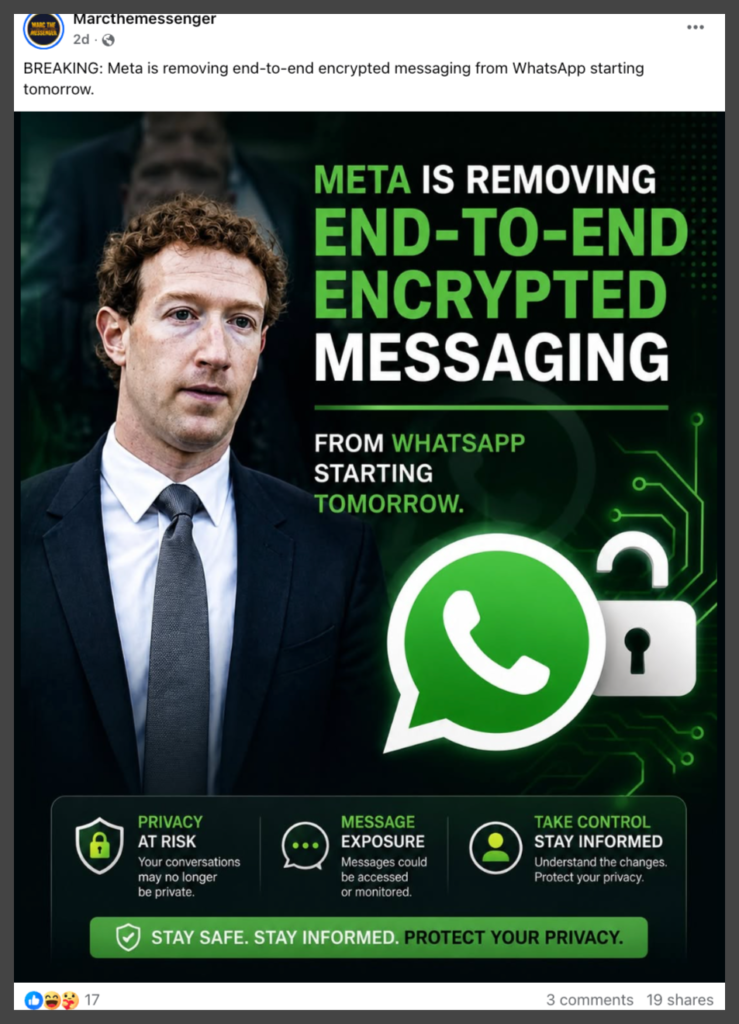
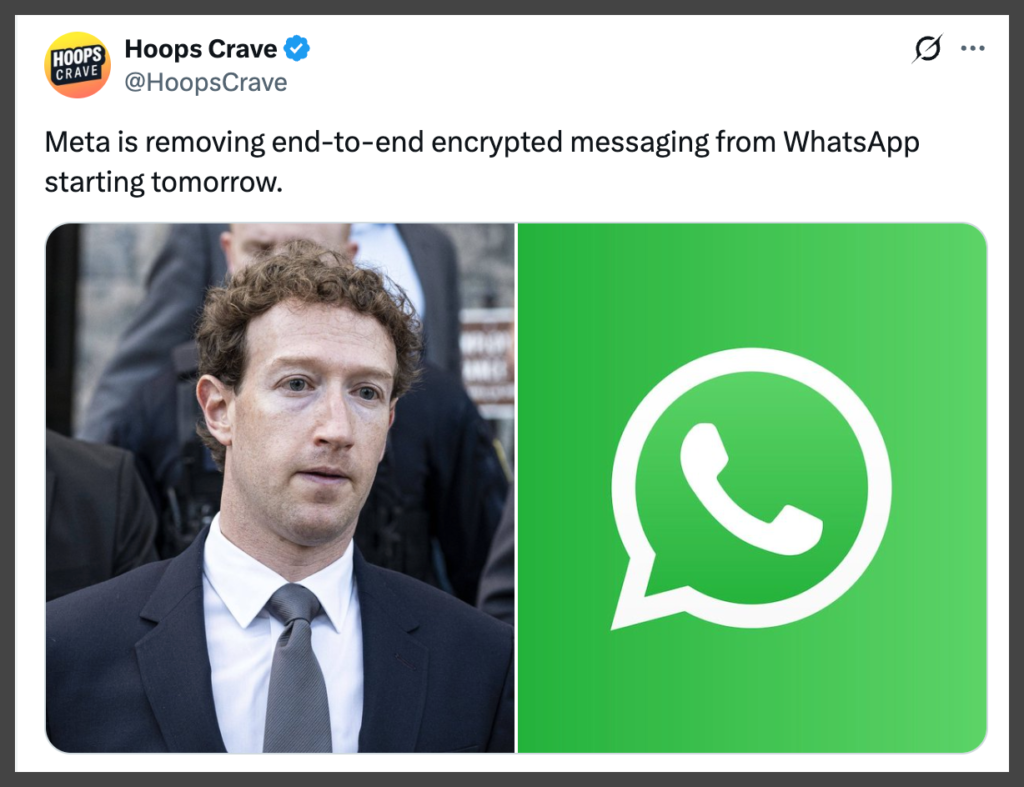
A viral claim circulating on platforms alleges that Meta is removing end-to-end encrypted messaging from WhatsApp. The claim spread widely amid ongoing debates over online privacy and Meta’s messaging platforms. However, after reviewing Meta’s official statements, WhatsApp documentation, and reporting from multiple reputable outlets, we found this claim to be misleading.
Social Media Posts
The claim circulated in viral posts warning users that Meta was “removing encrypted messaging from WhatsApp.” The claim is spreading on Facebook and X.
Fact Check
Background: Encryption Across Meta’s Messaging Platforms
To evaluate this claim accurately, it is necessary to understand how Meta has implemented end-to-end encryption (E2EE) differently across each of its messaging platforms. Meta does not operate a single unified messaging system. WhatsApp, Facebook Messenger, Instagram DMs, and Threads each have distinct encryption histories and current statuses.
| Platform | E2EE introduced | Current status | Notes |
|---|---|---|---|
| 2016 (default) | Active — default | E2EE on all messages, calls, media by default. Based on the open-source Signal Protocol. Reinforced Jan 2026 with new Strict Account Settings mode. | |
| Facebook Messenger | 2016 (optional) → Dec 2023 (default) | Active — default | Secret Conversations launched July 2016 as opt-in feature. Meta made E2EE the default for all Messenger chats in Dec 2023. Largest E2EE rollout in Meta’s history at the time. |
| Instagram DMs | 2021 (optional) → Removed May 2026 | Removed | Optional E2EE for DMs launched in 2021. Meta cited very low opt-in rates. Feature discontinued 8 May 2026. Users directed to WhatsApp for encrypted messaging. |
| Threads | Never offered | No E2EE | Threads launched in July 2023 with no E2EE for direct messaging. Meta has not announced plans to introduce E2EE on Threads. All messages are accessible to Meta on this platform. |
WhatsApp has offered end-to-end encryption by default for all messages, calls, photos, videos, and documents since April 2016. This encryption is built on the open-source Signal Protocol, developed by Open Whisper Systems and independently audited by security researchers. Because the protocol is open-source, WhatsApp’s encryption claims are independently verifiable rather than being purely a marketing assertion from Meta.
Facebook Messenger
Messenger’s E2EE journey is the most directly relevant comparison to the Instagram situation. Meta launched optional “Secret Conversations” in July 2016 , an opt-in E2EE feature structurally identical to what Instagram later offered and has now removed. For years, standard Messenger chats were not encrypted end-to-end. Then, in December 2023, Meta rolled out default E2EE for all Messenger conversations globally, describing it as one of the most complex engineering challenges in the company’s history. This means Messenger went in the opposite direction to Instagram: it moved from optional to default encryption, while Instagram has moved from optional to none.
Instagram Direct Messages
Instagram introduced an optional E2EE feature for direct messages in 2021, allowing users to opt in to encrypted chats. However, Meta’s own data showed that very few users enabled it. On 8 May 2026, Meta discontinued this feature entirely. Users with affected chats received instructions to download messages or media they wished to keep. Meta has directed users who want encrypted messaging to use WhatsApp instead.
Threads
Threads, Meta’s text-based social platform launched in July 2023 as a direct competitor to X (formerly Twitter), has never offered end-to-end encryption for its direct messages. All Threads messages are accessible to Meta. The company has made no public announcements of plans to introduce E2EE on Threads. Meta’s own help documentation for Threads confirms this, noting the platform does not currently support end-to-end encrypted messaging.
This means that, across Meta’s four main messaging surfaces, only two, WhatsApp and Messenger, currently offer E2EE by default.
What Meta Actually Announced
Therefore, Meta did not announce the removal of end-to-end encryption from WhatsApp.
Instead, the company confirmed that Instagram’s optional encrypted messaging feature for direct messages would no longer be supported after 8 May 2026. According to Meta’s support documentation, users with affected encrypted chats received instructions on how to download messages or media they wanted to keep before the feature was removed.
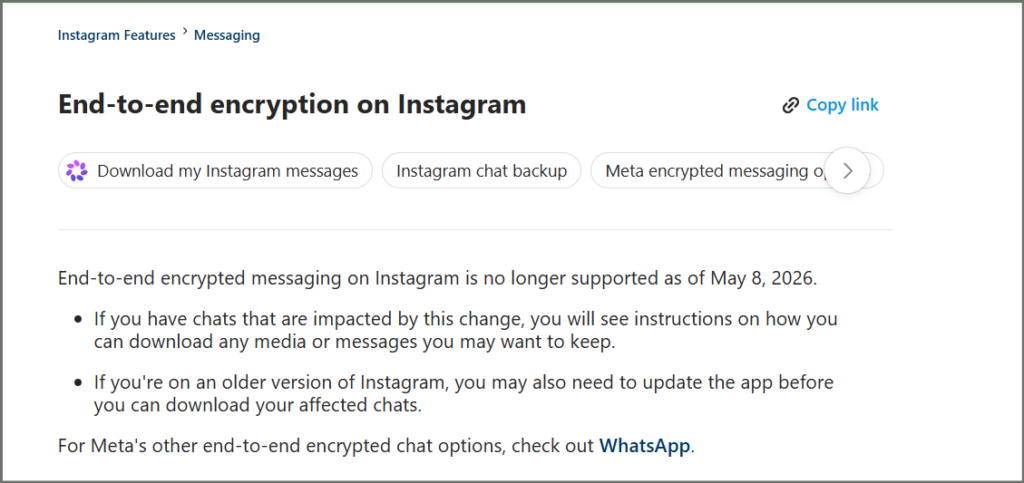
9to5Google reported Meta’s clarification that the change only applied to Instagram DMs. Instagram’s PR team stated: “Very few people were opting in to end-to-end encrypted messaging in DMs, so we’re removing this option from Instagram in the coming months. Anyone who wants to keep messaging with end-to-end encryption can easily do that on WhatsApp.”
That statement directly contradicts the viral claim that WhatsApp encryption was being removed.
Why the Rumour Spread
The rumour appears to have spread in part due to confusion about which Meta product the announcement applied to.
Meta’s decision to discontinue optional end-to-end encryption for Instagram direct messages led to headlines about “Meta removing encryption,” which some users interpreted as applying across Meta-owned messaging services.
Because Instagram, Facebook Messenger, and WhatsApp are often discussed together as part of Meta’s broader messaging ecosystem, some posts and commentary framed the change as a platform-wide shift.
The background context above illustrates why this confusion is understandable: Meta’s encryption policies genuinely do differ from platform to platform, making it easy for a change on one service to be misread as a broader policy shift. Meta’s public statements, however, described the change as specific to Instagram DMs and distinguished it from WhatsApp’s default end-to-end encryption.
Reports also noted that Instagram’s encrypted DMs were not widely enabled because users had to opt in. Meta said “very few people” used the feature before it was discontinued.
As a result, coverage in privacy and cybersecurity outlets generally framed the development as an Instagram-specific change rather than a broader removal of encryption across Meta’s messaging apps.
WhatsApp Still Uses End-to-End Encryption by Default
WhatsApp’s official help pages continue to describe end-to-end encryption as a core feature of the platform. According to WhatsApp’s Help Center, personal messages, calls, photos, videos, and documents are protected so that “only you and the person you’re talking to can read or listen to them, and nobody in between, not even WhatsApp.”
This encryption is built on the Signal Protocol, an open-source cryptographic framework developed by Open Whisper Systems and independently audited by security researchers. This matters because it means WhatsApp’s encryption claims are technically verifiable, not simply a marketing pledge.
WhatsApp also continues to market privacy and encryption as central part of its platform. The company’s official security pages and app store descriptions still state that private conversations are end-to-end encrypted by default.
In January 2026, WhatsApp introduced a new “Strict Account Settings” security mode designed to offer additional protection against sophisticated cyberattacks targeting journalists, activists, and public figures. Reuters reported at the time that WhatsApp conversations already remained protected by end-to-end encryption while the company added extra security layers.
That rollout further contradicts claim that Meta is abandoning encryption on WhatsApp. Instead, the company has continued expanding security features on the platform.
What Changes for Users
Beginning 8 May 2026, Instagram users lost access to optional end-to-end encrypted chats. Reports from The Guardian and PCMag described the move as a rollback of privacy protection for Instagram messaging. Meta advised users who wanted encrypted messaging to use WhatsApp instead.
After 8 May reported that Instagram users received prompts to download encrypted chats and media before the feature ended. However, there has been no major evidence showing large-scale migration from Instagram to WhatsApp because of the change.
For Facebook Messenger users, nothing changes, Messenger’s default E2EE, rolled out in December 2023, remains in place. For Threads users, nothing changes either: the platform has never offered E2EE, and there is no indication that will change in the near term.
The net result across Meta’s platforms is that the overall availability of E2EE has not meaningfully contracted: WhatsApp (the largest Meta messaging app globally, with over two billion users) and Messenger both offer default E2EE.
Privacy Nuance: Encryption Does Not Mean Zero Data Collection
Even though the viral claim about WhatsApp ending encryption is false, privacy experts note that end-to-end encryption is not the same as “total privacy.”
E2EE primarily protects the content of messages, meaning third parties (including the platform provider) generally should not be able to read the message text. However, other information (often called “metadata”) may still be collected, such as phone numbers, who someone messages, when messages are sent, IP addresses, and other usage patterns.
Researchers have noted that metadata can still reveal details about relationships and behavior, even when message content remains encrypted. (Source)
Privacy groups also warn that backups (for example, cloud backups) may not be protected in the same way unless users enable encrypted backups. WhatsApp offers an opt-in encrypted backup feature, but it is not enabled by default.
For these reasons, “end-to-end encrypted” should not be treated the same as anonymity or zero data collection. These broader privacy considerations also do not support the specific viral claim that Meta removed WhatsApp’s encryption.
Conclusion
The claim that Meta is removing end-to-end encrypted messaging from WhatsApp is misleading. The confusion arose because Meta’s announcement about Instagram DMs where optional E2EE was discontinued from 8 May 2026, was misread as a platform-wide policy affecting WhatsApp.
WhatsApp continues to use end-to-end encryption by default, and Meta itself continues recommending WhatsApp as its encrypted messaging platform. Official WhatsApp documentation and recent security updates also confirm that encrypted messaging remains active on the service.
Across Meta’s ecosystem, the full picture is more nuanced:
- WhatsApp retains default E2EE and has actively expanded its security features.
- Facebook Messenger upgraded to default E2EE in December 2023, moving in the opposite direction to Instagram.
- Instagram DMs lost their optional E2EE feature, a genuine privacy rollback on that platform.
- Threads has never had E2EE and has no announced plans to introduce it.

Title: Meta Is Not Removing End-to-End Encryption From WhatsApp
Written By: Fact Crescendo Team
Result: Misleading
