

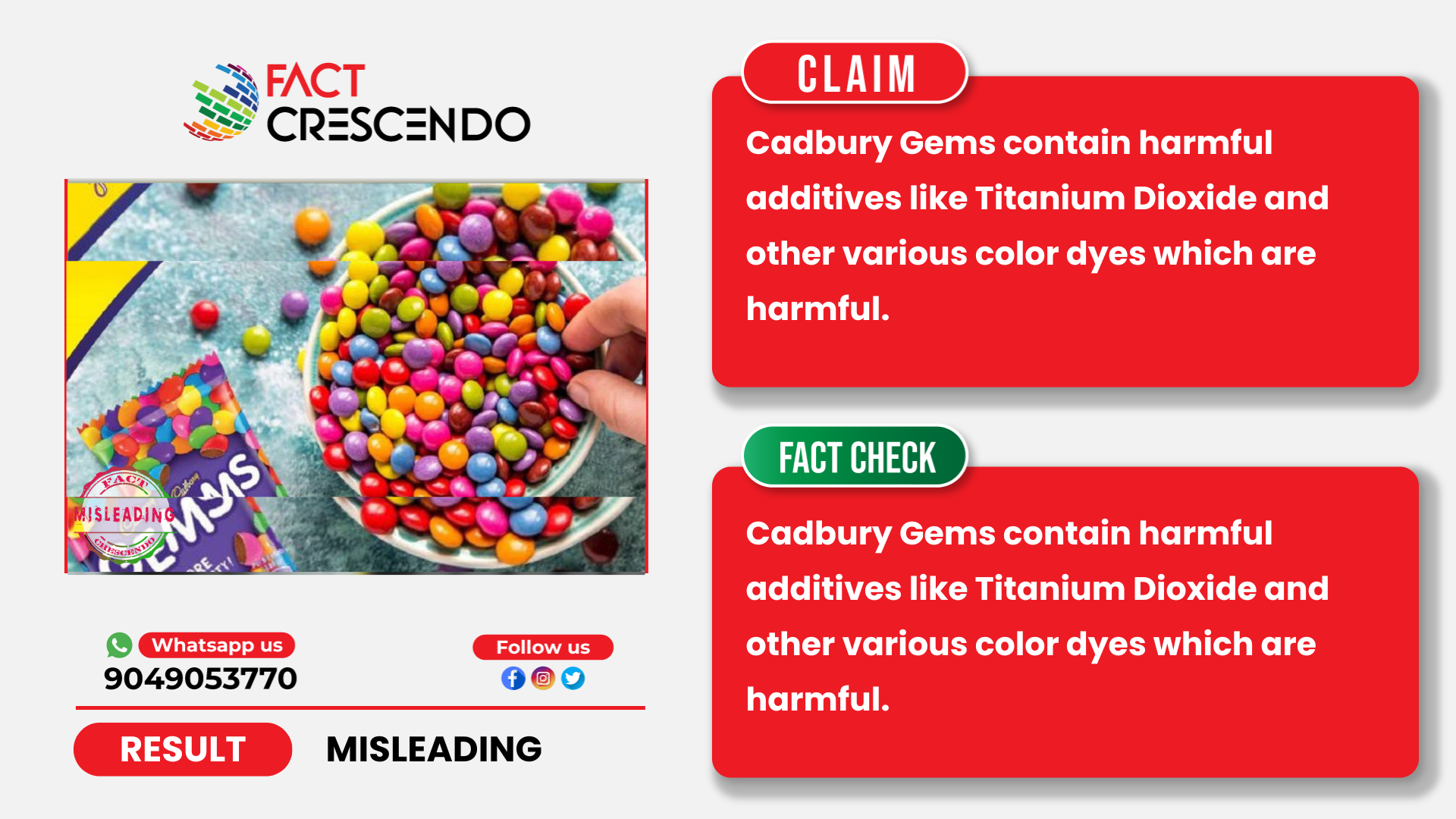
Cadbury Gems is a popular chocolate candy known for its colourful, unique shape filled with milk chocolate. It has been in the market for many decades and has successfully captured the hearts of people of all ages.
However, recently social media users had raised concerns over the use of certain color additives in the product. The claim suggests that these color additives are really harmful for human health.
In the video, the person can be heard saying, “Do you know what are the numbers written on the back side of the Gems chocolate? These numbers actually represent various colors of the gems. 171 is white color which is known as Titanium Dioxide and is banned in the European Union as it damages DNA. 102 is Yellow color which is known as Tartrazine which leads to Asthma attack and hyperactivity in children. 133 is Brilliant Blue FCF which can lead to allergic reactions. 127, 124, 122 is a red color which is manufactured from Coal Tar.”
Fact Check-
Let’s check the facts of each of the mentioned ingredients.
E 171 Titanium Dioxide:
Titanium Dioxide is a naturally occurring inorganic material that is mined from the earth and then processed and refined before it is used. It exists as a white and powdery solid substance. It is used as a white pigment for paints, in the food industry as a coloring agent, in sunscreens and cosmetics. It is also used by pharmaceutical companies for manufacturing gelatin capsules, tablet coatings and syrups.
During our research, we found that The European Food Safety Authority (EFSA) reviewed scientific evidence and found that titanium dioxide (TiO₂) particles may cause genotoxicity (damage to DNA). Due to this concern, EFSA no longer considers titanium dioxide (E171) safe as a food additive and cannot establish a safe daily intake. However, this evaluation applies only to its use in food and not to other applications.
In 2022, the Court of Justice of the European Union overturned the European Commission’s decision to classify titanium dioxide as a possible carcinogen. The court found that the scientific study used to support the classification was flawed because it did not consider how TiO₂ particles tend to clump together and how it affects their behavior in the lungs. Additionally, the court ruled that titanium dioxide does not naturally cause cancer. The risk only arises in specific situations when large amounts of fine particles are inhaled. Due to these errors, the court found the classification to be wrong and chose to cancel it.
E 102 Tartrazine:
The EFSA reviewed the safety of Tartrazine, a yellow food dye used in many products. Older studies showed that only a tiny amount of Tartrazine is absorbed by the body, while most of it is broken down by gut bacteria and leaves the body in urine. An acceptable daily intake (ADI) of 7.5 mg per kg of body weight was set many years ago, but the studies used were not detailed enough or focused on mixtures of dyes instead of just Tartrazine. Because of this, EFSA advised for more research to fully understand if Tartrazine is safe and if the ADI needs to be updated.
E 133 Brilliant Blue FCF:
The EFSA reviewed the safety of Blue 1, also known as Brilliant Blue FCF (E 133). It was previously approved with an acceptable daily intake (ADI) of 10 mg/kg body weight per day, set in 1984. After reviewing new data on how the dye is absorbed, processed, and its effects on health, the EFSA decided to lower the ADI to 6 mg/kg body weight per day. This decision was based on updated studies showing the dye is safe at this level. The EFSA also found that most people’s intake is below this new ADI.
E 127 Red No. 3:
Red No. 3 is a synthetic red dye that was commonly used to colour foods, desserts, candies, and some medicines. The FDA has decided to ban its use in foods and ingested drugs starting 15 January 2025 because the studies showed that high doses of this dye caused cancer in male rats. Because of this the FDA chose to revoke its approval, meaning Red No. 3 will no longer be permitted in edible products. Manufacturers have until 15 January 2027 (for food) and 18 January 2028 (for drugs) to reformulate their products.
E 124 Ponceau 4R:
The European Food Safety Authority (EFSA) reviewed the safety of Ponceau 4R, a red food dye used in the EU, to see if people, especially kids might be consuming too much of it. A previous review in 2013 had reduced the amount that could be used. In a recent review, EFSA used updated data to see how much people are actually consuming. The results showed that even in the highest exposure cases, people, including toddlers and children were still eating less than the daily safe limit of 0.7mg per kg of body weight per day. So, the dye is considered safe at the levels currently used in food.
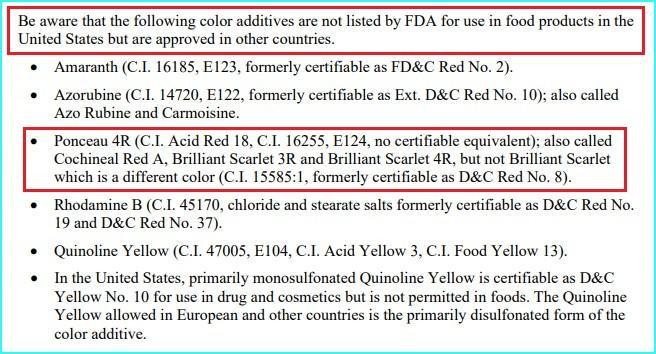
The FDA had warned that Ponceau 4R or INS 124 color additive along with a few others had not been listed by the organization for use in food products in the United States. But these color additives are approved in other countries.
Conclusion:
Fact Crescendo found the claim to be misleading. According to food safety regulatory bodies, the mentioned additives are safe when consumed within the set limits. The presence of these additives does not make Cadbury Gems harmful
Title:Ingredients in Cadbury Gems are approved and safe for consumption.
Fact Check By: Drabanti GhoshResult: Misleading
