

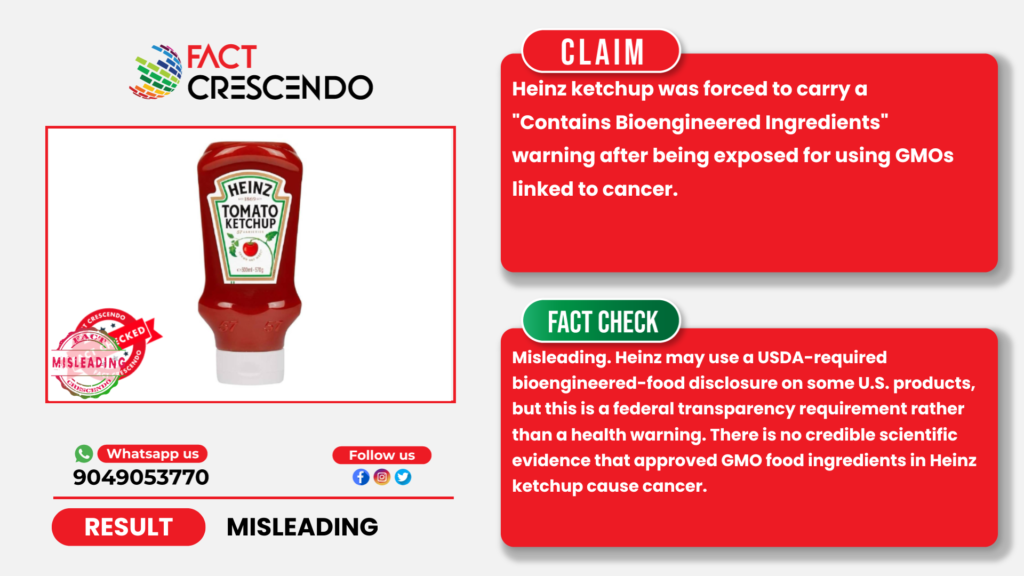
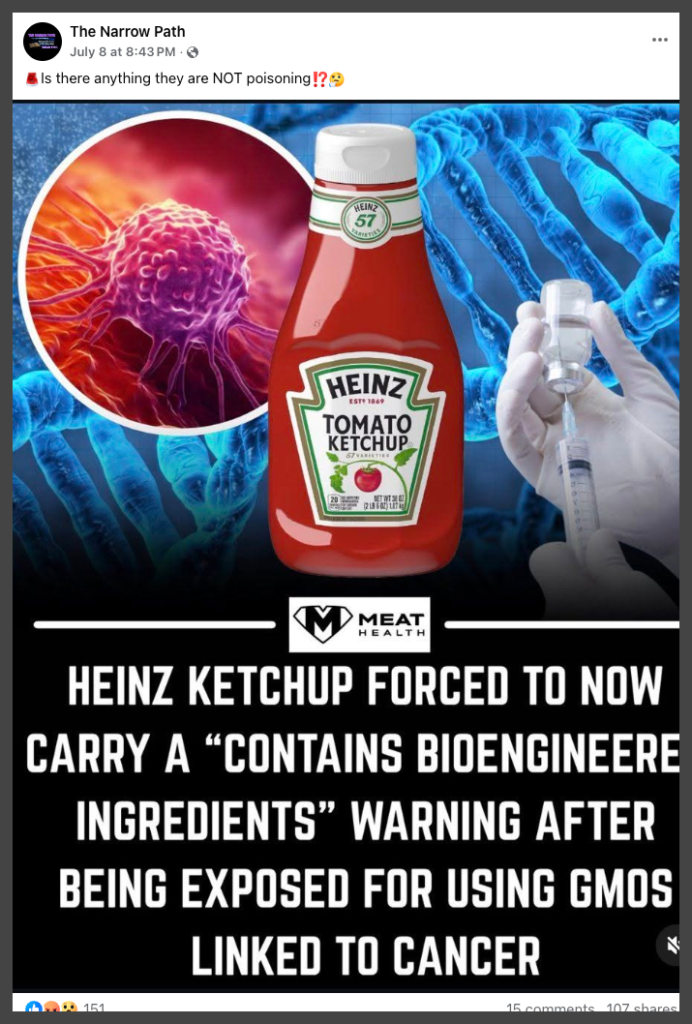
A viral image circulating on social media platforms claims that Heinz ketchup has been “forced to now carry a ‘contains bioengineered ingredients’ warning after being exposed for using GMOs linked to cancer.” However, our investigation found that the claim misrepresents U.S. food-labeling regulations and the current scientific evidence. The claim is misleading.
Social Media Posts
The claim has been widely shared across Facebook and Instagram, accompanied by an image of a Heinz ketchup bottle alongside graphics depicting cancer cells and a syringe. The viral caption states: “Heinz ketchup forced to now carry a ‘contains bioengineered ingredients’ warning after being exposed for using GMOs linked to cancer.”
Fact Check
Heinz may carry a bioengineered-food disclosure, but it is not a safety warning
The most accurate part of the viral claim is that certain Heinz ketchup products sold in the United States may display the statement “Contains Bioengineered Food Ingredients.” However, the post falsely portrays this disclosure as a government-issued warning about health risks.
Under the standard, a “bioengineered food” is defined narrowly: it is food that contains detectable genetic material modified through certain laboratory (in-vitro rDNA) techniques and that could not otherwise be obtained through conventional breeding or found in nature. The word “detectable” is central to this story.
The disclosure exists because of the U.S. National Bioengineered Food Disclosure Standard (NBFDS), administered by the U.S. Department of Agriculture (USDA). Congress passed the law in 2016, USDA finalized the rule in 2018, and mandatory compliance began on January 1, 2022. The standard requires certain foods sold at retail that meet USDA’s legal definition of a bioengineered food to disclose that information using text, an approved symbol, a QR code, or other approved methods. More information is available on the USDA’s National Bioengineered Food Disclosure Standard page.
USDA also makes clear that a bioengineered disclosure is not a health or safety warning. According to the agency’s consumer guidance, the disclosure “is a marketing label, and does not convey any information about the health, safety, or environmental attributes of bioengineered food as compared to non-bioengineered counterparts.” See the USDA’s Information for Consumers page here.
Why Heinz ketchup may qualify for the disclosure
Some Heinz ketchup products sold in the United States contain high fructose corn syrup and corn syrup, according to the ingredient list published on Heinz’s official website. These ingredients are commonly derived from corn, and because most field corn grown in the United States is genetically engineered, products containing corn-derived ingredients are sometimes assumed to require disclosure. In practice, however, that is frequently not the case.
NBFDS requires disclosure only when a food contains detectable modified genetic material. The refining that produces high fructose corn syrup and corn syrup degrades or eliminates DNA, so these highly refined ingredients typically contain no detectable modified genetic material and are generally not required to be disclosed. (See USDA disclosure FAQ here.) A company may still choose to disclose voluntarily, for example, to keep one uniform label across product lines, and USDA permits voluntary disclosure. Any “Contains Bioengineered Food Ingredients” text on such a product is therefore more likely a voluntary business decision than a legal mandate, which directly undercuts the “forced to carry a warning” narrative.
It is also worth being precise about the product. Heinz is owned by Kraft Heinz, and recipes and labels vary by individual product (SKU) and region. The accurate statement is not that “Heinz ketchup” carries a bioengineered disclosure, but that some Heinz-branded products in some U.S. markets may.
The phrase “forced to carry a warning” is misleading
The viral image repeatedly describes the disclosure as a “warning.” That wording is inaccurate.
A warning label communicates that a product presents a recognized hazard. By contrast, the USDA bioengineered disclosure is a transparency requirement that applies broadly to qualifying foods under federal law. It is not unique to Heinz and was not introduced because the company was “exposed” for wrongdoing.
The distinction is concrete. A genuine regulatory warning, such as a mandatory FDA safety warning or a California Proposition 65 notice, is triggered by an identified hazard. A bioengineered disclosure carries no such meaning; USDA states plainly that it does not communicate information about health, safety, or environmental risks (USDA consumer guidance). Describing it as a “warning” fundamentally misrepresents its purpose.
There is no credible evidence that approved GMO foods cause cancer
The second part of the viral claim alleges that GMOs used in Heinz ketchup are “linked to cancer.” Current scientific evidence does not support this assertion. The U.S. Food and Drug Administration (FDA) states that genetically engineered foods currently on the market have undergone regulatory review and do not present different or greater safety concerns than foods developed through conventional breeding
Similarly, the National Academies of Sciences, Engineering, and Medicine concluded, after reviewing hundreds of studies, that there is no persuasive evidence linking consumption of genetically engineered foods with increased cancer rates or other adverse health outcomes in humans
This conclusion is not limited to U.S. agencies. The World Health Organization states that GM foods on the international market “have passed safety assessments and are not likely to present risks for human health”, and the European Food Safety Authority reaches comparable conclusions on approved GM foods. The scientific consensus across independent international bodies is consistent.
Confusion between GMOs and pesticides
Some online discussions incorrectly combine debates about genetically engineered crops with separate discussions about agricultural chemicals such as glyphosate. These are different scientific questions. Whether a crop has been genetically engineered is distinct from whether a pesticide used during cultivation poses health risks. Therefore, claims about glyphosate cannot be used as evidence that genetically engineered food ingredients themselves cause cancer.
The strongest version of the viral claim usually leans on glyphosate, so it is worth addressing directly. In 2015 the WHO’s International Agency for Research on Cancer (IARC) classified glyphosate as “probably carcinogenic to humans” (Group 2A). However, the U.S. EPA concluded glyphosate is “not likely to be carcinogenic to humans,” and the European Food Safety Authority, Germany’s BfR, and the FAO/WHO Joint Meeting on Pesticide Residues reached similar conclusions at realistic dietary exposures.
The apparent contradiction reflects two different questions. IARC assesses hazard, whether a substance could cause cancer under any circumstance, while EPA and EFSA assess risk, whether real-world exposure levels are actually dangerous. Even taken at its strongest, the glyphosate debate concerns a pesticide residue, not the genetic modification of the crop, and not tomato ketchup specifically. U.S. regulators evaluate the two through separate frameworks (see here).
Why consumers are seeing more bioengineered labels
Many consumers only began noticing bioengineered disclosures after the National Bioengineered Food Disclosure Standard became mandatory in 2022. The appearance of these labels does not indicate that manufacturers recently changed their recipes or that products suddenly became unsafe. Instead, it reflects implementation of a nationwide labeling law that standardized disclosure requirements across the United States. USDA’s overview of the regulation is available here, while FDA provides an overview of the labeling requirements here.
Consumers who want to verify any product can check the ingredient panel and USDA’s bioengineered-food resources, and can treat a bioengineered disclosure as neutral information rather than a safety alert.
Conclusion
The claim that Heinz ketchup was “forced to carry a ‘contains bioengineered ingredients’ warning after being exposed for using GMOs linked to cancer” is misleading. While some Heinz ketchup products sold in the United States may display a bioengineered-food disclosure under USDA regulations, the label is not a cancer warning and does not indicate that regulators found the product unsafe. Furthermore, the claim that approved GMO ingredients cause cancer is not supported by the current scientific consensus or by major food safety authorities.
In fact, because the corn-derived ingredients in ketchup are highly refined, any such disclosure is frequently voluntary rather than required, the opposite of being “forced”, and the cancer allegation conflates a pesticide-residue debate with the safety of the approved GMO trait itself. Consumers should distinguish between a legally permitted ingredient disclosure and evidence of a health risk.

Title: Fact Check: Heinz’s “Contains Bioengineered Ingredients” Label Is Not a Cancer Warning
Fact Check By: Cielito Wang
Result: Misleading
