

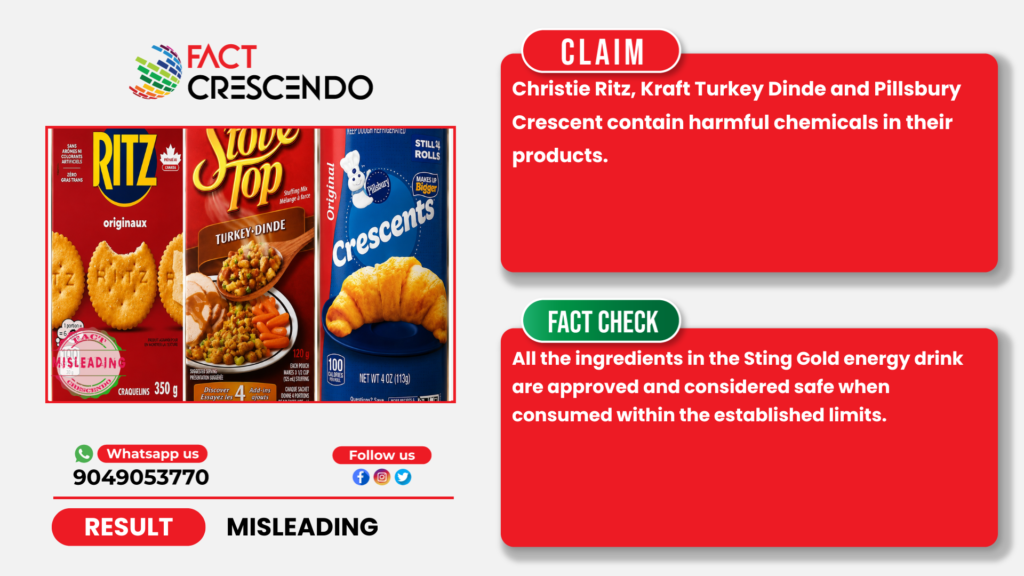
People have recently raised concerns through various social media platforms that products such as Christie Ritz, Kraft Turkey Dinde and Pillsbury Crescent contain harmful chemicals that pose serious health risks. These claims have led many consumers to question the safety of using these products.
However, Fact Crescendo found the claim to be misleading. All the ingredients mentioned in the Christie Ritz, Kraft Turkey Dinde and Pillsbury Crescent products are approved and safe to consume.
Fact Check-
Ammonium Bicarbonate: Ammonium Bicarbonate is made by reacting carbon dioxide with ammonia, forming crystals that are washed and dried. It is commonly used as a leavening agent, dough strengthener, pH control agent and a texturizer. The U.S. Food and Drug Administration (FDA) recognizes ammonium bicarbonate as Generally Recognized as Safe (GRAS) for use in food. It must meet the purity standards set by the Food Chemicals Codex. The FDA had clarified that only the amount needed for its intended purpose should be used.
According to the European Commission’s Food Additive Database, it is approved for use in various foods in the European Union. However, certain conditions were established like, manufacturers can use only the amount needed to achieve its intended functions, such as raising agent, acidity regulator, or stabilizer. No fixed limit of this additive was established. It must be used at the lowest level necessary in accordance with Good Manufacturing Practice (GMP) to ensure the food remains safe and of good quality.
BHT: Butylated hydroxytoluene (BHT), is a lab made chemical and antioxidant that is added to food as a preservative. This is also used as medicine to treat genital herpes and AIDS. It is also used in a wide range of cosmetic formulations as an antioxidant. It is a common synthetic compound that is used as a preservative in cosmetic formulations to stabilize the formulation and prevent its oxidation. It maintains the properties of a formulation like color, odour, and texture, which may change upon exposure to air.
As per FDA report, BHT (butylated hydroxytoluene) is approved for use as a food preservative to prevent oxidation and extend shelf life, provided it meets a purity level of at least 99%. It can be used alone or combined with BHA. For the safety of the consumers, its concentration has been limited to specific levels in different foods products, such as 50 ppm in dry breakfast cereals and potato flakes, 10 ppm in potato granules, and up to 200 ppm in emulsion stabilizers for shortenings. FDA has ordered strict guidelines such as labels for products containing BHT must clearly state its presence, and if mixed with a carrier, the percentage must also be disclosed to ensure safety and transparency.
BHT has been extensively studied for its metabolism and toxicology. It is recognized as an effective antioxidant. According to reports, it may have vitamin E-like effects in fatty tissues and reduce certain tumour incidences in animal studies. At low dietary levels no toxic effects are observed. However, higher doses can lead to increased liver weight and elevated microsomal enzyme activity, which is generally reversible and not considered as toxic at standard usage levels. But the possibility of BHT affecting other tissues (like the lungs or gastrointestinal lining) requires further investigation. No immediate public health hazards have been identified so far.
Maltodextrin: According to reports, Maltodextrin has a higher glycemic index than normal sugar. This results in a sharp spike in people’s blood sugar shortly after they eat foods that contain it. This can cause serious issues for people with diabetes. It was also suggested after a study that people who consume maltodextrin may have a reduced number of good bacteria and an increased quantity of harmful bacteria which can lead to intestine damage.
However, the FDA considers Maltodextrin as Generally Recognized as Safe (GRAS) substance. It had permitted the use of maltodextrin as a thickener or texturizer, stabilizer, flavoring agent or carrier, nutrient supplement or sweetener substitute. It is considered safe for use under current food-additive regulations.
Silicon Dioxide: Silicon dioxide (E 551) is a common food and drug additive majorly used as an anti-caking agent to prevent products from clumping. A recent study on mice found that regular intake of silicon dioxide can affect the immune system. It reduces the body’s ability to tolerate food and causes inflammation in the intestines. This additive can lead to celiac disease.
According to the National Institute of Health, it is poorly absorbed by the body when consumed. Most of the silicon dioxide passes through the body without causing harm. Scientific evaluations have found no clear evidence of harmful effects from eating silicon dioxide at the amounts people normally consume from food and additives. In animal studies, even very high doses did not cause toxic effects, reproductive problems, or cancer, and there was no sign of genotoxicity. However, researchers also noted that the available data have limitations and that long-term studies are missing.
The European Food Safety Authority (EFSA) reviewed the safety of silicon dioxide. After carefully studying exposure levels, scientific data, and previous safety studies, EFSA concluded that silicon dioxide does not pose a safety risk to people of any age group when used in foods at the approved levels. The review also looked specifically at infants below 16 weeks of age and found that the use of silicon dioxide in infant foods is also safe at current exposure levels.
Dextrose: Dextrose is a type of sugar that usually comes from corn or wheat. It can be quickly used as a source of energy by the human body. It is often used in foods as an artificial sweetener or a preservative. It is generally found in sauces, chips, canned foods, pickles, jams etc. As Dextrose has a high glycemic index, it can increase blood sugar quickly and lead to diabetes. Weight gain, heart disease etc.
However, the FDA considers Dextrose as safe when it is used within the set limits. The FDA had allowed the use of dextrose not only as a sweetener but also as an anticaking agent, flavor enhancer, coloring adjunct etc.
Food Safety and Standards Authority of India (FSSAI) had also approved the use of dextrose in many consumable products like dairy whitener, ice cream, kulfi, foods for infants, synthetic syrup etc.
Potassium Sorbate: Potassium sorbate is a chemical food additive which is used as a preservative in foods. It prevents the growth of molds, fungi and yeast. It can be found in many food products like cheese, chewing gums, processed meat, citrus fruits, wine and in personal care products etc.
According to a report, regulatory agencies such as the FDA, the United Nations Food and Agriculture Organization, and the European Food Safety Authority (EFSA) have determined that potassium sorbate is “generally regarded as safe,” (GRAS). When one eats potassium sorbate as a food additive, it passes through the system harmlessly as water and carbon dioxide. It does not accumulate in the body.
The European Food Safety Authority (EFSA) reviewed the safety of sorbic acid and its salts like potassium sorbate and calcium sorbate, which are commonly used as food preservatives in the EU. These additives were already approved under EU law, and an acceptable daily intake (ADI) of 25 mg per kg of body weight per day was set. Studies showed that potassium sorbate is easily absorbed by the body and mostly broken down into carbon dioxide after digestion. Animal studies did not show harmful effects even at very high doses. No evidence suggesting that potassium sorbate damages DNA was found.
Sodium Phosphate: According to the FDA, sodium phosphate is an approved food ingredient used for several important functions in food manufacturing. It is used as an anticaking agent or free-flow agent, antimicrobial agent, drying agent, emulsifier, etc. The FDA includes this ingredient in its food ingredient inventory and lists it for certain functions mentioned in the website.
According to the European Commission Food Additives Database, it is an approved food additive that can be used in a wide range of foods across the European Union. It is mainly used as an acidity regulator, emulsifier, stabilizer, raising agent, sequestrant, and water-retaining agent. It is only permitted to use at the lowest level necessary in accordance with Good Manufacturing Practice (GMP) to ensure the food remains safe and of good quality.
Conclusion:
Fact Crescendo found the claim to be misleading. All the ingredients mentioned in the Christie Ritz, Kraft Turkey Dinde and Pillsbury Crescent products are approved and safe to consume.
Title: Claims That Christie Ritz, Kraft Turkey Dinde and Pillsbury Crescent Products Contain Harmful Chemicals Are Misleading
Fact Check By: Siddharth Sahu
Result: Misleading
