

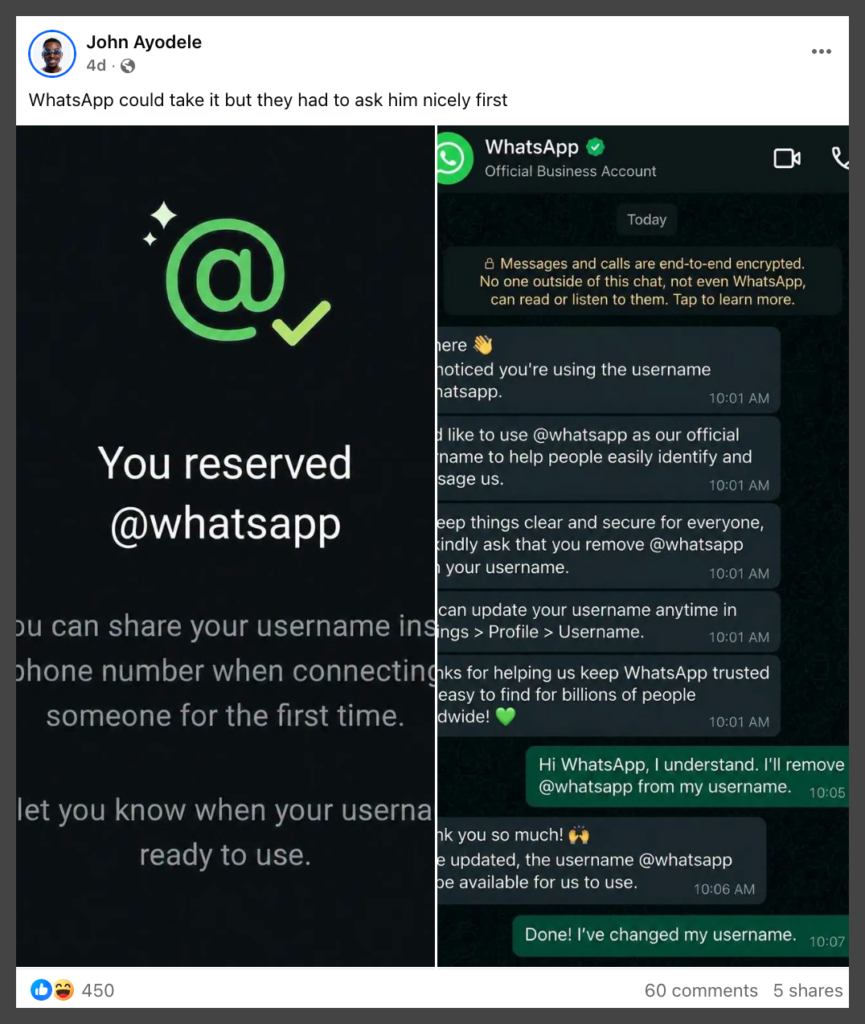
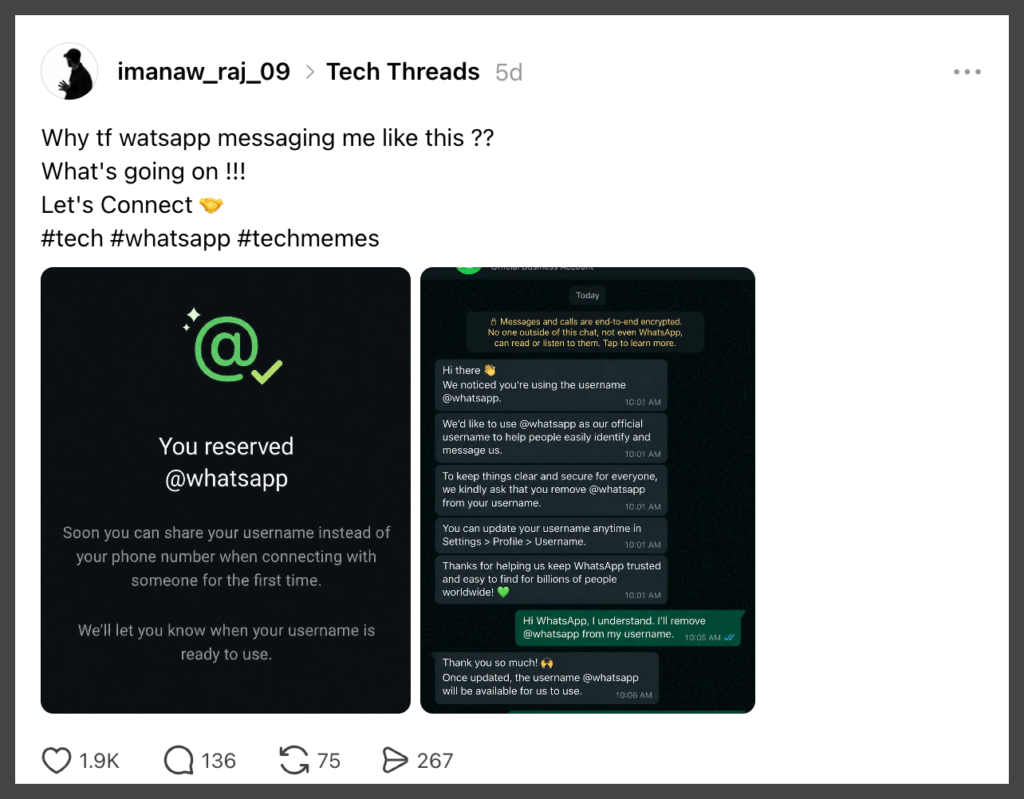
Social media posts circulating on Facebook, X, Instagram, Threads, and WhatsApp claim that someone managed to reserve the username @whatsapp before WhatsApp’s new username feature officially launches. The posts include screenshots supposedly showing WhatsApp’s official account politely asking the user to surrender the username so the company could use it itself.
However, our investigation found the screenshots do not reflect how WhatsApp’s reservation system works. WhatsApp has publicly confirmed that ordinary users cannot reserve protected usernames such as @whatsapp, and that these names are reserved exclusively for their legitimate owners. Therefore, the viral claim is false.
Social Media Posts
The viral posts typically include two screenshots.
The first appears to show a confirmation screen stating, “You reserved @whatsapp.” It also claims that users will soon be able to share usernames instead of phone numbers.
The second screenshot allegedly shows a conversation with WhatsApp’s verified business account.
Fact Check
WhatsApp usernames are real
The underlying news is genuine. In late June 2026, WhatsApp officially announced that it had begun rolling out username reservations, allowing users to reserve unique usernames before the feature becomes widely available later in the year. The feature is also being rolled out gradually, meaning not all users can reserve usernames yet.
According to WhatsApp’s official announcement, usernames are designed primarily as a privacy feature, enabling users to communicate with new contacts without immediately revealing their phone numbers.
WhatsApp explains that accounts will still require a phone number for registration. Usernames are simply an additional identity layer rather than a replacement for phone number.
TechCrunch also reported that the reservation system was introduced ahead of the full launch to avoid duplication among WhatsApp’s more than three billion users.
WhatsApp explicitly denied that ordinary users can reserve famous usernames
WhatsApp itself publicly denied that ordinary users can reserve well-known usernames, the messaging platform utilized its official Threads account to issue a public clarification. In response to the viral speculation, WhatsApp specifically addressed the rumors through its verified Threads profile, stating:
“People are making false claims about reserving popular or well-known usernames. This isn’t true. Only the legitimate account owners are able to reserve well-known public-figure names.”
WhatsApp further explained that reservations were opened early because many users would want their preferred username before the full rollout.
This statement directly refutes the viral claim that someone successfully reserved @whatsapp before the company itself.
WhatsApp’s Help Center similarly explains that certain usernames are reserved to prevent impersonation and protect businesses, organizations, celebrities, and public figures.
Reserved usernames are protected to prevent impersonation
WhatsApp’s username system differs from social media platforms where usernames are generally available on a first-come, first-served basis.
According to WhatsApp’s documentation, the platform reserves certain usernames for verified organizations, businesses, celebrities, public figures and well-known entities to reduce impersonation and prevent confusion once usernames become available globally.
According to WhatsApp, username reservations serve several purposes. First, they help prevent duplicate usernames before the feature launches globally.
Second, usernames improve user privacy because people can communicate without exposing their phone numbers to new contacts.
Third, usernames are not searchable. Users cannot browse a public directory of usernames. Instead, someone must already know the exact username to initiate contact.
According to TechCrunch, WhatsApp has also introduced additional security measures, including optional username keys, to reduce impersonation and unwanted messages.
Conclusion
The claim that a regular user successfully reserved the username @whatsapp, causing WhatsApp to ask for it back, is false. WhatsApp did introduce username reservations, but the company clarified that popular names for brands and public figures are restricted to their real owners.
Consequently, there is no evidence that an ordinary user ever reserved @whatsapp, and the screenshots claiming WhatsApp later asked for the username back are unsupported by official evidence.

Title: No, a Regular User Did Not Reserve “@WhatsApp” and Force WhatsApp to Ask for It Back
Written By: Pranpreeya P
Result: False
