

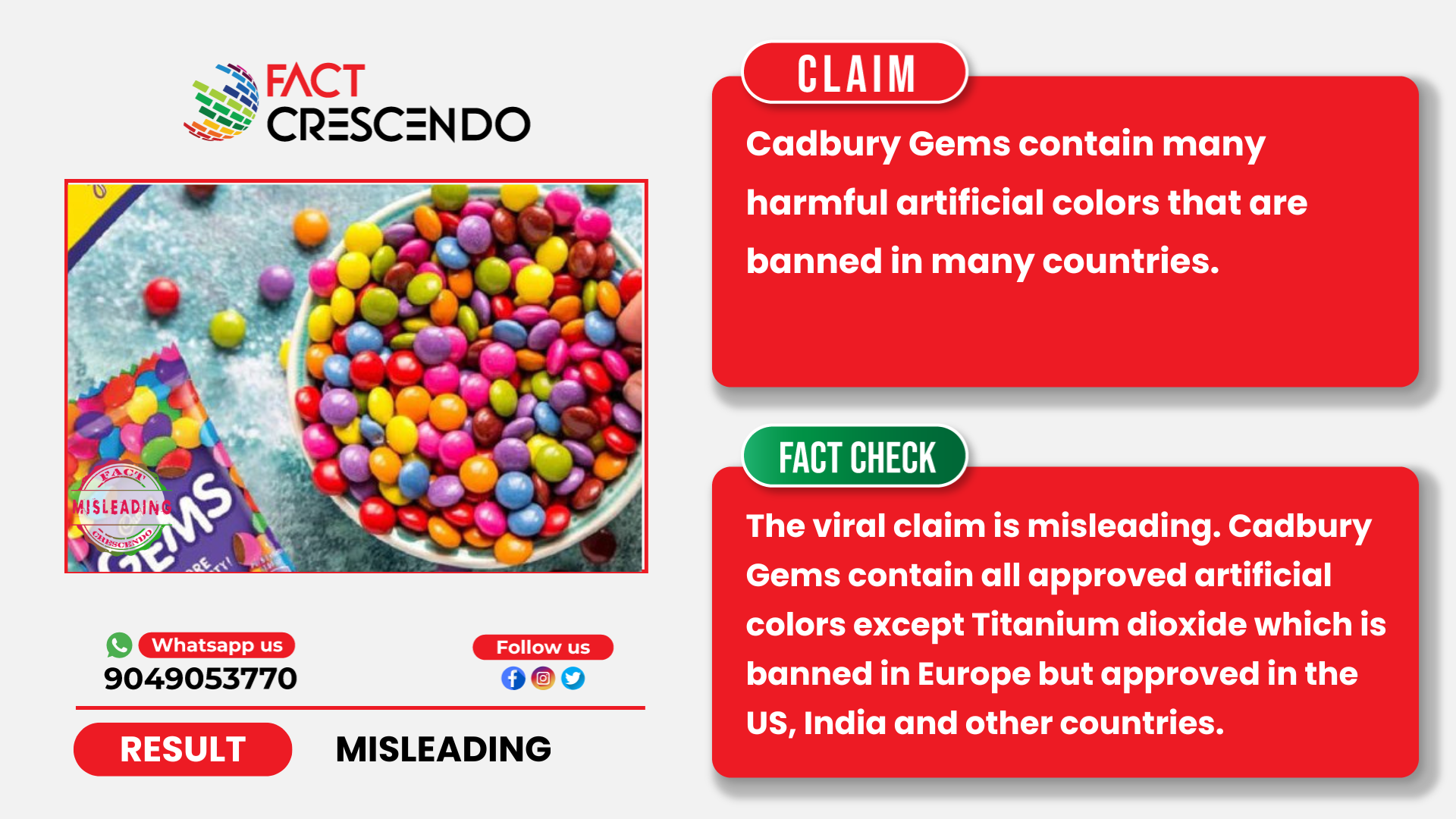
Social media users are accusing Cadbury Gems of containing harmful artificial colours which are a risk to health. The claim suggests that Gems contain Titanium Dioxide which is banned in many countries. Apart from this, there are several other colors like yellow 5, blue 2 etc which are equally harmful.
However, Fact Crescendo found the claim to be misleading. Cadbury Gems contain all approved artificial colors except Titanium dioxide which is banned in Europe but approved in US, India and other countries.
Fact Check-
Let’s check the safety of each artificial color used in Cadbury Gems mentioned in the viral video.
Titanium Dioxide: The European Food Safety Authority (EFSA) reviewed scientific evidence and found that titanium dioxide (TiO₂) particles may cause genotoxicity (damage to DNA). Due to this concern, EFSA no longer considers titanium dioxide (E171) safe as a food additive and cannot establish a safe daily intake. However, this evaluation applies only to its use in food and not to other applications.
According to the National Institute of Health, titanium dioxide (E171) is widely used in the food industry as an additive to enhance whiteness and texture. It is also found in oral medicines and is considered safe and non-toxic in small amounts. However, despite its common use in food and medicine, there is limited information on how tiny TiO₂ particles affect the body or where they go after ingestion.
On 24 November 2023, World Health Organization (WHO) and the Food and Agriculture Organization (FAO) Joint Expert Committee on Food Additives (JECFA) released an assessment of the health impacts of titanium dioxide. According to the report, TiO₂ is poorly absorbed in the gastrointestinal tract. JECFA found no evidence of carcinogenic, reproductive, or developmental toxicity effects from long-term exposure to TiO₂.
In India, FSSAI had also approved the use of Titanium Dioxide in specific categories of food and under controlled conditions. It must meet food-grade quality standards.
Tartrazine: Tartrazine is also known as E102 or Yellow 5. According to a study conducted in 2015, researchers found that food with Yellow 5 as an ingredient damages the DNA of white blood cells. It was also found that since gastrointestinal tracts are exposed directly to yellow 5, these cells may be more likely to develop cancer.
FDA and top researchers have reviewed the evidence and concluded that Tartrazine doesn’t pose an immediate threat to human health. However, research does suggest that this dye may harm cells over time, especially when cells are exposed to greater amounts than the recommended intake.
The EFSA reviewed the safety of Tartrazine, a yellow food dye used in many products. Older studies showed that only a tiny amount of Tartrazine is absorbed by the body, while most of it is broken down by gut bacteria and leaves the body in urine. An acceptable daily intake (ADI) of 7.5 mg per kg of body weight was set many years ago, but the studies used were not detailed enough or focused on mixtures of dyes instead of just Tartrazine. Because of this, EFSA advised for more research to fully understand if Tartrazine is safe and if the ADI needs to be updated.
FDA has also approved the use of Yellow 5 in confections, cereals, snack foods, condiments, baked goods, and yogurt.
E 110- This is also known as Sunset Yellow or Yellow 6. It is an orange-yellow dye that is used in candy, sauces, baked goods and preserved fruits. The European Food Safety Authority (EFSA) has set a new Acceptable Daily Intake (ADI) of 4 mg per kg of body weight per day for the food colouring Sunset Yellow. Previously, in 2009, EFSA had set a temporary ADI of 1 mg/kg due to limited data and recommended further studies. With new scientific data now available, EFSA has increased the ADI, confirming Sunset Yellow’s safety at the new updated level.
E 124- This additive is also known as Ponceau 4R or Cochineal Red A or E124.
The European Food Safety Authority (EFSA) reviewed the safety of Ponceau 4R, a red food dye used in the EU, to see if people, especially kids might be consuming too much of it. A previous review in 2013 had reduced the amount that could be used. In a recent review, EFSA used updated data to see how much people are actually consuming. The results showed that even in the highest exposure cases, people, including toddlers and children were still eating less than the daily safe limit of 0.7mg per kg of body weight per day. So, the dye is considered safe at the levels currently used in food.
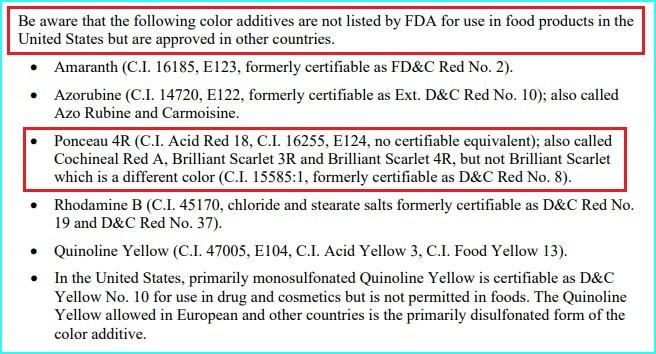
FDA had warned that Ponceau 4R or INS 124 color additive along with a few others had not been listed by the organization for use in food products in the United States. But these color additives are approved in other countries.
Indigo Carmine: Indigo Carmine, also known as Blue 2 is an artificial food colour approved by the U.S. Food and Drug Administration for use in foods, drugs, and cosmetics. It is considered safe when used within the prescribed limits and conditions set by the regulatory bodies. It is a certified colour additive which undergoes strict testing and approval by the FDA to ensure it meets required purity and safety standards before it can be used.
According to the National Institute of Health, most of the Indigo Carmine passes through the body and is excreted without being absorbed. Generally it does not cause genetic damage, long-term toxicity or fertility issues. However, some research during animal trials has shown that at very high doses it may increase the risk of tumors in the brain. But these are at much higher doses than what is commonly consumed by humans.
Conclusion:
Fact Crescendo found the claim to be misleading. Although there are studies that showed harmful effects of the artificial colors, the ones mentioned in the viral video are considered safe when used within established limits.
Title: Cadbury Gems are safe to consume. All the artificial colors in it are approved.
Fact Check By: Siddharth Sahu
Result: Misleading
