

A claim circulating widely suggests that drinking “Diet Coke” or diet soda during pregnancy or breastfeeding can cause autism in children. However, a close review of the original study shows that this interpretation is misleading.
Social Media Posts
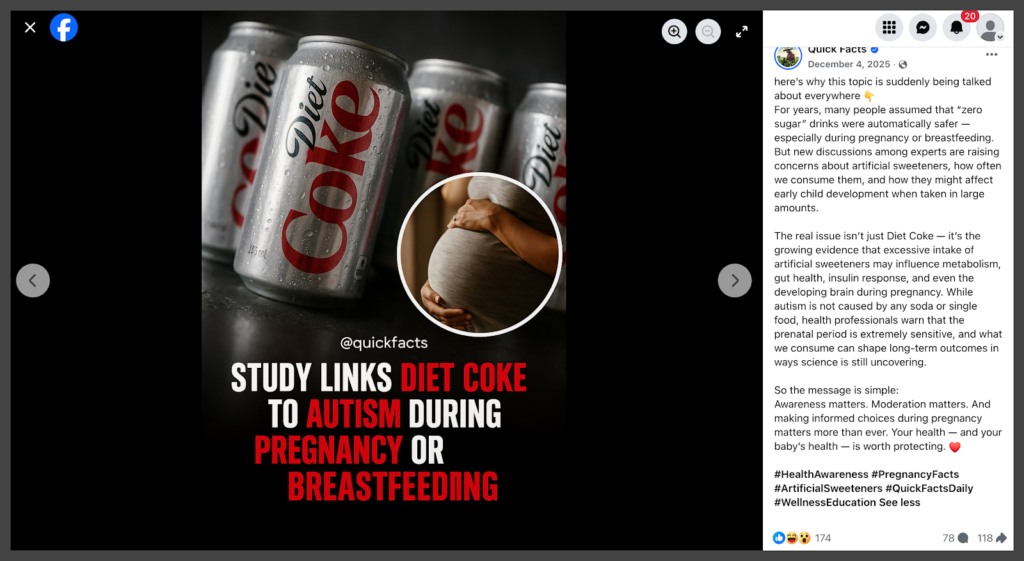
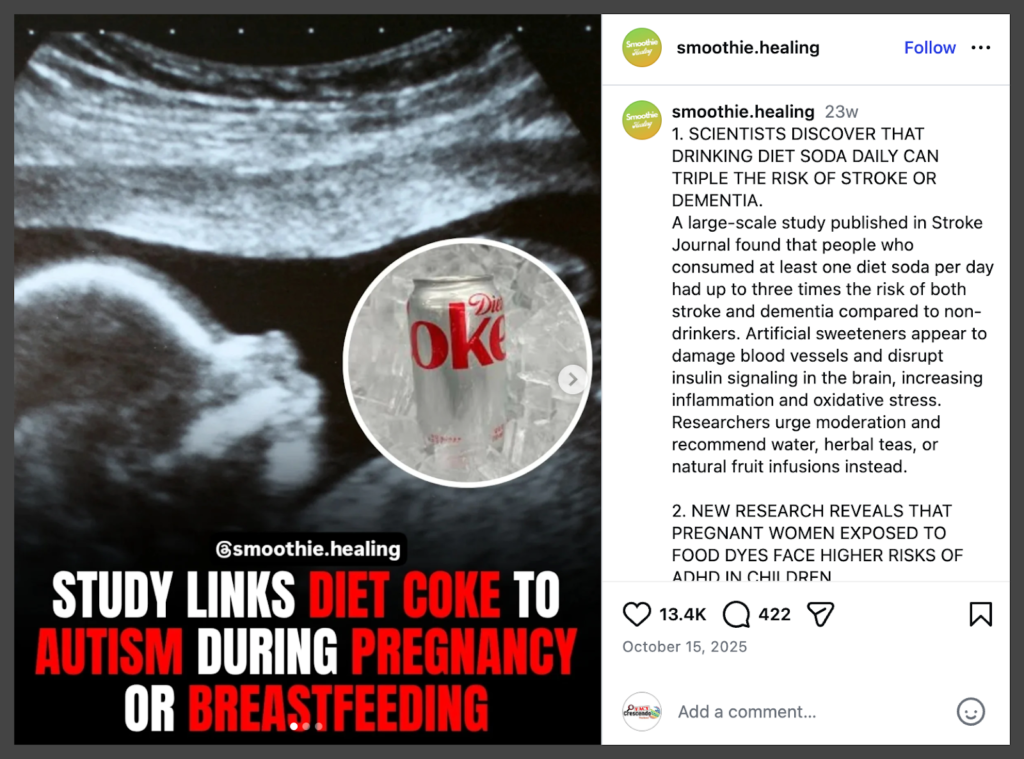
Posts sharing this claim often state that “Study links “Diet Coke” to autism during pregnancy or breastfeeding.” The statement was shared widely on Facebook and Instagram.
Fact Check
What the Study Actually Found
The claim traces back to a 2023 case-control study in the Nutrients Journal titled Daily Early-Life Exposures to Diet Soda and Aspartame Are Associated with Autism in Males. Researchers compared mothers’ recalled diet during pregnancy and early infancy for 235 children with autism and 121 children without autism.
The study reported that, in boys only, mothers who consumed at least one diet soda a day (or about 177 mg/day of aspartame) during pregnancy or breastfeeding had higher odds of an autism diagnosis in their child. The reported odds ratios were about 3.1 for diet soda and 3.4 for aspartame intake.
Important details are often left out in viral posts. The study did not find the same association in girls, and results were not consistently significant across all autism-related measures. Lower intake levels were not statistically significant. The authors also stressed that this kind of study cannot prove cause and effect, and said the findings are meant to “raise new questions,” not provide a final answer (Source).
Study Design and Key Limitations
This case-control study is difficult to interpret because it relies on mothers recalling diet from 20 to 30 years earlier, which may introduce recall bias.
The sample was relatively small and not necessarily representative, with participants recruited from registries and volunteer groups, which may increase the risk of selection bias. Moreover, the analysis did not adjust for some established autism risk factors, such as maternal obesity and diabetes, which could affect the observed association. The study also conducted multiple subgroup analyses (e.g., by sex and autism subtype), increasing the likelihood that some statistically significant findings may have occurred by chance.
Expert Criticism and Scientific Debate
Independent researchers have formally challenged the study’s conclusions. A 2024 commentary in the Nutrients Journal said the findings are “unreliable,” pointing to methodological problems and a lack of a clear biological mechanism.
The commentary also noted that aspartame is broken down during digestion into common substances, including amino acids and small amounts of methanol, before they enter the bloodstream. At typical intake levels, these breakdown products are similar to, or lower than, what people get from many everyday foods, which makes a direct effect on brain development less plausible.
Finally, the authors argued that the original study did not adequately account for key confounding factors and was at high risk of bias. They suggested the reported association could reflect underlying maternal health conditions that influence both autism risk and diet choices, rather than aspartame exposure itself.
Clarifying the “Diet Coke” Claim
The mentioned study did not test any single brand, including “Diet Coke.” Instead, it looked at diet soda in general and total aspartame intake, regardless of which products participants drank. The researchers defined exposure as overall diet-beverage intake (for example, ≥1 serving per day) or an estimated daily aspartame amount (≥177 mg/day), not a specific soda brand.
Because of that, the study does not show that “Diet Coke causes autism,” and it does not provide a Diet Coke-specific risk estimate. Any statistical association they reported applies to grouped categories (all aspartame-sweetened diet drinks combined), not to one product.
Brand names such as Diet Coke appeared only as examples on the questionnaire to help participants remember what they drank during pregnancy or breastfeeding. When the data were analyzed, those responses were rolled up into broader categories, and the study did not compare brands.
So, presenting the study as evidence about one branded drink is inaccurate. The research is about broader diet patterns and artificial sweetener exposure, not the effects of a single soft drink.
Scientific Consensus on Aspartame Safety
Major health authorities, including the World Health Organization (WHO) and the U.S. Food and Drug Administration (FDA), continue to consider aspartame safe when consumed within established limits. In 2023, WHO and the Joint FAO/WHO Expert Committee on Food Additives reaffirmed the acceptable daily intake at 0-40 mg per kilogram of body weight.
This means that a typical adult would need to consume multiple cans of diet soda daily to approach the upper limit. Importantly, no major public health organization has identified aspartame or diet soda as a cause of autism. Current guidance does not recommend complete avoidance during pregnancy but generally advises moderation as part of a balanced diet. To date, no major health authority has concluded that aspartame or diet soda consumption is linked to autism risk. (Source)
Conclusion
Claims that Diet Coke or other diet sodas during pregnancy “cause autism” are misleading and overstate the evidence. A small, retrospective 2023 study reported an association under limited conditions, but it cannot establish causation and has important limitations, including recall bias and limited control of confounding factors.
Overall, the available evidence does not support concluding that diet soda causes autism. General guidance during pregnancy is to prioritize water and other unsweetened drinks, and to consume artificially sweetened beverages in moderation. Presenting diet soda as a proven cause of autism is misleading.
Title: Claim That Diet Coke During Pregnancy Causes Autism Is Misleading
Fact Check By: Cielito Wang
Result: Misleading
