

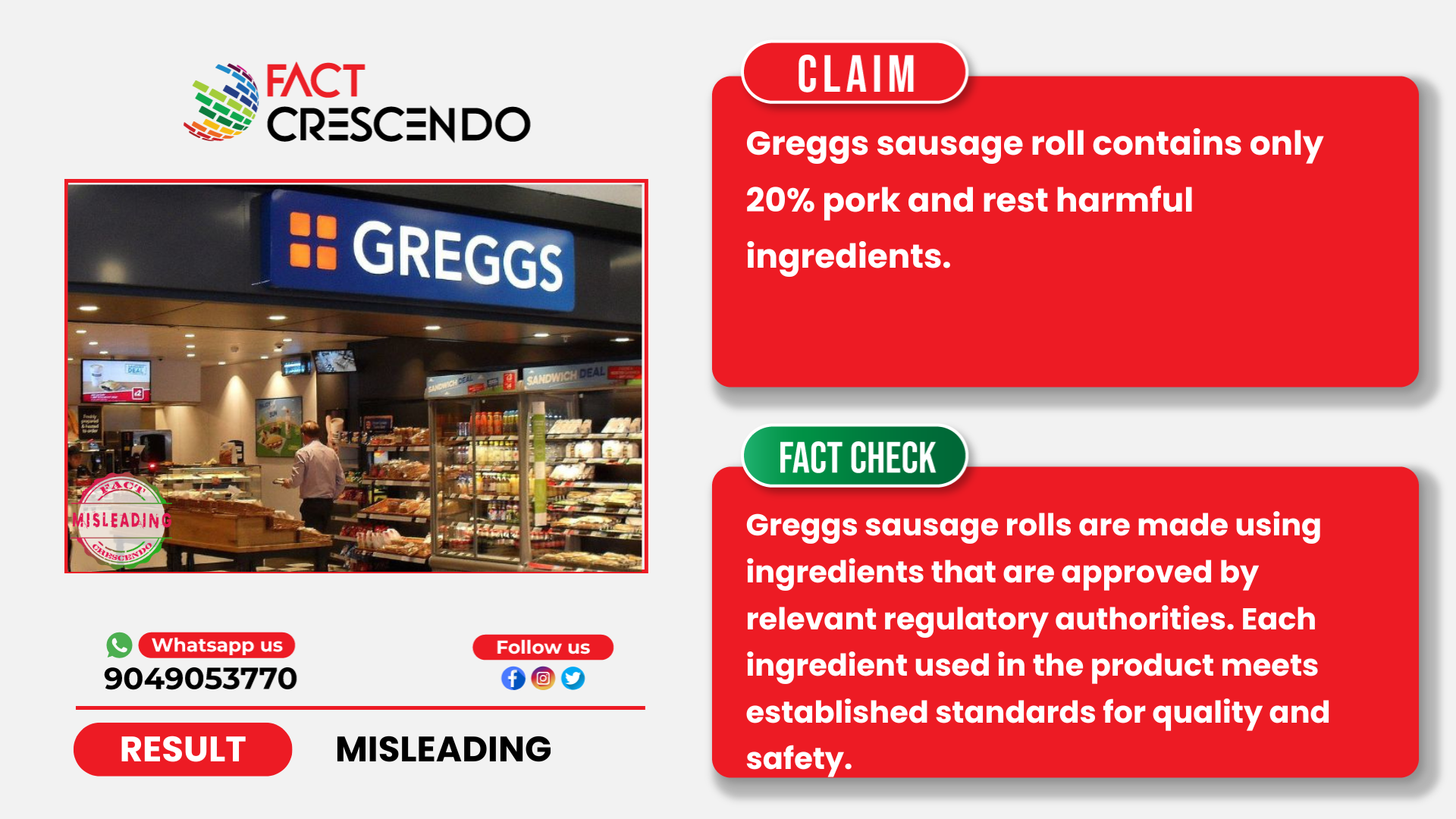
Recently, social media users were found questioning the safety of Greggs sausage rolls. Claims suggest that the sausage rolls of the brand contain very little meat and a lot of chemical additives which are found to be harmful when consumed by humans.
However, Fact Crescendo found the claim to be misleading. All the ingredients in Greggs sausage roll are approved and safe.
Fact Check-
Let’s check the safety of each of the ingredients mentioned in the post.
Sunflower Oil: According to the EFSA, sunflower oil is generally safe for people, animals, and the environment when used properly. It is also used as a fungicide on vegetables. It is not toxic, does not cause health problems, and breaks down naturally without leaving harmful residues. EFSA even agreed that there are no major risks to consumers, workers, or the environment when exposed to it. However, some areas need more data for further study, but overall the oil is considered safe and suitable for use for agricultural purposes as well.
The Food and Drug Administration (FDA) includes sunflower seed oil and its triglycerides or fatty acids on its list of indirect food additives. These ingredients can be used in special coatings that might touch food by accident. The CIR Panel studied sunflower seed oil, hydrogenated sunflower seed oil, and sunflower seed acid and found these to be safe when used in cosmetics and personal care products as well.
Carboxymethyl Cellulose: Carboxymethylcellulose (CMC) is a water-soluble gum derived from cellulose through esterification and etherification processes. It serves as a thickener, emulsifier, stabilizer, and water absorber, making it valuable in various industries, including food production. According to Code of Federal Regulations, this is generally recognized as safe (GRAS) when used in accordance with good manufacturing practice.
In 2018, the EFSA Panel on Food Additives reviewed the safety of sodium carboxymethyl cellulose (E466) as a food additive. Later, another EFSA panel (FAF) was asked to check if the additive is safe for infants under 16 weeks old in special medical foods. It was stated that E466 is not used for infants under 16 weeks, so no safety assessment was done for this group. Additionally, companies did not provide enough biological and toxicology data to assess its safety for young children in special medical foods. Since little new information was available, EFSA confirmed its earlier conclusion that there is not enough data to determine the safety of E466 for infants and young children.
Carrageenan: According to a study, the FDA in 2012 rejected a request to ban carrageenan in food but didn’t fully review all scientific research. The report on the study further tried to encourage consumers to resist using products with carrageenan which will eventually put pressure on the brands to stop using the ingredient in their products.
But further research on this led us to the National Library of Medicine’s report on the use of carrageenan as a food additive. According to the report, food-grade carrageenan does not get absorbed by the body. It remains stable in the digestive system. Studies show that carrageenan does not cause cancer or promote tumors, and its effects on the immune system are not relevant to its oral consumption. Toxicological studies on carrageenan at very high doses (much higher than human exposure) show no harmful effects. International food safety organizations, like JECFA, have reviewed carrageenan and consider it safe for consumption.
EFSA evaluated the food additive carrageenan (E407) and processed Eucheuma seaweed (E 407a). Studies show that carrageenan is not absorbed by the body, is not toxic even in large amounts, and does not cause cancer or genetic damage. Processed Eucheuma seaweed is also considered safe. However, there are still some uncertainties about its chemistry, how much people are exposed to, and some biological effects. Because of these unknowns, the current safe intake limit of 75 mg per kg of body weight per day has been set. More research is being done to better understand carrageenan’s effects.
Sodium Metabisulphite: According to the U.S. Food and Drug Administration (FDA) regulations, sodium metabisulphite is considered safe to use in food when it is used with good manufacturing practices. It is classified as “Generally Recognized as Safe” (GRAS) in the Code of Federal Regulations.
However, there are clear restrictions on where it can be used. It is not permitted in fresh fruits or vegetables intended to be eaten raw, in meats, or in foods that are a significant source of vitamin B1 (thiamine) because it can affect nutrient content or may lead to some reactions.
The European Food Safety Authority (EFSA) reviewed the safety of Sulphur dioxide and sulphites including Sodium Metabisulphite in 2022. Due to a lack of evidence of its toxicity, the panel removed the Acceptable Daily Intake (ADI) value. The Panel determined that the Margin of Exposure (MOE) for dietary exposure to these additives should be at least 80.
When EFSA studied different ways these additives might be used in food, they found that toddlers could have the highest exposure, especially if the additives were used at the maximum allowed levels. But from real data, they found that the estimated intake was much lower. Adults mainly get exposure from wine, beer, and meat products, children from fruit juices and flavoured drinks.
Mono- and Diglyceride of Fatty Acids: EFSA reviewed the safety of mono- and di-glycerides of fatty acids (E471), a common food additive used as an emulsifier. The panel found that in the body, E471 is broken down into glycerol and fatty acids, which are normal substances already evaluated as safe. Studies conducted for short-term and long-term effects showed no harmful effects, including no evidence of cancer risk, genetic damage, or problems with reproduction or development. Based on all the evidence, EFSA concluded that E471 is safe at current usage levels and does not need a specific daily intake limit.
Conclusion: Fact Crescendo found the claim to be misleading. Greggs sausage rolls are made using ingredients that are approved by relevant regulatory authorities. Each ingredient used in the product meets established standards for quality and safety
Title: Are Greggs sausage rolls safe for consumption? Check the facts.
Fact Check By: Siddharth Sahu
Result: Misleading
