

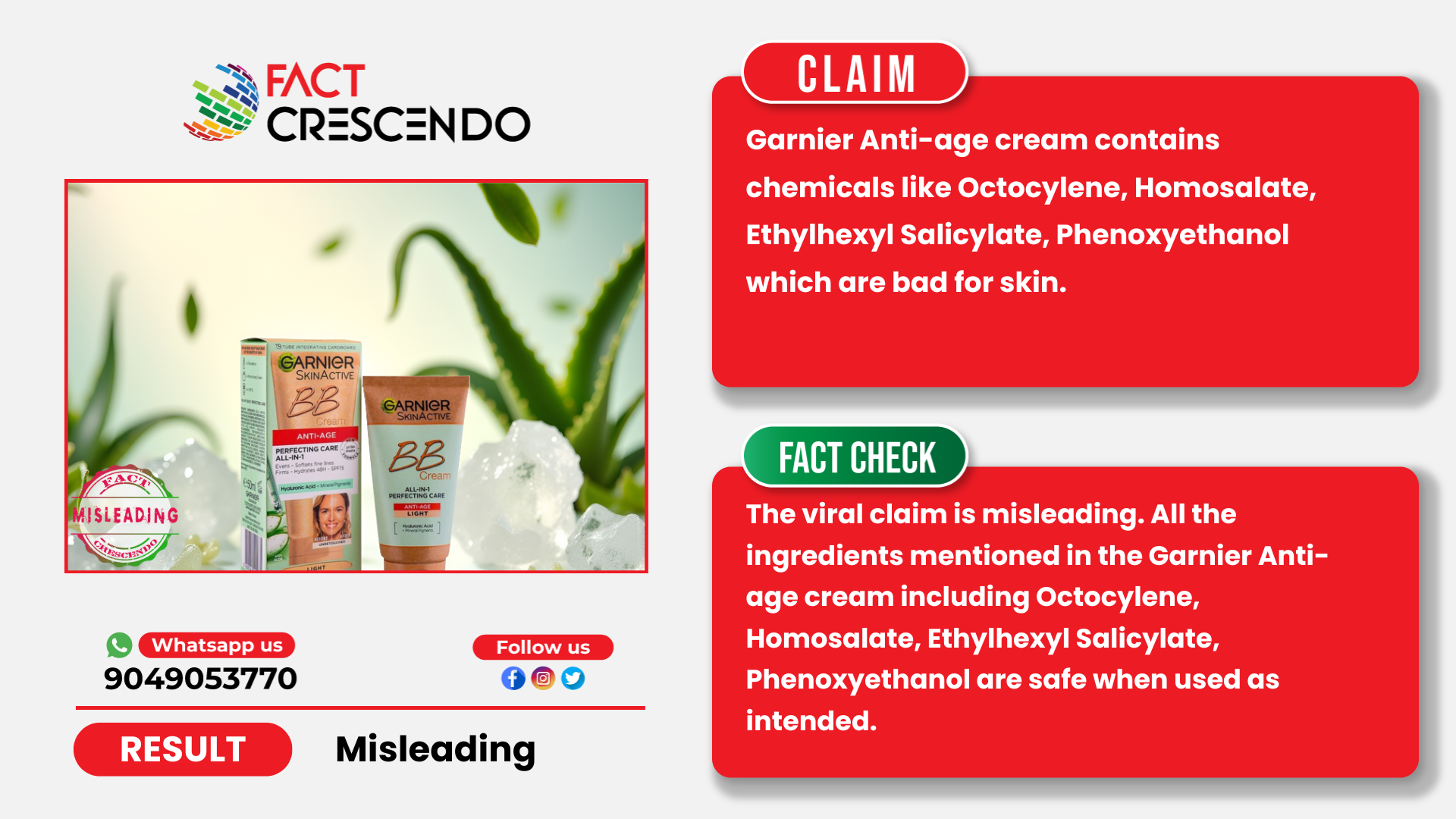
A viral claim on social media suggests that Garnier Anti-Age cream contains harmful chemicals such as Octocrylene, Homosalate, Ethylhexyl Salicylate and Phenoxyethanol. This has raised concerns among some consumers about the product’s safety.
However, Fact Crescendo found the claim to be misleading. All the ingredients mentioned in the Garnier Anti-age cream including Octocylene, Homosalate, Ethylhexyl Salicylate, Phenoxyethanol are safe when used as intended.
Fact Check-
Let’s check the safety of each of the ingredients mentioned in the post.
Octocrylene: According to the National Institute of Health, Octocrylene is a common sunscreen ingredient and is generally considered safe when used on skin. It is widely used and approved by the FDA and EU. However, there have been rare reports of allergic skin reactions, particularly in children. Studies are going on for clarity on its potential to disrupt Vitamin D production.
Medical News Today reported that Octocrylene helps in protecting the skin from UVA and UVB rays and keeps the sunscreen stable and water resistant. The FDA and The European Scientific Committee on Consumer Safety (SCCS)considered Octocrylene safe at concentrations up to 10%. However, some people, especially adults previously allergic to certain medications have experienced allergic skin reactions like photo-contact dermatitis . There’s limited evidence from animal studies suggesting it could disrupt hormones, but no strong proof in humans. Researchers have also found that octocrylene can break down into benzophenone which may lead to health concerns but it requires further research.
Homosalate: Homosalate is an organic compound, a type of salicylate, used as a chemical UV filter in sunscreens and other personal care products to absorb and convert harmful UVB rays into heat.
According to the FDA, homosalate had been categorized as Not GRASE (Generally Recognized as Safe and Effective). This categorization was done not because homosalate is harmful, but because there’s not enough safety data available to confirm their safety and effectiveness for use in over-the-counter products.
This means, Homosalate is approved for use in over-the-counter products but not considered GRASE and the status of its use may change in future after further studies.
According to another source, the FDA had currently allowed homosalate in sunscreens at concentration up to 15%. Meanwhile, the European Union had restricted the concentration of homosalate to 10%.
Ethylhexyl Salicylate: Ethylhexyl salicylate, also known as octisalate, is an organic compound used in cosmetics, primarily in sunscreens, as a UV-B filter to protect the skin from sunburn and premature aging.
The Expert Panel for Cosmetic Ingredient Safety (Expert Panel) has reviewed ethylhexyl salicylate on several occasions. In 2003, the Expert Panel evaluated available scientific data and concluded that salicylic acid and 16 other salicylates, including ethylhexyl salicylate, are safe when formulated to avoid skin irritation and increase the skin’s sun sensitivity.
In 2019 also, the Expert Panel concluded that salicylic acid and other salicylates, including ethylhexyl salicylate, are safe as used when formulated to be non-irritating and non-sensitizing.
The U.S. Food and Drug Administration (FDA) has checked the safety of Ethylhexyl salicylate and approved it as an active ingredient in sunscreens. In February 2019, the FDA asked for more data on some sunscreen ingredients having Ethylhexyl salicylate. These ingredients are approved worldwide and have been used in U.S. products for many years. The FDA confirmed in September 2021 that sunscreens with these ingredients are safe and will stay on the market.
Phenoxyethanol: Phenoxyethanol is a synthetic chemical substance widely used as a preservative in the preparation of skin, cosmetic, and personal care products. It is mainly responsible for the prevention of bacteriological and fungal contamination. Studies, including tests on humans, found that it does not cause serious harm, not an allergen, and not toxic to the body in the amounts generally used. The Cosmetic Ingredient Review Expert Panel reviewed it in 1990 and again in 2007 and confirmed it is safe to use in cosmetics at levels usually under 1%. The FDA also reviewed it and approved it for limited use in food packaging. The same ingredient has also been approved as a preservative by the European Union to be used in cosmetics.
Conclusion:
Fact Crescendo found the viral claim to be misleading. All the ingredients mentioned in the Garnier Anti-age cream including Octocylene, Homosalate, Ethylhexyl Salicylate, Phenoxyethanol are safe when used as intended.
Title: Claims About Harmful Chemicals in Garnier Anti-Age Cream Are Misleading
Fact Check By: Siddharth Sahu
Result: Misleading
