

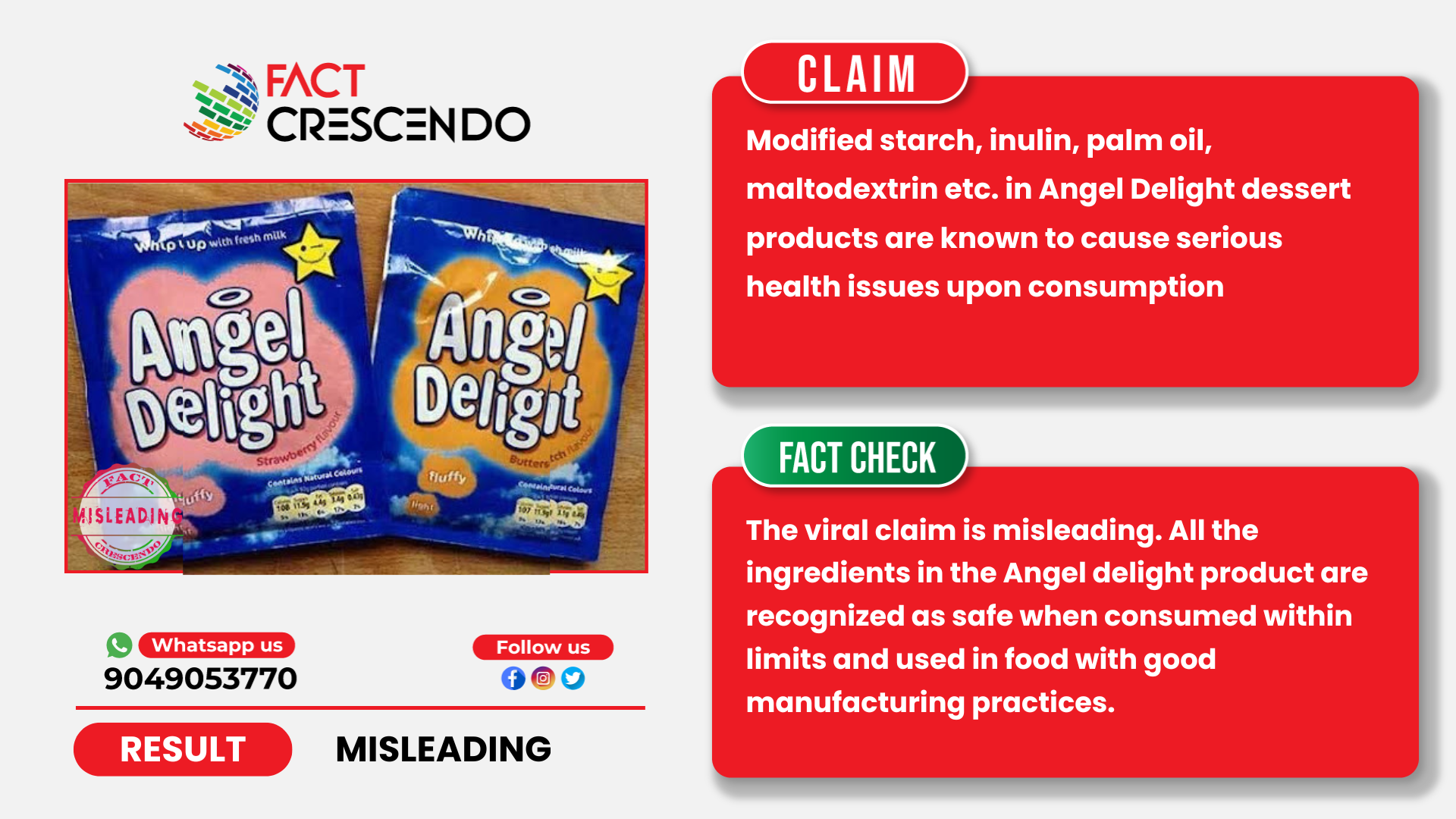
Several posts on social media are claiming that the famous Angel Delight dessert products contain harmful ingredients like modified starch, inulin, palm oil, maltodextrin etc. which are known to cause serious health issues when consumed. The claim suggests that these ingredients make Angel Delight as one of the worst foods in the super market.
However, Fact Crescendo found the claim to be misleading. All the ingredients mentioned in the viral video are recognized as safe when consumed within the established amount. These ingredients are approved to be used in foods when prepared with good manufacturing practices.
Fact Check-
Lets check the facts about the safety of each ingredient mentioned in the viral video.
Modified Starch: The European Food Safety Authority found no safety concerns when modified starch is used as a food additive within the permitted level. The panel reviewed the effect of modified starches in animals and human bodies. They found that this additive is broken down by enzymes and gut bacteria and is not absorbed in its original form. No harmful effects related to cancer, toxicity, or genetic damage were seen in the available data. EFSA concluded there is no need to set a specific acceptable daily intake (ADI) value and its use as a food additive does not pose a risk.
Inulin: Inulin is a type of prebiotic, a substance that’s used by the microorganisms in your digestive tract and positively influences health. Inulin is extracted from chicory root fiber, a natural dietary fiber that is extracted using hot water from the dandelion family plant.
According to a report, inulin is a type of prebiotic fiber that is not digested by the human body. It is fermented by gut microbes which benefits digestion, immunity and metabolism. This additive is considered as a safe prebiotic fibre which acts as a feed for good gut bacteria.
The National Institute of Health states that the human body can tolerate 20 grams per day of Inulin. Studies have found that this additive does not cause toxicity, cancer, or organ damage. It is considered safe when eaten in foods or short-term supplements. However, some mild side effects like gas, bloating, and diarrhea can be seen if high doses of inulin will be consumed.
Palm Oil: The U.S. Food and Drug Administration had found that during high temperature refining of palm oils two contaminants 3-MCPD esters and glycidyl esters can form. These substances are considered harmful to the kidney and have potential link cancer. The FDA is actively researching these contaminants to better understand their occurrence in foods and to develop methods for reducing their levels during oil processing.
Palm oil is approved for use in food. The FDA recommended the manufacturers to minimize the presence of these contaminants to ensure safety of the consumers.
Several studies were conducted to check the safety of palm oils, palm olein etc after large scale frying. It was found that when these oils are used in factories for making potato chips or french fries, they stay in good condition even after many hours of continuous use. These oils were found to show low damage, low acidity and stable quality. In fast-food cooking, these oils remain safe and usable even after several days if it was used under acceptable smoke point value.
Maltodextrin: Maltodextrin is a type of carbohydrate which is made from starches of corn, rice or potatoes. The FDA considers it safe to use in foods. It is not very sweet because it has a low dextrose equivalent, less than 20. It is considered safe to use till it meets the purity standards and follows proper manufacturing practices.
Sodium Phosphate: Both the US and European Union have allowed the use of sodium phosphate in foods. In the US, the FDA considers it safe when used appropriately. In the European Union, it is commonly used as an acidity regulator, stabilizer, texture improver, and shelf-life enhancer. A variety of food categories, including bread and bakery goods, processed cheese, sugars and syrups, baby food, and beverages, are permitted to use phosphate additives, including sodium phosphate.
Sodium phosphates (mono-, di-, and tri-sodium phosphate) are food additives mainly used to control acidity (pH) and act as stabilizers in processed foods. They help fruits and vegetables keep their color and texture, stop foods from clumping, and improve moisture retention. These additives are also used in baked goods, cereals, beverages, and dairy products. The FDA recognizes them as Generally Recognized As Safe (GRAS). However, a few studies have shown that eating too much phosphate may be harmful for the kidney, bones, and heart.
Carrageenan: As per National Institute of Health’s report, food-grade carrageenan has a large molecular weight and is not absorbed by the body. It remains stable in the digestive system. Studies show that carrageenan does not cause cancer or promote tumors, and its effects on the immune system are not relevant to its oral consumption. Toxicological studies on carrageenan at very high doses (much higher than human exposure) show no harmful effects. International food safety organizations, like JECFA, have reviewed carrageenan and consider it safe for consumption with no specified daily intake limit.
EFSA evaluated the food additive carrageenan (E407) and processed Eucheuma seaweed (E 407a). Studies show that carrageenan is not absorbed by the body, is not toxic even at high doses, and does not cause cancer or genetic damage. Processed Eucheuma seaweed is considered equally safe. However, there are uncertainties about its chemistry, exposure levels, and some biological data. Because of these gaps, the current acceptable daily intake (ADI) of 75 mg/kg body weight per day is set for a temporary period. The organization is continuing its research on carrageenan.
Mono-and Diglycerides of Fatty Acids: EFSA reviewed the safety of mono- and di-glycerides of fatty acids (E471), a common food additive used as an emulsifier. The panel found that in the body, E471 is broken down into glycerol and fatty acids, which are normal substances already evaluated as safe. Studies conducted for short-term and long-term effects showed no harmful effects, including no evidence of cancer risk, genetic damage, or problems with reproduction or development. Based on all the evidence, EFSA concluded that E471 is safe at current usage levels and does not need a specific daily intake limit.
Dextrose: Dextrose is a type of sugar that usually comes from corn or wheat. It can be quickly used as a source of energy by the human body. It is often used in foods as an artificial sweetener or a preservative. It is generally found in sauces, chips, canned foods, pickles, jams etc. As Dextrose has a high glycemic index, it can increase blood sugar quickly and lead to diabetes. Weight gain, heart disease etc.
However, the FDA considers Dextrose as safe when it is used within the set limits. The FDA had allowed the use of dextrose not only as a sweetener but also as an anticaking agent, flavor enhancer, coloring adjunct etc.
Food Safety and Standards Authority of India (FSSAI) had also approved the use of dextrose in many consumable products like dairy whitener, ice cream, kulfi, foods for infants, synthetic syrup etc.
Calcium Carbonate: According to the FDA, Calcium Carbonate is safe when used in foods according to regulations. It is used in foods to prevent clumping of powdered products, improve texture, control acidity, baking etc. The FDA lists specific rules for how and where calcium carbonate can be used, ensuring it is safe when added to food within approved limits.
In supplements, a maximum dose of 8 to 10 g per day of calcium carbonate can be administered for short-term use as suggested by the FDA. But, long-term use of over 2 grams can lead to adverse effects such as hypercalcemia, renal calculi, hypophosphatemia, and nephrotoxicity, especially in individuals with chronic kidney disease
Conclusion:
Fact Crescendo found the claim to be misleading. All the ingredients in the Angel delight product are recognized as safe when consumed within limits and used in food with good manufacturing practices.
Title:Angel Delight dessert products are safe to consume. The viral claim is misleading.
Fact Check By: Siddharth SahuResult: Misleading
